
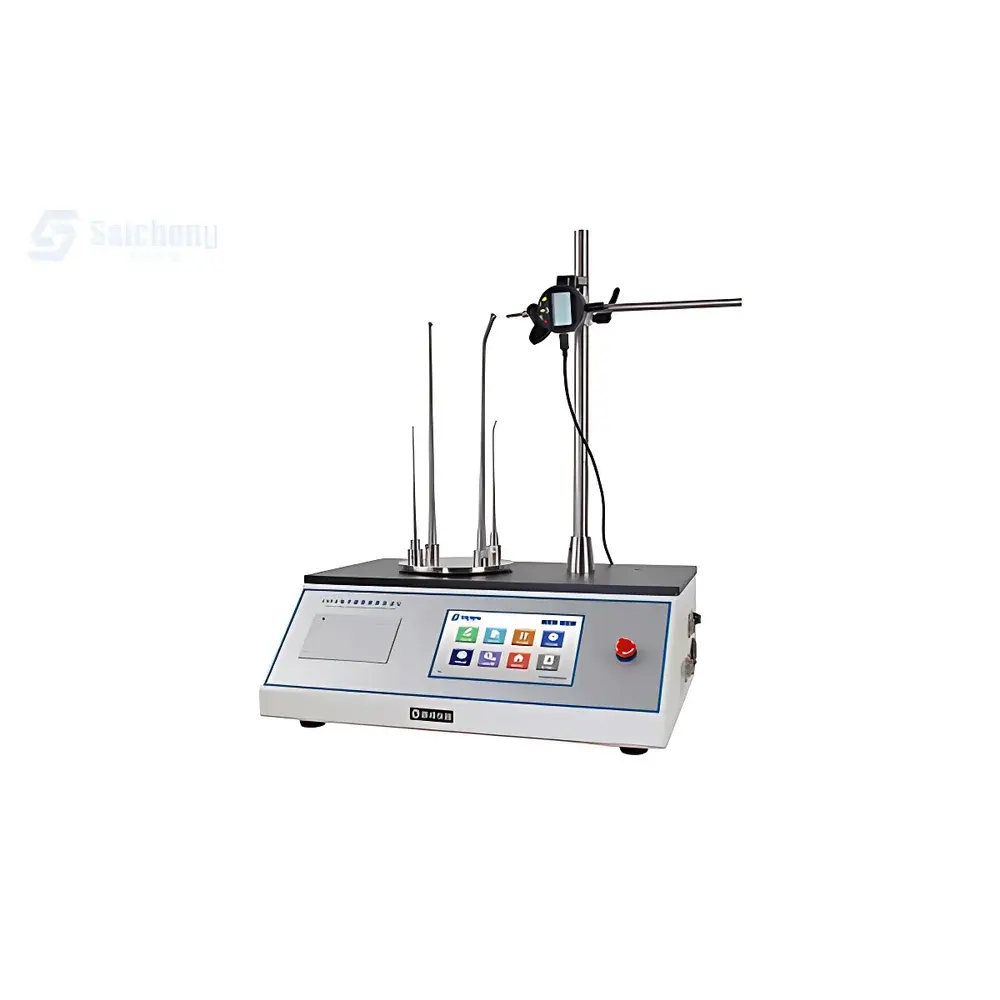
SEARCHING CHY-G Electronic Wall Thickness Gauge
| Brand | SEARCHING |
|---|---|
| Origin | Shandong, China |
| Model | CHY-G |
| Measurement Range | 0–12.7 mm |
| Resolution | 0.001 mm |
| Sample Diameter | 5–300 mm (customizable) |
| Sample Height | 5–330 mm (customizable) |
| Power Supply | AC 220 V, 50 Hz |
| Dimensions | 400 × 360 × 700 mm (L×W×H) |
| Display | 7-inch color touchscreen LCD |
| Data Output | Built-in thermal printer, USB interface, PC software support (Excel export, curve plotting, audit-trail-capable user permission management) |
Overview
The SEARCHING CHY-G Electronic Wall Thickness Gauge is a precision metrology instrument engineered for non-destructive, high-resolution thickness measurement of cylindrical pharmaceutical and food packaging containers—including glass vials (e.g., ampoules, serum bottles, lyophilized vials), infusion bottles, PET bottles, and cosmetic containers. It operates on the principle of contact-based mechanical displacement sensing: a calibrated probe applies controlled, low-force axial pressure to the container surface while a high-accuracy linear encoder captures real-time positional change with micrometric resolution. This method ensures traceable, repeatable measurements compliant with dimensional metrology best practices—distinct from ultrasonic or eddy-current techniques, which are unsuitable for curved, thin-walled, or heterogeneous substrates common in regulated packaging. The CHY-G is specifically designed to address critical quality control checkpoints defined in pharmaceutical primary packaging standards, where wall and base thickness uniformity directly impacts container strength, sterilization integrity, and filling performance.
Key Features
- 7-inch full-color capacitive touchscreen interface with intuitive icon-driven navigation and real-time angular position feedback during rotational probe alignment
- Microprocessor-controlled measurement sequence with automatic statistical processing: calculates and displays minimum, maximum, and mean thickness values per test group
- Dual-mode positioning system enabling precise, repeatable measurement of both bottle base thickness (flat-bottom mode) and sidewall thickness (curved-surface mode) via motor-assisted rotation and vertical Z-axis translation
- Integrated thermal printer for immediate hard-copy documentation of test results, including timestamp, sample ID, operator ID, and statistical summary
- High-stability mechanical architecture featuring hardened stainless-steel guide rails, zero-backlash lead screws, and temperature-compensated transducers to minimize thermal drift over extended operation
- Modular design supporting optional calibration verification kits and NIST-traceable reference standards for internal audit readiness
Sample Compatibility & Compliance
The CHY-G accommodates cylindrical samples with diameters from 5 mm to 300 mm and heights up to 330 mm—covering standard formats such as 2R–50R glass vials (ISO 8536), USP Type I/II borosilicate ampoules, ISO 8362-1 syringes, PET water bottles (ISO 11339), and cosmetic HDPE jars. Its probe geometry and force profile (<0.3 N contact load) prevent deformation of thermoplastic or annealed glass substrates. The instrument conforms to multiple regulatory-relevant specifications: GB/T 2641 (glass container wall thickness), GB/T 2639 (glass bottle dimensional tolerance), and YBB series standards issued by the Chinese Pharmacopoeia Commission—including YBB00332002-2015 (glass infusion bottles), YBB00332003-2015 (glass ampoules), and YBB00032004-2015 (plastic infusion containers). While not an ISO/IEC 17025-accredited system, its measurement uncertainty budget is documented per ISO/IEC GUIDE 98-3 (GUM) and supports GLP/GMP-aligned validation protocols.
Software & Data Management
The optional PC-based analysis software provides full 21 CFR Part 11 compliance capabilities: electronic signatures, role-based user permissions (administrator, operator, reviewer), immutable audit trails for all data modifications, and encrypted local database storage. Raw measurement sequences are logged with metadata (date/time, probe calibration status, environmental temperature/humidity if externally interfaced). Software features include thickness profile mapping (radial and axial), statistical process control (SPC) charts (X̄-R, Cpk), automated report generation in PDF and native Excel (.xlsx) formats, and trend analysis across batches. All data files are stored with SHA-256 hash integrity verification and support long-term archival per ALCOA+ principles (Attributable, Legible, Contemporaneous, Original, Accurate, Complete, Consistent, Enduring, Available).
Applications
- Pharmaceutical QC labs verifying wall thickness consistency in sterile glass vials prior to depyrogenation and filling
- Biologics manufacturers assessing base thickness uniformity in cryogenic storage vials to prevent fracture under thermal cycling
- PET bottle producers monitoring sidewall thickness distribution to optimize blow-molding parameters and reduce material waste
- Contract packaging organizations performing incoming inspection of glass containers against supplier COA specifications
- Regulatory submission support: generating validated thickness datasets for ANDA, BLA, or MAA dossiers requiring container-closure system characterization
- R&D departments correlating thickness profiles with burst pressure test results to refine container design specifications
FAQ
What calibration standards are recommended for routine verification?
NIST-traceable gauge blocks (0.1 mm to 10 mm range) and certified glass thickness reference standards (e.g., Schott N-BK7 discs with certified thickness ±0.0005 mm) are recommended. Calibration frequency should follow risk-based assessment per ISO/IEC 17025 Clause 6.6.
Can the CHY-G measure multilayer plastic bottles (e.g., EVOH barrier layers)?
No—the instrument measures total physical thickness only and cannot resolve individual layer thicknesses. For multilayer analysis, FTIR microspectroscopy or cross-sectional SEM is required.
Is the system compatible with LIMS integration?
Yes—via TCP/IP or RS-232 serial protocol using ASTM E1384-compliant message formatting. Custom API integration is supported through the optional software development kit (SDK).
Does the device meet FDA requirements for electronic records?
When used with the validated PC software package and configured per 21 CFR Part 11 Subpart B, it satisfies requirements for signed electronic records, audit trails, and secure user authentication.
What maintenance intervals are specified for the mechanical drive system?
Linear guide rails require lubrication every 6 months; encoder calibration verification is recommended quarterly; probe tip replacement is advised after 10,000 measurement cycles or visible wear. A full mechanical inspection is part of annual preventive maintenance.



