
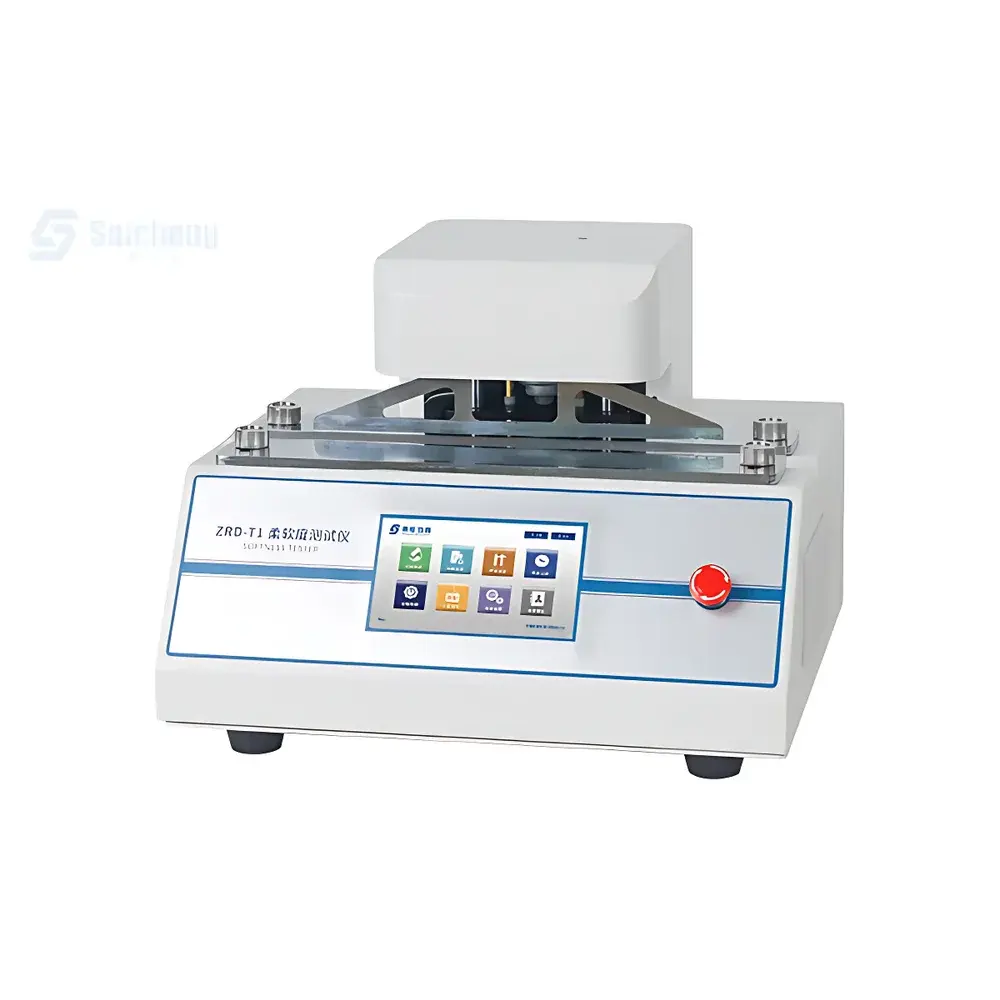
SEARCHING ZRD-T1 Paper Softness Tester
| Brand | SEARCHING |
|---|---|
| Origin | Shandong, China |
| Model | ZRD-T1 |
| Measurement Range | 10–1000 mN |
| Resolution | 0.01 mN |
| Indication Error | ±1% (±1 mN for values <20% of full scale) |
| Repeatability Error | <3% (±1 mN for values <20% of full scale) |
| Probe Total Travel | 12 ±0.5 mm |
| Probe Penetration Depth | 8 ±0.5 mm |
| Slit Width Options | 5 mm, 6.35 mm, 10 mm, 20 mm |
| Slit Width Tolerance | ±0.05 mm |
| Slit Parallelism Error | ≤0.05 mm |
| Probe Alignment Error | ≤0.05 mm |
| Motor | Permanent-magnet low-speed synchronous motor (4 r/min, 220 V) |
| Dimensions | 240 × 300 × 280 mm (L×W×H) |
| Net Weight | ~15 kg |
| Compliance | GB/T 8942–2016, QB/T 1016, JIS Z 0237 |
Overview
The SEARCHING ZRD-T1 Paper Softness Tester is a precision mechanical testing instrument engineered to quantify the tactile softness of flexible sheet materials—primarily paper-based products—through standardized bending and friction resistance measurement. It operates on the principle defined in GB/T 8942–2016: a rigid plate-shaped probe vertically displaces a conditioned specimen into a precisely machined slit under controlled kinematic conditions. The maximum force required during this displacement—comprising both the specimen’s flexural rigidity and its interfacial friction against the slit walls—is recorded as the softness value in millinewtons (mN). This method replicates the fundamental biomechanical interaction between human fingertip and planar material surfaces, enabling objective, repeatable correlation with subjective sensory evaluation. Unlike optical or acoustic softness proxies, the ZRD-T1 delivers direct mechanical quantification traceable to national metrological standards, making it suitable for quality control laboratories operating under ISO/IEC 17025-accredited frameworks.
Key Features
- Electronically controlled servo-assisted actuation system ensures consistent probe velocity (4 r/min) and precise depth control (8 ±0.5 mm penetration), minimizing operator-induced variability.
- Four interchangeable slit widths (5 mm, 6.35 mm, 10 mm, 20 mm) accommodate diverse product geometries—from narrow tissue strips to wide nonwovens—while maintaining dimensional tolerance (±0.05 mm) and parallelism (≤0.05 mm) per JIS Z 0237 requirements.
- High-resolution load cell (0.01 mN resolution) with calibrated linearity (±1% FS, ±1 mN at low-end) enables detection of subtle softness differences across low-basis-weight tissues and high-density laminates.
- Integrated thermal-stable hydraulic damping mechanism suppresses vibration-induced noise, enhancing signal-to-noise ratio during peak-force capture.
- Onboard micro-printer provides immediate hard-copy output of test results, including date/time stamp, sample ID, slit width, and measured mN value—supporting GLP-compliant documentation without external software dependency.
Sample Compatibility & Compliance
The ZRD-T1 is validated for use with standard-width specimens (typically 50 mm × 50 mm or 60 mm × 60 mm) conditioned per ISO 187 (23 ±1 °C, 50 ±2% RH). It accommodates a broad range of compliant materials: facial tissues, toilet papers, paper towels, baby wipes, sanitary napkin coverstocks, cigarette paper, reconstituted tobacco sheet (RTS), and nonwoven medical fabrics. All mechanical tolerances—including probe alignment (≤0.05 mm), slit geometry, and travel repeatability—are verified against GB/T 8942–2016 Annex B calibration procedures. The instrument meets essential safety and electromagnetic compatibility (EMC) requirements per GB 4793.1 (IEC 61010-1), and its structural design complies with static load stability criteria for benchtop laboratory equipment.
Software & Data Management
While the ZRD-T1 operates as a standalone instrument with embedded firmware, optional RS-232 or USB-to-serial interface enables integration with laboratory information management systems (LIMS) or custom data acquisition platforms. Raw force-vs.-displacement time-series data can be exported in ASCII CSV format for post-test analysis in MATLAB, Python (NumPy/Pandas), or statistical process control (SPC) software. Audit trails—including operator ID, calibration timestamp, and environmental condition logs—can be appended via external database linkage. For regulated environments (e.g., FDA-regulated tissue manufacturing), the system supports 21 CFR Part 11-compliant electronic signatures when paired with validated third-party software meeting ALCOA+ data integrity principles.
Applications
- Quality assurance in tissue converting facilities: monitoring softness drift across production batches and validating supplier pulp specifications.
- R&D formulation studies: evaluating impact of fiber blend ratios, wet-end additives (e.g., softening resins), creping adhesives, and embossing patterns on perceived softness.
- Regulatory conformance testing: generating submission-ready data for GB/T 8942–2016, QB/T 1016 (tissue paper), and JIS Z 0237 (Japanese industrial standard for paper softness).
- Comparative benchmarking: cross-referencing proprietary softness metrics against industry reference materials (e.g., NIST-traceable tissue standards) in accredited testing labs.
- Educational use in pulp & paper engineering programs: demonstrating structure–property relationships between fiber morphology, sheet density, and mechanical compliance.
FAQ
What physical property does the ZRD-T1 actually measure?
It measures the peak resistive force (in mN) generated when a standardized probe bends and slides a conditioned paper specimen into a fixed-width slit—quantifying combined flexural stiffness and surface friction under quasi-static loading.
Is calibration traceable to national standards?
Yes. Load cell calibration follows GB/T 8942–2016 Annex B using certified deadweight standards traceable to CNAS-accredited metrology institutes; annual verification is recommended.
Can the ZRD-T1 test non-paper substrates like spunbond polypropylene?
Yes—provided the material exhibits sufficient planar uniformity and thickness consistency (0.05–0.5 mm), and is tested within the 10–1000 mN range using appropriate slit width selection.
Does the instrument require routine maintenance beyond cleaning?
Yes: periodic inspection of hydraulic oil level and viscosity, verification of probe tip wear (replacable tungsten-carbide tip), and recalibration of zero-load offset every 200 cycles or quarterly—whichever occurs first.
How does softness value correlate with consumer perception?
Empirical studies show strong inverse correlation (r = −0.87–−0.92) between ZRD-T1 mN readings and panel-rated softness scores for homogenous tissue grades, particularly below 300 mN; correlation weakens for highly textured or multi-layered products requiring supplementary sensory protocols.



