
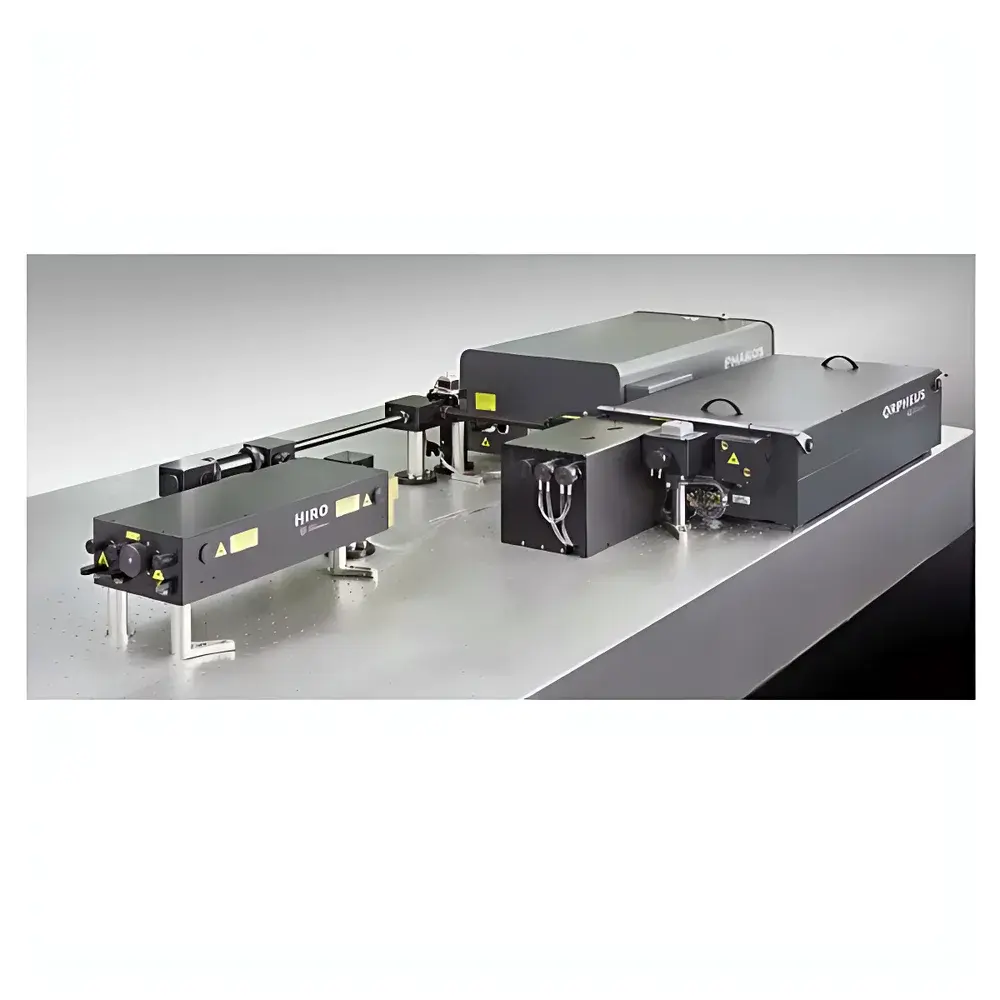
SEMETROL HERA-DLTS Deep Level Transient Spectroscopy System
| Brand | SEMERSUN |
|---|---|
| Origin | USA |
| Manufacturer Type | Authorized Distributor |
| Origin Category | Imported |
| Model | SEMETROL HERA-DLTS |
| Price Range | USD $105,000 – $210,000 |
| Instrument Class | Semiconductor Defect Characterization System |
Overview
The SEMETROL HERA-DLTS is a high-precision deep level transient spectroscopy (DLTS) system engineered for quantitative characterization of electrically active defects in semiconductor materials and devices. Based on the fundamental principle of thermal emission kinetics from trap states within the bandgap, the HERA-DLTS measures capacitance or current transients following controlled voltage or optical perturbation, then applies rigorous mathematical deconvolution—including Fourier-transform DLTS (F-DLTS), Laplace-transform analysis, multi-exponential transient fitting, and isothermal transient spectroscopy (ITS)—to extract activation energy (ET), capture cross-section (σ), trap concentration (NT), and thermal emission rate parameters. First introduced in 1990 as the world’s first fully digital DLTS platform, the HERA series leverages modern computational architecture to execute real-time spectral reconstruction with sub-meV energy resolution—enabling discrimination of closely spaced defect levels that conventional analog systems cannot resolve.
Key Features
- Automated contact integrity verification prior to measurement initiation
- Digital signal acquisition with 24-bit resolution and configurable sampling rates up to 10 MS/s
- Integrated automatic capacitance compensation for stable baseline across wide C–V ranges (1 pF – 100 nF)
- Triple-terminal FET transient current measurement capability with guarded low-noise front-end
- Modular hardware architecture supporting seamless integration of cryogenic stages (liquid nitrogen, closed-cycle He, or variable-temperature inserts)
- Comprehensive software suite featuring 28 built-in correlation functions executable in a single temperature scan
- Direct emission transient acquisition without pre-filtering—preserving phase and amplitude fidelity
- Support for seven primary operational modes: C-DLTS, CC-DLTS, I-DLTS, DD-DLTS, Zerbst-DLTS, O-DLTS, and FET/MOS-specific analysis protocols
Sample Compatibility & Compliance
The HERA-DLTS accommodates standard semiconductor device geometries including Schottky diodes, p–n junctions, MOS capacitors, HEMTs, and vertical power devices. It supports wafer-level probing (with optional probe station interface) and discrete package testing. All measurement sequences adhere to ASTM F1331–22 (Standard Test Method for Deep-Level Transient Spectroscopy of Semiconductors) and are compatible with ISO/IEC 17025 quality management requirements. Audit trails, electronic signatures, and user-access controls meet FDA 21 CFR Part 11 criteria when configured with validated software modules. Traceable calibration procedures align with NIST-traceable standards for capacitance, temperature, and timebase accuracy.
Software & Data Management
The HERA Control Suite provides a deterministic, scriptable environment for experiment design, real-time visualization, and post-processing. Raw transient data are stored in HDF5 format with embedded metadata (temperature ramp rate, bias conditions, instrument configuration). The software implements GLP-compliant data handling: all processing steps—including windowing, background subtraction, exponential fitting, and Arrhenius plotting—are logged with timestamps, operator ID, and parameter sets. Export options include CSV, MATLAB .mat, and industry-standard SDF (Semiconductor Data Format) for interoperability with TCAD simulation tools (e.g., Synopsys Sentaurus, Silvaco Atlas). Optional IQS (Instrument Qualification Suite) module supports GMP-compliant installation qualification (IQ), operational qualification (OQ), and performance qualification (PQ) documentation.
Applications
- Identification and quantification of recombination centers in Si, SiC, GaN, GaAs, and InP substrates
- Interface trap density profiling at Si/SiO2, AlGaN/GaN, and SiC/SiO2 interfaces
- Process-induced defect monitoring in ion implantation, rapid thermal annealing, and gate oxide growth
- Reliability assessment of power devices under high-field stress (TDDB, hot-carrier injection)
- Correlation of DLTS spectra with minority carrier lifetime (τeff) measured by µ-PCD or QSSPC
- Validation of defect energy levels predicted by DFT calculations
- Characterization of radiation-induced traps in space-grade electronics
FAQ
What cooling systems are compatible with the HERA-DLTS?
Liquid nitrogen dewars (77–300 K), closed-cycle helium refrigerators (4–350 K), and resistive-heated cryostats with ±0.1 K stability are fully supported via IEEE-488 and RS-232 interfaces.
Does the system support automated temperature scanning with dwell-time optimization?
Yes—integrated thermal control logic adjusts dwell time per temperature step based on transient decay length, minimizing total measurement duration without sacrificing signal-to-noise ratio.
Can ITS (Isothermal Transient Spectroscopy) be performed without temperature ramping?
Yes—ITS mode acquires sequential transients at fixed temperature under varying pulse width or amplitude, enabling defect profiling independent of thermal activation.
Is raw transient data accessible for third-party analysis?
All acquired waveforms—including unprocessed capacitance/current vs. time—are exportable in open-format HDF5 with full metadata; no proprietary binary locking is applied.
How is emission rate calibration performed?
Calibration uses reference diodes with well-characterized gold-related traps in silicon, traceable to NIST SRM 2136, with uncertainty < ±0.8 meV in ET and < ±15% in σ.




