
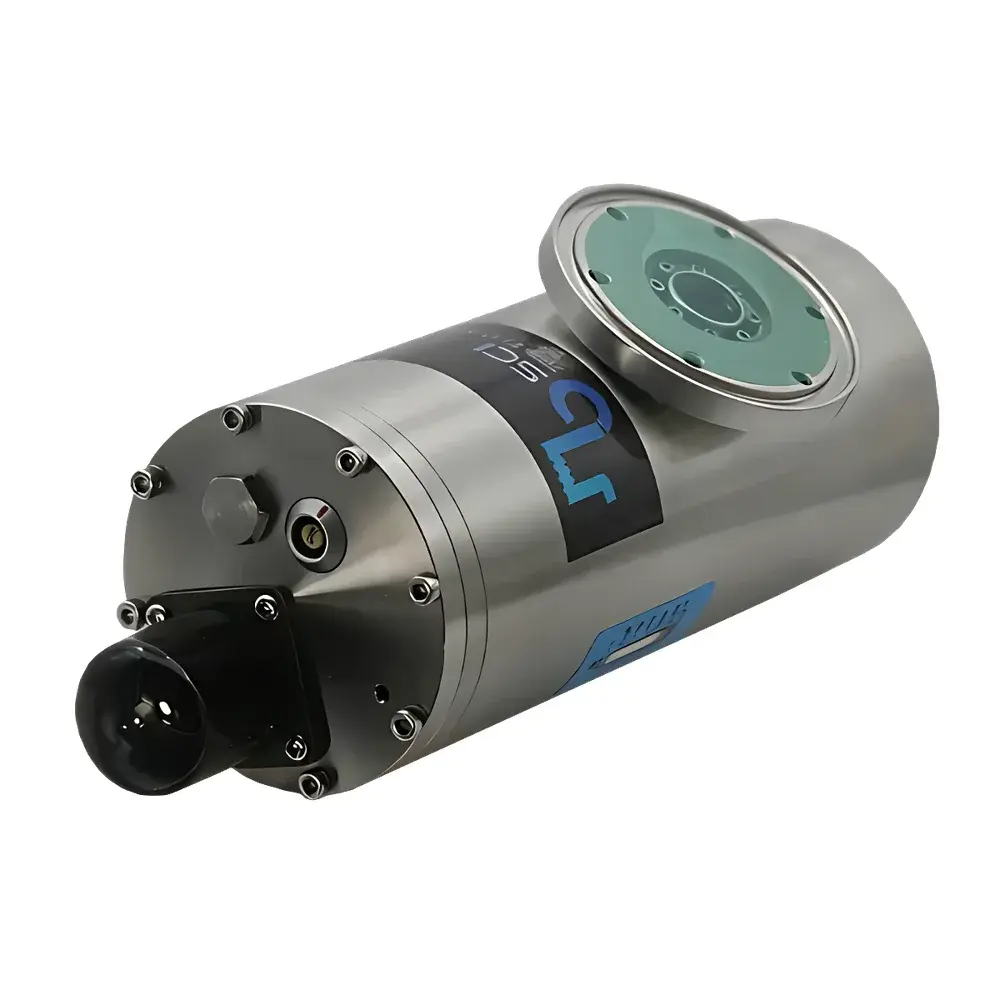
Semicircle-Instrument TUB0011-CS1B/2B Low-Energy Side-Window X-Ray Tube
| Brand | Semicircle-Instrument |
|---|---|
| Origin | Jiangsu, China |
| Manufacturer Type | OEM Manufacturer |
| Model | TUB0011-CS1B/2B |
| Max Anode Voltage | 50 kV |
| Max Anode Current | 1 mA |
| Max Power | 50 W |
| Focal Spot Size | 1.0 × 1.0 mm (CS1B) / 0.1 × 0.1 mm (CS2B) |
| Filament Current | ≈1.7 A @ 50 kV/1 mA |
| Filament Voltage | ≈2.0 V |
| X-ray Exit Angle | 17° |
| Anode Target Materials | W, Rh, Mo, Ag, Cu (customizable) |
| Beryllium Window Thickness | 125 µm or 200 µm (selectable) |
| Electrical Configuration | Anode at positive high voltage, cathode grounded |
| Cooling Method | Forced-air cooling (>150 CFM), max housing temperature ≤55 °C |
| Weight | 2.5 kg |
Overview
The Semicircle-Instrument TUB0011-CS1B/2B is a low-energy, side-window, general-purpose X-ray tube engineered for stable and reproducible generation of characteristic and bremsstrahlung radiation in benchtop and industrial X-ray analytical systems. Based on thermionic emission principles, the tube employs a tungsten filament cathode and a selectable metal anode (W, Rh, Mo, Ag, or Cu) to produce optimized spectral output for energy-dispersive X-ray fluorescence (EDXRF), wavelength-dispersive XRF (WDXRF), X-ray transmission densitometry, thickness gauging, and real-time process monitoring. Its sealed stainless-steel envelope with internal lead shielding and dielectric oil filling ensures high-voltage integrity up to 50 kV DC while simultaneously providing thermal management under continuous operation. Designed as a drop-in replacement for legacy imported tubes, the TUB0011-CS1B/2B meets mechanical, electrical, and thermal interface requirements defined by international OEM instrument platforms—enabling seamless integration without hardware or software revalidation.
Key Features
- Robust hermetic construction: 304 stainless-steel outer housing with integrated lead lining and dielectric oil immersion for enhanced radiation containment and HV insulation.
- Dual focal spot options: CS1B variant delivers 1.0 × 1.0 mm nominal focus for higher power tolerance and broader beam coverage; CS2B provides a micro-focus 0.1 × 0.1 mm spot enabling improved spatial resolution in imaging and micro-XRF applications.
- Configurable anode material selection: Choice of W (high-intensity bremsstrahlung), Rh (enhanced L-line excitation), Mo (optimized for light-element analysis), Ag (mid-Z excitation balance), or Cu (low-energy Kα line at 8.04 keV) supports application-specific spectral tailoring.
- Standardized 17° X-ray exit geometry with precision-machined beryllium window (125 µm or 200 µm thickness), ensuring optimal transmission for elements from Na (Z=11) to Pb (Z=82) while maintaining vacuum integrity and mechanical durability.
- Forced-air thermal management system compliant with IEC 61000-3-2 harmonic current limits; airflow ≥150 CFM maintains housing surface temperature ≤55 °C at rated 50 W load, supporting uninterrupted operation in ambient temperatures up to 40 °C.
Sample Compatibility & Compliance
The TUB0011-CS1B/2B is compatible with solid, powdered, liquid, and thin-film samples across EDXRF spectrometers, handheld analyzers, inline thickness gauges, and laboratory-scale X-ray imaging rigs. Its stable output and repeatable beam characteristics support quantitative analysis per ASTM E1621 (standard test method for elemental analysis by EDXRF), ISO 21043 (XRF instrumentation performance verification), and RoHS Directive 2011/65/EU compliance screening workflows. The tube’s grounding configuration (anode-positive, cathode-grounded) aligns with standard high-voltage supply architectures used in CE-certified analytical instruments. All materials—including Be window, stainless-steel body, and insulating oil—conform to REACH Annex XVII restrictions and are documented in full material declarations (DfE) available upon request.
Software & Data Management
While the TUB0011-CS1B/2B operates as a hardware component without embedded firmware, its electrical and thermal behavior is fully characterized in instrument control software via standardized analog feedback channels (e.g., filament current monitor, anode voltage divider, and thermal sensor outputs). OEMs may integrate real-time tube health diagnostics—including filament resistance drift tracking, HV leakage detection, and thermal derating alerts—into existing platform software complying with FDA 21 CFR Part 11 audit trail requirements. Semicircle-Instrument provides comprehensive technical documentation including pinout schematics, thermal derating curves, spectral emission charts (by target/anode combination), and lifetime expectancy models based on accelerated aging tests per IEC 60747-10.
Applications
- Routine RoHS and ELV compliance testing of electronic components and plastics.
- PVC chlorine content quantification and additive screening in polymer manufacturing QA/QC labs.
- Non-destructive thickness measurement of metallic coatings (e.g., Zn on steel, Sn on Cu) in electroplating lines.
- Multi-element assay of precious metals (Au, Pt, Pd) in jewelry and recycling streams using fundamental parameter (FP) calibration.
- Real-time density profiling in paper, nonwovens, and battery electrode coating processes.
- Preclinical small-animal radiography and industrial NDT where compact size and low-power operation are critical.
FAQ
What is the maximum recommended duty cycle for continuous operation?
At 50 kV / 1 mA (50 W), forced-air cooling enables indefinite continuous operation provided ambient temperature remains ≤40 °C and airflow is sustained at ≥150 CFM with unobstructed inlet/outlet paths.
Can the tube be operated with pulsed high voltage?
Yes—the TUB0011-CS1B/2B supports gated operation down to 10 µs pulse width with rise/fall times <50 ns when paired with compatible HV pulsers; consult application notes for anode thermal inertia limitations.
Is the beryllium window replaceable in the field?
No—the Be window is permanently bonded during factory sealing; replacement requires return to Semicircle-Instrument for certified reprocessing under ISO 9001-controlled conditions.
Does this tube comply with IEC 61010-1 safety standards?
As a component-level device, it is designed to meet the requirements of IEC 61010-1 when integrated into a final instrument meeting Class I protection, double insulation, and interlock provisions as specified in the host system’s risk assessment.
What filament life can be expected under nominal operating conditions?
Typical filament lifetime exceeds 2,000 hours at 50 kV / 0.8 mA with proper warm-up/cool-down sequencing; lifetime is inversely proportional to operating temperature and degrades exponentially above 1.0 mA.





