
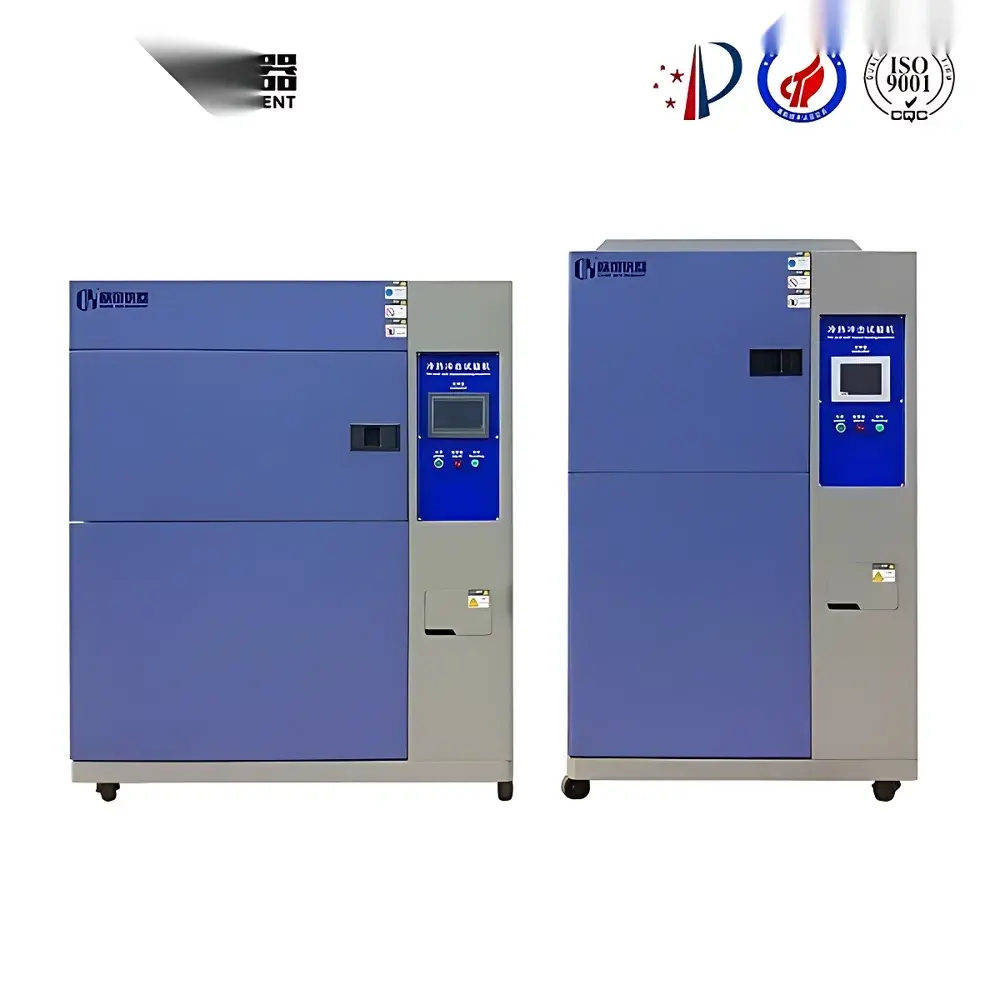
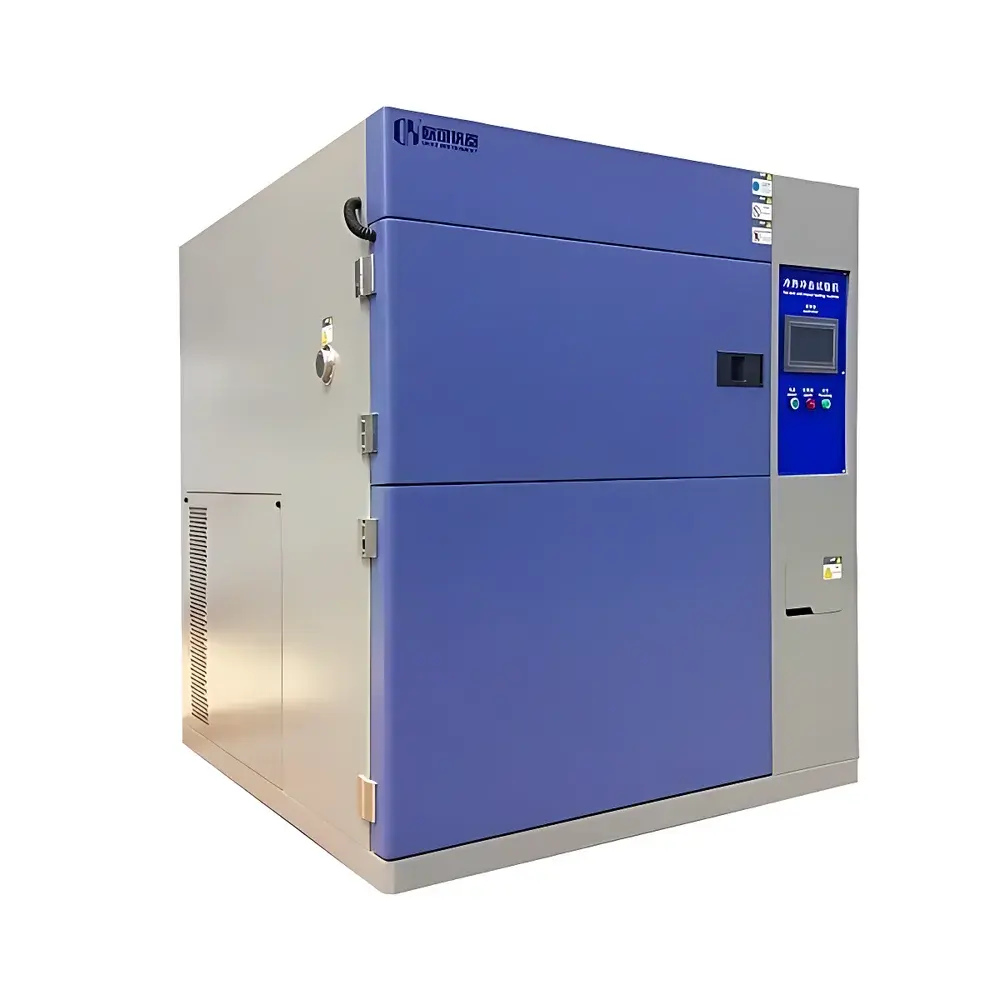
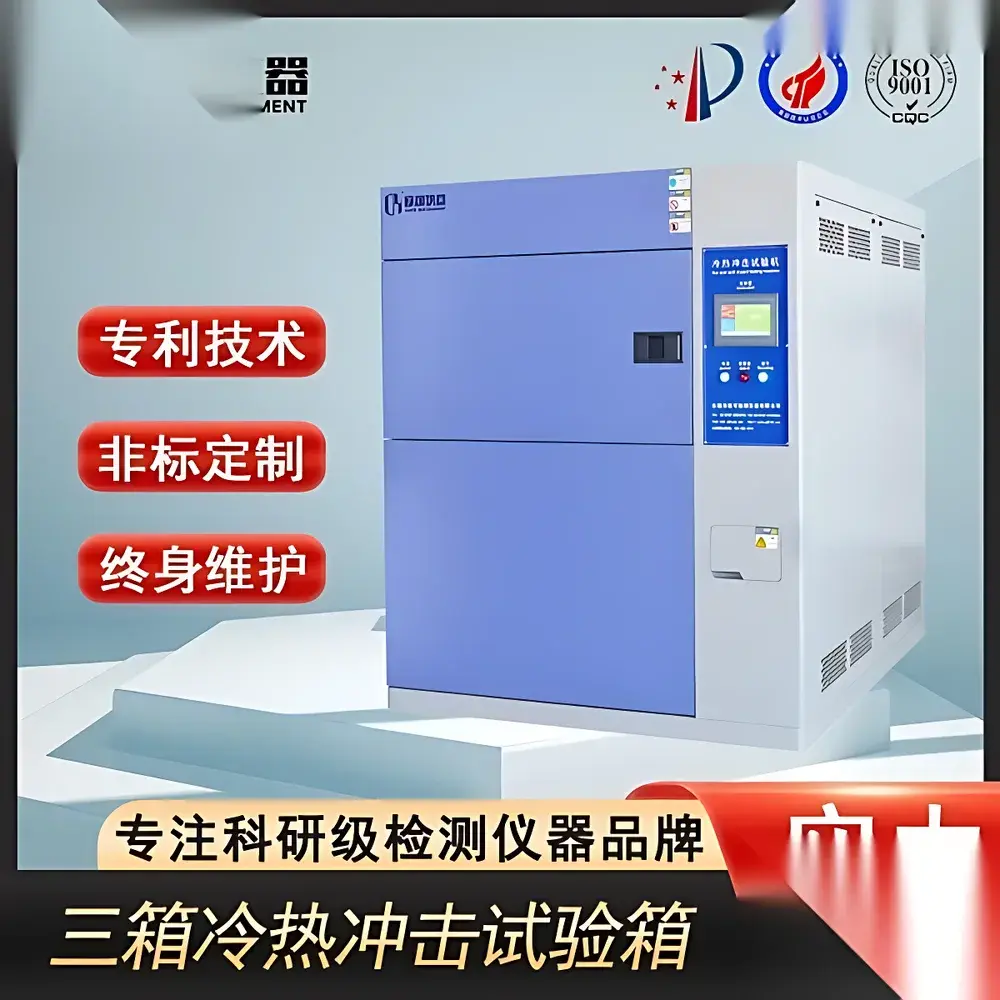
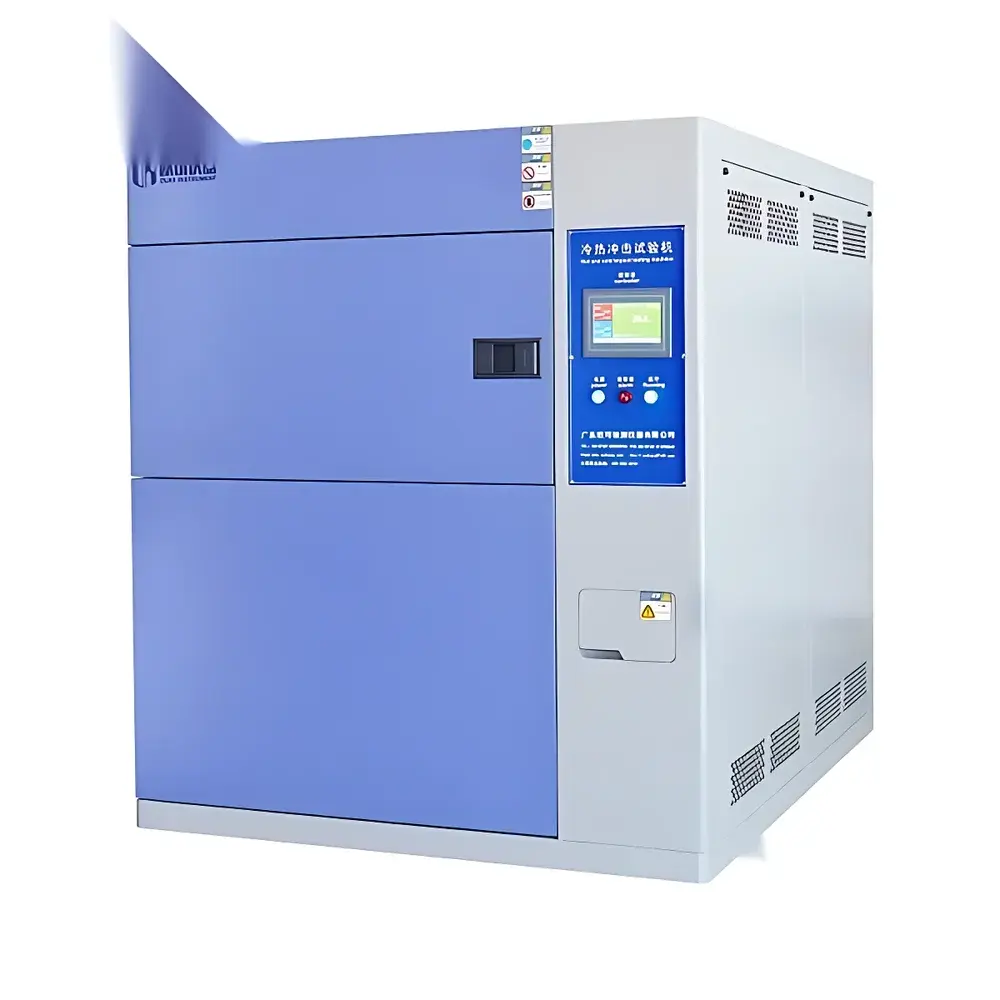
Semiconductor Thermal Shock Test Chamber
| Brand | Other Brands |
|---|---|
| Origin | Imported |
| Manufacturer Type | Authorized Distributor |
| Price | USD 11,200 (FOB) |
| Temperature Range | -65°C to +180°C |
| Thermal Transition Time | ≤15 s (typical between chambers) |
| Control System | TEMI880 Color Touchscreen Controller (English/Chinese Switchable) or TEMI300 Membrane Keypad Controller (English Only) |
| Refrigeration | Twin-Stage or Single-Stage Hermetic Compressor (Original Tecumseh or Copeland) |
| Insulation | Rigid Polyurethane Foam (≥100 mm) + Ultra-Fine Glass Fiber |
| Interior Material | SUS304 Stainless Steel |
| Exterior Finish | Electrostatic Powder-Coated Cold-Rolled Steel or Optional Brushed SUS304 |
| Air Circulation | Wide-Band Forced Convection with Centrifugal Blower |
| Compliance | ASTM D5229, MIL-STD-883 Method 1010, JESD22-A104, IEC 60068-2-14 |
Overview
The Semiconductor Thermal Shock Test Chamber is a precision-engineered environmental test system designed specifically for evaluating the reliability of semiconductor devices, IC packages, PCB assemblies, and advanced electronic components under rapid, repetitive thermal transitions. It operates on the principle of two-zone (hot/cold) or three-zone (hot/cold/ambient) thermal shock methodology—where specimens are mechanically transferred between independently controlled high-temperature and low-temperature chambers at programmable dwell times and transition intervals. This enables accelerated stress testing per industry-standard protocols including JEDEC JESD22-A104 (Temperature Cycling), MIL-STD-883 Method 1010 (Thermal Shock), and IEC 60068-2-14 (Change of Temperature). The chamber’s architecture minimizes thermal inertia through optimized insulation, high-efficiency compressors, and laminar airflow design—ensuring repeatable ΔT rates (>15°C/s typical transfer), tight temperature uniformity (±0.5°C within working volume), and minimal overshoot during recovery phases.
Key Features
- Dual- or triple-chamber configuration with independent PID-controlled hot (up to +180°C) and cold (down to –65°C) zones, enabling precise dwell time programming and automated basket transfer
- TEMI880 full-color touchscreen controller with intuitive graphical interface, multi-language support (English/Chinese), real-time trend logging, and USB data export capability
- Backup TEMI300 membrane keypad controller for simplified operation in GLP-compliant environments where touch interfaces are restricted
- High-reliability refrigeration system featuring hermetically sealed compressors (original Tecumseh or Copeland), dual-stage cascade design for sub-zero performance, and eco-friendly R404A/R507 refrigerant
- Robust thermal insulation using ≥100 mm rigid polyurethane foam combined with ultra-fine glass fiber layers—achieving thermal conductivity <0.022 W/m·K
- Forced-air circulation via multi-wing centrifugal blower with top-out/bottom-in airflow path, ensuring ±0.8°C temperature uniformity across 200–600 L working volumes
- Integrated safety suite: compressor overheat/overcurrent/overpressure protection, heater dry-run prevention, chamber over-temperature cutoff, water-level monitoring, and door interlock logic
Sample Compatibility & Compliance
This chamber accommodates standard semiconductor test carriers—including JEDEC trays (330 × 250 mm), wafer cassettes (up to 8″), QFN/BGA packages, and populated PCBs up to 450 × 450 × 150 mm (W×D×H). Dual-layer tempered observation window (with anti-fog heating element), φ50 mm cable port (left-side mounted), adjustable stainless steel sample racks, and internal fluorescent lighting facilitate real-time visual inspection without interrupting test cycles. All configurations comply with ISO/IEC 17025 calibration traceability requirements and support audit-ready documentation for GMP/GLP environments. Optional validation packages include IQ/OQ documentation, temperature mapping reports (per ASTM E2297), and 21 CFR Part 11–compliant software audit trails when paired with certified PC-based control software.
Software & Data Management
The included Windows-based control software enables remote monitoring, script-based test sequence definition (e.g., 500-cycle profiles with variable dwell/transition parameters), and synchronized data acquisition from up to 16 external thermocouples (Type K/T). Raw data exports as CSV or Excel-compatible files with timestamps, setpoints, actual readings, alarm logs, and cycle counters. For regulated laboratories, optional FDA 21 CFR Part 11 modules provide electronic signature enforcement, role-based user access control, and immutable audit trail generation—fully compatible with LIMS integration via Modbus TCP or RS485. All firmware and software updates are delivered via secure HTTPS portal with version-controlled release notes.
Applications
- Qualification testing of flip-chip, wafer-level CSP, and 3D-IC packaging under JEDEC JESD22-A104 and A110 standards
- Failure mode analysis (FMA) of solder joint fatigue, die attach delamination, and mold compound cracking
- Process validation for reflow soldering, underfill curing, and conformal coating adhesion
- Reliability screening of automotive-grade semiconductors (AEC-Q100 Grade 0–3) and aerospace electronics
- Material compatibility studies involving thermal expansion mismatch between Si, Cu, SnAgCu, and epoxy molding compounds
FAQ
What is the minimum achievable thermal transition time between chambers?
Typical basket transfer time is ≤15 seconds for standard configurations; optional high-speed pneumatic transfer systems reduce this to ≤8 seconds.
Does the chamber support humidity-controlled thermal shock?
No—this is a dry thermal shock system. Humidity control is excluded to prevent condensation-induced electrical failure during rapid transitions.
Can the system be integrated into an automated test line?
Yes—RS485, Ethernet (Modbus TCP), and digital I/O ports enable seamless integration with SECS/GEM, PLCs, or MES platforms.
Is calibration certification included with shipment?
A factory-as-built temperature uniformity report and NIST-traceable sensor calibration certificate are provided standard; on-site IQ/OQ services are available upon request.
What maintenance intervals are recommended for long-term reliability?
Compressor oil and refrigerant checks every 12 months; air filter replacement every 3 months; full system performance verification annually per ISO/IEC 17025 guidelines.



