
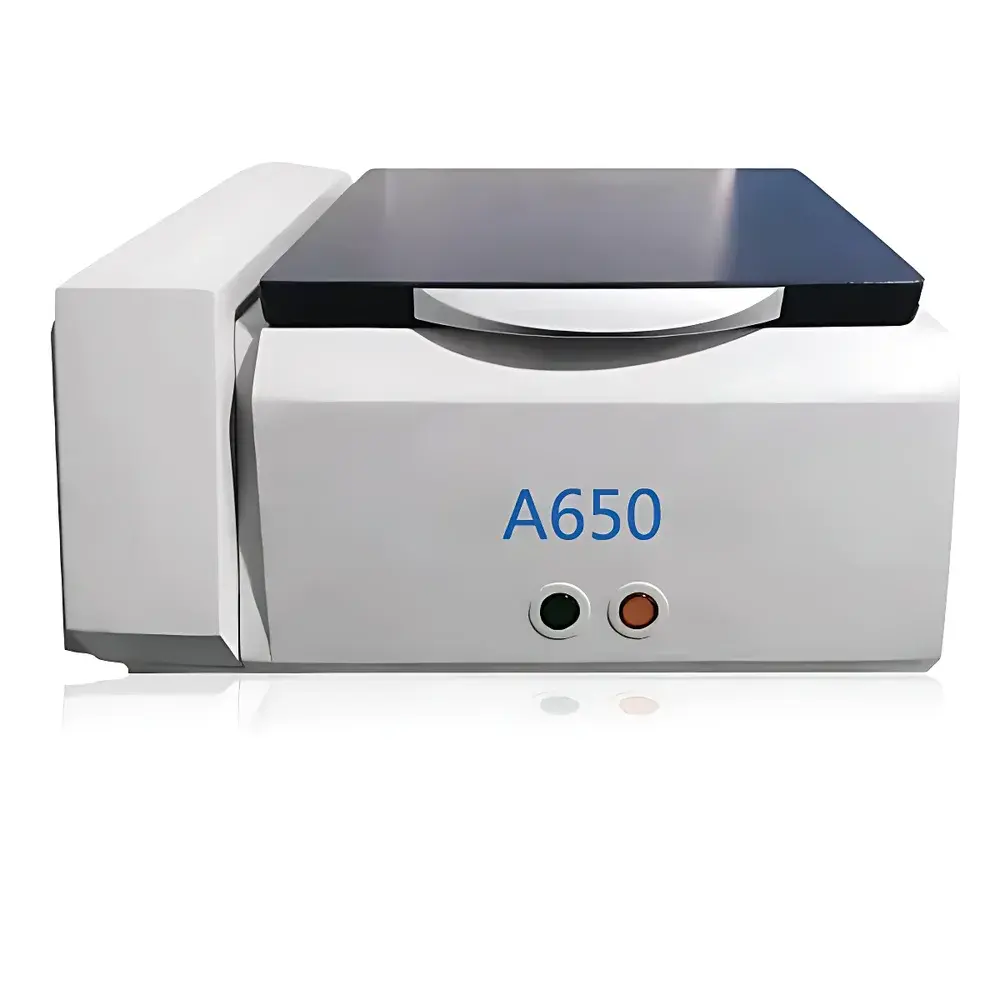
Senbe A650 Benchtop Energy-Dispersive X-ray Fluorescence (EDXRF) Spectrometer for Magnetic Materials Elemental Analysis
| Brand | Senbe |
|---|---|
| Model | A650 |
| Type | Benchtop Energy-Dispersive X-ray Fluorescence (EDXRF) Spectrometer |
| Detector | Silicon Drift Detector (SDD), Resolution: 129 ± 5 eV |
| X-ray Tube | 50 W, 5–50 kV / 0–1000 µA |
| Measurable Elements | Na (11) to U (92) |
| Detection Limit | ppm-level |
| Quantification Range | 0.0001% – 99.99% (matrix-dependent) |
| Sample Form | Solid, Powder, Liquid |
| Vacuum Capability | Integrated Vacuum System for Light Element Enhancement (Mg, Al, Si, P, S) |
| Cooling | Peltier-based Electric Refrigeration |
| Safety | Triple-layer Radiation Shielding, Interlocked Sample Chamber, Real-time Beam Monitoring |
| Software | Proprietary EDXRF Analysis Suite with Fundamental Parameters (FP), Empirical Coefficient, and Matrix Correction Algorithms |
| Compliance | Designed to meet IEC 61000-6-3 (EMC), IEC 61000-6-4, and GB/T 18806–2002 (Chinese EDXRF Standard) |
Overview
The Senbe A650 is a benchtop energy-dispersive X-ray fluorescence (EDXRF) spectrometer engineered specifically for quantitative elemental analysis of magnetic materials—including sintered NdFeB, SmCo, ferrites, and iron oxide-based permanent magnets—without destructive sample preparation. It operates on the principle of primary X-ray excitation inducing characteristic secondary (fluorescent) X-rays from constituent atoms; emitted photons are resolved by a high-resolution silicon drift detector (SDD) and processed via digital pulse processing to generate element-specific spectra. Unlike wavelength-dispersive systems, the A650 delivers rapid, simultaneous multi-element detection (Na–U) in a compact, laboratory-grade platform. Its vacuum-compatible sample chamber enables reliable quantification of light elements critical to magnetic performance—such as oxygen (in Fe₂O₃), silicon (SiO₂ impurities), calcium (CaO), manganese (MnO), and chlorine (Cl)—which strongly influence coercivity, Curie temperature, and corrosion resistance in permanent magnet alloys.
Key Features
- High-performance SDD detector with energy resolution ≤129 ± 5 eV at Mn Kα, ensuring superior peak separation for overlapping transitions (e.g., S Kα/Pb Mα, Ca Kα/Ti Kβ)
- 50 W microfocus X-ray tube (5–50 kV, 0–1000 µA) with <0.05% 8-hour output stability, optimized for both heavy-metal quantification (e.g., Nd, Dy, Co) and trace-light-element sensitivity
- Integrated vacuum system reducing atmospheric absorption of low-energy X-rays (<1.5 keV), significantly improving precision for Mg, Al, Si, P, and S—key indicators of raw material purity and sintering atmosphere control
- Proprietary SES (Smart Energy Signal) digital pulse processor with 4096-channel MCA, adaptive gain control, and real-time background subtraction to maximize peak-to-background ratio
- Multi-stage radiation safety architecture: lead-shielded housing, beam-stop interlock, shutter-controlled primary beam, and continuous dose-rate monitoring compliant with national radiation protection regulations
- Intelligent thermal management via multi-zone Peltier cooling and convection-assisted heat dissipation, maintaining detector and tube operating temperatures within ±0.5 °C over extended acquisition cycles
Sample Compatibility & Compliance
The A650 accommodates standard magnetic material forms: pressed pellets (≥10 mm diameter), polished metal discs, granular powders, and slurry suspensions in XRF cups with ultrathin polymer films. Its 400 × 340 × 80 mm sample cavity supports ASTM E1621-compliant pellet geometry and ISO 21043-1 alignment protocols. All hardware and firmware comply with IEC 61000 electromagnetic compatibility standards and GB/T 18806–2002 for EDXRF instrumentation. While not FDA 21 CFR Part 11-certified out-of-the-box, the software architecture supports configurable user roles, electronic signatures, and full audit trail logging—enabling validation under GLP or internal GMP frameworks for QC labs in magnet manufacturing and recycling facilities.
Software & Data Management
The bundled EDXRF analysis suite provides dual-mode quantification: empirical calibration (using certified reference materials such as NIST SRM 2782 NdFeB or BAM RM 035-1 Ferrite) and fundamental parameters (FP)-based matrix correction. Users may apply linear regression, quadratic fitting, or intensity-ratio algorithms to correct for interelement effects (e.g., Fe–O absorption, Co–Ni enhancement). Spectral deconvolution employs iterative least-squares fitting with physical detector response modeling. Raw spectra and processed reports (CSV, PDF, XML) are timestamped and stored with metadata including vacuum status, tube settings, and detector temperature. Optional database integration allows traceability across production batches and raw material lot numbers.
Applications
- Quality control of rare-earth content (Nd, Pr, Dy, Tb) and oxygen stoichiometry in sintered NdFeB magnets
- Detection of process contaminants—Si, Ca, Cl—in ferrite magnet feedstock to prevent grain boundary phase segregation
- Verification of coating composition (e.g., Ni–Cu–Ni layers) on bonded magnets using thin-film mode
- Recycled magnet scrap sorting via rapid Fe/Nd/Co/Ba ratio screening prior to hydrometallurgical recovery
- R&D support for developing low-dysprosium or cobalt-free alternatives by tracking dopant homogeneity at ppm levels
FAQ
Does the A650 require liquid nitrogen or other consumables for detector cooling?
No. It uses solid-state Peltier cooling with no cryogens or replaceable parts—ensuring zero operational downtime and minimal maintenance.
Can it analyze oxygen directly in Fe₂O₃ without vacuum?
Oxygen quantification requires vacuum or helium purge to minimize air absorption; the integrated vacuum pump achieves <10 Pa pressure in <45 seconds, enabling robust O, F, Na, and Mg measurement.
Is method transfer possible between different A650 units?
Yes. Calibration files—including spectral libraries, matrix coefficients, and instrument-specific dead-time corrections—are exportable and reproducible across identical configurations when using matched reference standards.
What is the minimum detectable mass for chlorine in a ferrite sample?
Under vacuum and 300-second live time, typical Cl detection limit is ~8 ppm (1σ) in BaFe₁₂O₁₉ matrices, verified against BAM RM 035-1.
How does the A650 handle magnetic interference during measurement?
The sample stage and detector assembly are fully non-magnetic (316L stainless, aluminum, and ceramic components); no magnetic shielding is required—even for samples with remanence up to 1.4 T.



