
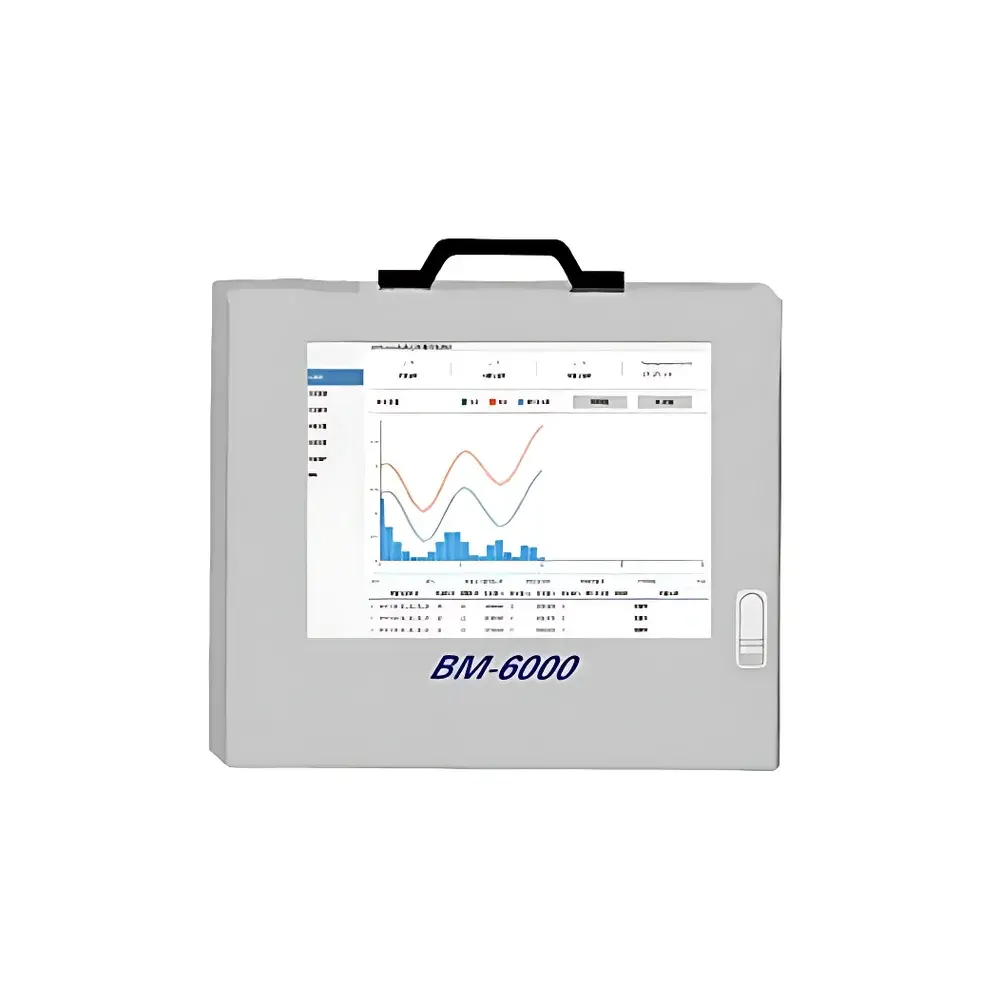
Senbe BM-6000 Online Water Toxicity Analyzer Using Bioluminescent Bacteria
| Brand | Senbe |
|---|---|
| Origin | Jiangsu, China |
| Manufacturer Type | Direct Manufacturer |
| Country of Origin | China |
| Model | BM-6000 |
| Instrument Type | Online Analyzer |
| Biological Agent | *Aliivibrio fischeri* (formerly *Vibrio fischeri*) bioluminescent bacteria |
| Operating Temperature Range | 0–40 °C |
| Reagent Storage Temperature | 0–40 °C |
| Temperature Control Accuracy | ≤ ±1 °C |
| Batch Capacity | 10 samples per cycle |
| Measurement Time | 5 min (default assay duration) |
| Measurement Principle | Dual-optical-path bioluminescence inhibition assay |
| Compliance Standard | ISO 11348-3:2007 & GB/T 15441–1995 |
| Photometric Range | 0–200% relative light units (RLU) |
| Reproducibility (CV) | ≤10% |
| Pure Water Light Loss | ±3% |
| Sample Injection Precision | ≤2% (syringe-based volumetric delivery) |
| Data Storage | ≥2 years at 1-hour measurement interval |
| Communication Interface | RS-232 / RS-485 (Modbus RTU protocol) |
| Analog Output | 4–20 mA DC (≤300 Ω load) |
| Display | 12.1″ capacitive touchscreen LCD |
| Dimensions (W×D×H) | 560 × 430 × 1600 mm |
| Weight | ~20 kg |
Overview
The Senbe BM-6000 Online Water Toxicity Analyzer is an automated, continuous-monitoring instrument engineered for real-time assessment of acute aquatic toxicity in surface water, drinking water sources, wastewater effluents, and industrial discharge streams. It employs a standardized biological endpoint—light inhibition in the marine bioluminescent bacterium Aliivibrio fischeri—to quantify the integrated toxic effect of unknown or complex pollutant mixtures. Unlike chemical-specific analytical methods, this bioassay detects functional toxicity regardless of compound identity, making it especially valuable for early warning of accidental spills, illicit discharges, or emerging contaminants not covered by routine chemical screening. The system implements the dual-optical-path photometric measurement principle specified in ISO 11348-3:2007, where sample-induced luminescence suppression is compared against a parallel control channel to correct for instrumental drift and background noise. Designed for unattended operation over extended periods, the BM-6000 delivers quantitative toxicity results expressed as percentage inhibition (%I) or effective concentration (EC50) equivalents, enabling rapid risk stratification and regulatory triage.
Key Features
- Modular architecture with physically isolated subsystems: refrigeration unit, fluidic handling module, optical detection chamber, motion control assembly, and embedded electronics—ensuring high operational stability and simplified field serviceability.
- Self-cleaning liquid handling system utilizing biocompatible stainless-steel sampling needles; no consumable tubing or valves subject to clogging or degradation, minimizing scheduled maintenance to periodic bacterial culture replenishment only.
- Integrated temperature-regulated incubation zone maintaining reaction temperature within ±1 °C across ambient conditions (0–40 °C), critical for consistent bioluminescent response kinetics.
- Configurable assay timing: users may define measurement intervals from 1 hour to 24 hours, and reaction durations from 5 to 45 minutes, supporting both rapid screening and kinetic toxicity profiling.
- Onboard data logging capacity supports >17,500 measurement records (e.g., two years’ data at hourly resolution); raw RLU values, inhibition percentages, timestamps, and QC flags are stored internally and exportable via USB mass storage.
- Industrial-grade communication suite compliant with Modbus RTU over RS-485 (up to 1,200 m cable length) and RS-232, enabling seamless integration into SCADA, DCS, or centralized environmental monitoring platforms.
Sample Compatibility & Compliance
The BM-6000 accepts raw or filtered aqueous samples without pretreatment—compatible with turbid, colored, or low-conductivity matrices typical of reservoirs, rivers, treated effluents, and distribution system taps. It meets the performance criteria defined in ISO 11348-3:2007 for freshwater and marine applications and aligns with Chinese national standard GB/T 15441–1995 for acute toxicity evaluation. While not certified for GLP or FDA 21 CFR Part 11 out-of-the-box, its audit-trail-capable firmware (with user login, action logging, and timestamped event history) provides foundational traceability required for quality-assured environmental laboratories operating under ISO/IEC 17025 or local regulatory frameworks. All wetted materials—including syringes, needles, and reaction cuvettes—are USP Class VI-certified and non-pyrogenic, ensuring no interference with bacterial viability.
Software & Data Management
The analyzer runs on a Linux-based embedded OS with a responsive 12.1″ capacitive touchscreen interface for local configuration, calibration, and diagnostic access. Remote supervision is enabled via TCP/IP-enabled gateways (optional), allowing secure HTTPS-based dashboard viewing, alarm notification (email/SMS via external middleware), and batch data retrieval through RESTful API endpoints. Collected toxicity time-series data can be exported in CSV or XML formats compatible with LIMS, EPA’s STORET, or custom GIS-integrated water quality visualization tools. The system supports configurable alarm thresholds (e.g., >30% inhibition sustained over two consecutive measurements), automatic QC flagging, and built-in recovery protocols following power interruption or sensor fault events.
Applications
- Early-warning monitoring at drinking water intakes and reservoirs for accidental contamination events.
- Continuous compliance verification of wastewater treatment plant (WWTP) effluent toxicity prior to environmental discharge.
- Industrial pretreatment monitoring for facilities discharging to municipal sewers under local POTW ordinances.
- Ecotoxicological screening of leachates from landfills, construction sites, or remediation zones.
- Research-grade toxicity trend analysis in long-term watershed health studies and climate-impact assessments.
FAQ
What biological indicator organism does the BM-6000 use?
It utilizes freeze-dried, rehydratable cultures of Aliivibrio fischeri, supplied in lyophilized vials calibrated per ISO 11348-3 requirements.
Is calibration required before each analysis?
No daily calibration is needed; the system performs automatic zero-reference correction using purified water blanks prior to each sample cycle.
Can the instrument operate in outdoor enclosures?
Yes—provided ambient temperature remains within 0–40 °C and humidity stays below 90% non-condensing; optional NEMA 4X-rated housing is available for harsh environments.
How often must the bacterial culture be replaced?
Typically every 7–14 days depending on usage frequency and storage conditions; the onboard culture stability monitor alerts users when viability falls below threshold.
Does the BM-6000 support regulatory reporting formats?
Raw data exports comply with ASTM D5868 and ISO 5725 traceability conventions; integration with third-party validation software enables formal EC50 derivation per OECD 201 guidelines.
Related Products







