
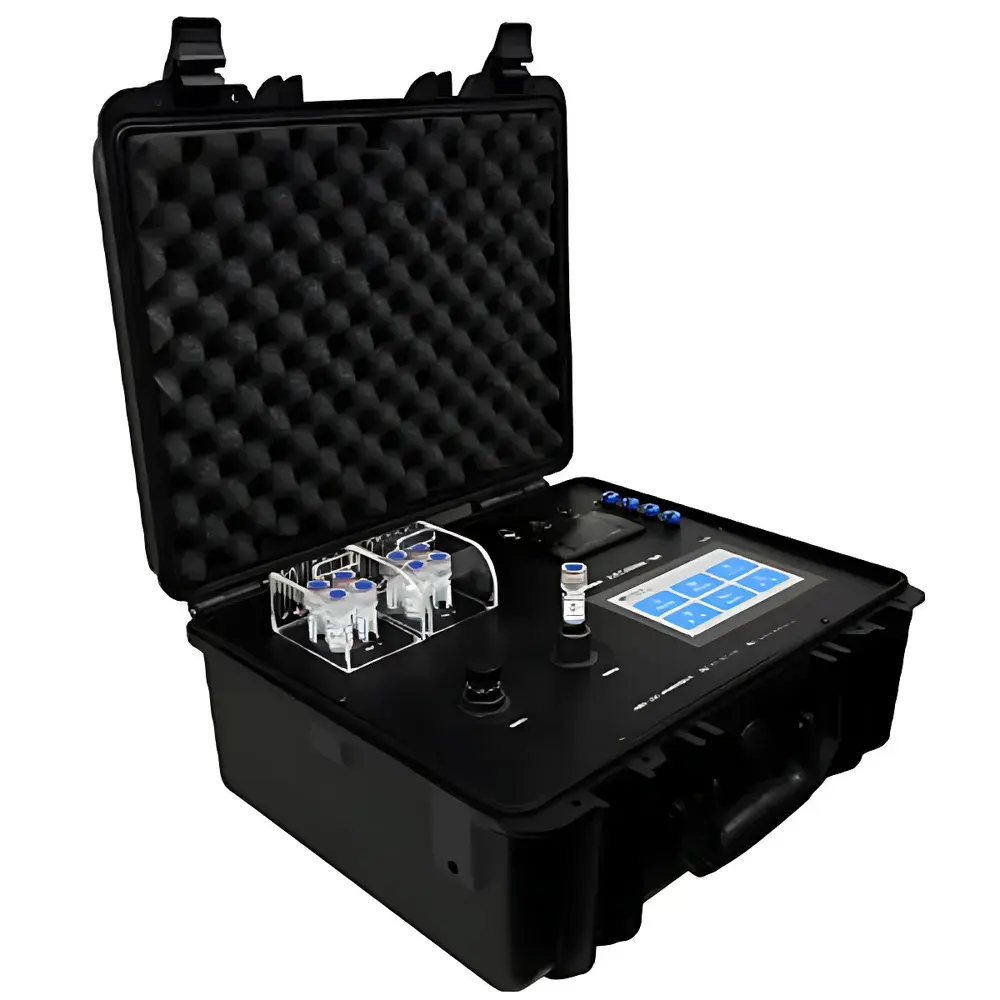
Senbe MP5300 Multi-Parameter Wastewater Rapid Analyzer
| Brand | Senbe |
|---|---|
| Origin | Jiangsu, China |
| Manufacturer Type | Original Equipment Manufacturer (OEM) |
| Country of Manufacture | China |
| Model | MP5300 |
| Pricing | Available Upon Request |
Overview
The Senbe MP5300 Multi-Parameter Wastewater Rapid Analyzer is an integrated benchtop analytical platform engineered for field-deployable and laboratory-grade wastewater characterization. It combines dual optical detection—photometric analysis via fixed-wavelength LED sources—and electrochemical sensing (pH, ORP, conductivity, dissolved oxygen, TDS, turbidity, suspended solids) within a single instrument architecture. The system operates on the principles of Beer-Lambert law-based absorbance quantification (0–3 A range) and potentiometric/amperometric transduction, enabling simultaneous determination of up to 70+ water quality parameters in accordance with standard methods including ISO 6060 (COD), ISO 7888 (conductivity), ISO 5667-3 (sampling preservation), and EPA Method 410.1 (turbidity). Designed for regulatory-compliant environmental monitoring, the MP5300 supports both routine compliance testing and rapid incident response in municipal wastewater treatment plants, industrial effluent discharge points, and decentralized monitoring stations.
Key Features
- 7-inch high-resolution color touchscreen (1024 × 600 pixels) with intuitive icon-driven interface supporting English and Chinese language modes
- Dual-zone programmable digestion block (8 positions per zone) with independent temperature control (ambient to 200 °C), enabling parallel CODcr, total phosphorus, total nitrogen, and permanganate index (CODMn) digestions under preloaded or user-defined thermal profiles
- High-stability LED optical system with ≤ ±0.003 A photometric drift over 20 minutes—calibrated against NIST-traceable standards
- Modular electrode ecosystem: hot-swappable digital sensors for pH/ORP, conductivity, DO, turbidity, suspended solids, chlorophyll-a, and phycocyanin—with automatic sensor ID recognition and real-time calibration validation
- Integrated thermal printer for immediate hardcopy output of measurement reports, including timestamp, operator ID, sample ID, and method reference
- Onboard rechargeable 24 V / 22.5 Ah lithium battery providing ≥8 hours continuous operation under mixed-mode usage (digestion + photometry + electrochemistry)
- Robust mechanical design (480 × 215 × 218 mm; ~11 kg) compliant with IP54 ingress protection for use in humid or dust-prone environments
Sample Compatibility & Compliance
The MP5300 accommodates standard cylindrical sample vials (φ16 mm and φ25 mm) compatible with ASTM D1293 (pH), ASTM D512 (chloride), and ISO 15839 (turbidimeter calibration). All photometric assays utilize factory-preloaded calibration curves traceable to certified reference materials (CRMs); users may import custom calibration functions via USB or Type-C data port. The instrument meets electromagnetic compatibility requirements per IEC 61326-1 and safety standards per IEC 61010-1. Its operational temperature range (5–40 °C) and humidity tolerance (≤85% RH, non-condensing) align with GLP laboratory environmental specifications. Data integrity is maintained through audit-trail-capable internal memory (≥10,000 result records), supporting retrospective review for ISO/IEC 17025-accredited laboratories.
Software & Data Management
Firmware includes embedded data management tools supporting CSV export, time-synchronized batch logging, and QC flagging (e.g., out-of-range absorbance, electrode saturation, digestion timeout). Measurement results are tagged with metadata including ambient temperature, battery level, sensor serial number, and active calibration certificate ID. The Type-C interface enables direct connection to LIMS or ELN systems without proprietary drivers. While native cloud synchronization is not implemented, raw data files conform to ASTM E1384-02 (standard format for analytical data exchange), facilitating integration into enterprise informatics platforms compliant with FDA 21 CFR Part 11 (electronic records/signatures) when deployed behind validated IT infrastructure.
Applications
- Regulatory wastewater discharge monitoring (e.g., NPDES permit compliance, EU Urban Wastewater Treatment Directive Annex I parameters)
- Influent/effluent profiling at activated sludge, MBR, and SBR treatment facilities
- Industrial pretreatment verification (textile dyeing, pharmaceutical manufacturing, food processing effluents)
- Third-party environmental testing laboratories performing ISO/IEC 17025 accredited analyses
- Aquaculture and recirculating aquaculture systems (RAS) water quality surveillance
- Emergency response screening during combined sewer overflows (CSOs) or chemical spill events
- Academic research in environmental engineering, limnology, and microbial ecology requiring multi-analyte temporal resolution
FAQ
Does the MP5300 support USP General Chapter <1227> for validation of water quality test methods?
Yes—the instrument’s documented measurement uncertainty, optical stability, and sensor repeatability meet foundational requirements for method validation per USP <1227>. Full validation kits (including CRM sets and protocol templates) are available separately.
Can custom digestion programs be created and saved onboard?
Yes—up to 20 user-defined thermal profiles can be stored locally, each with ramp rate, hold time, and target temperature parameters.
Is the battery replaceable by end-users without service intervention?
No—the sealed lithium battery pack requires authorized service center replacement to maintain IP rating and thermal safety certification.
Are reagent kits supplied with lot-specific certificates of analysis (CoA)?
Yes—all Senbe-certified reagent kits include CoAs referencing NIST SRM numbers, shelf-life expiration dates, and assay linearity data.
How frequently must the optical system be verified using blank standards?
Daily zero-check with deionized water is recommended; full photometric verification using certified neutral density filters is required every 90 days or after transport/shock events.
Related Products







