
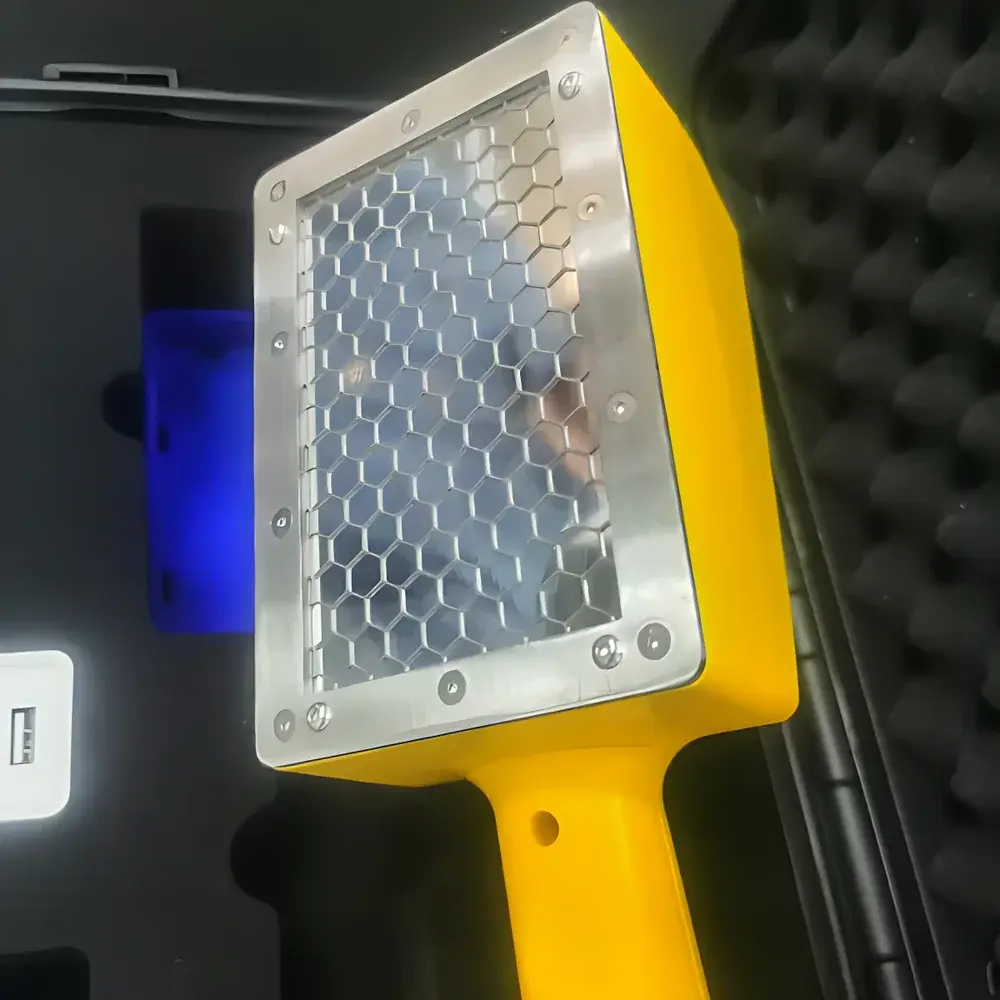
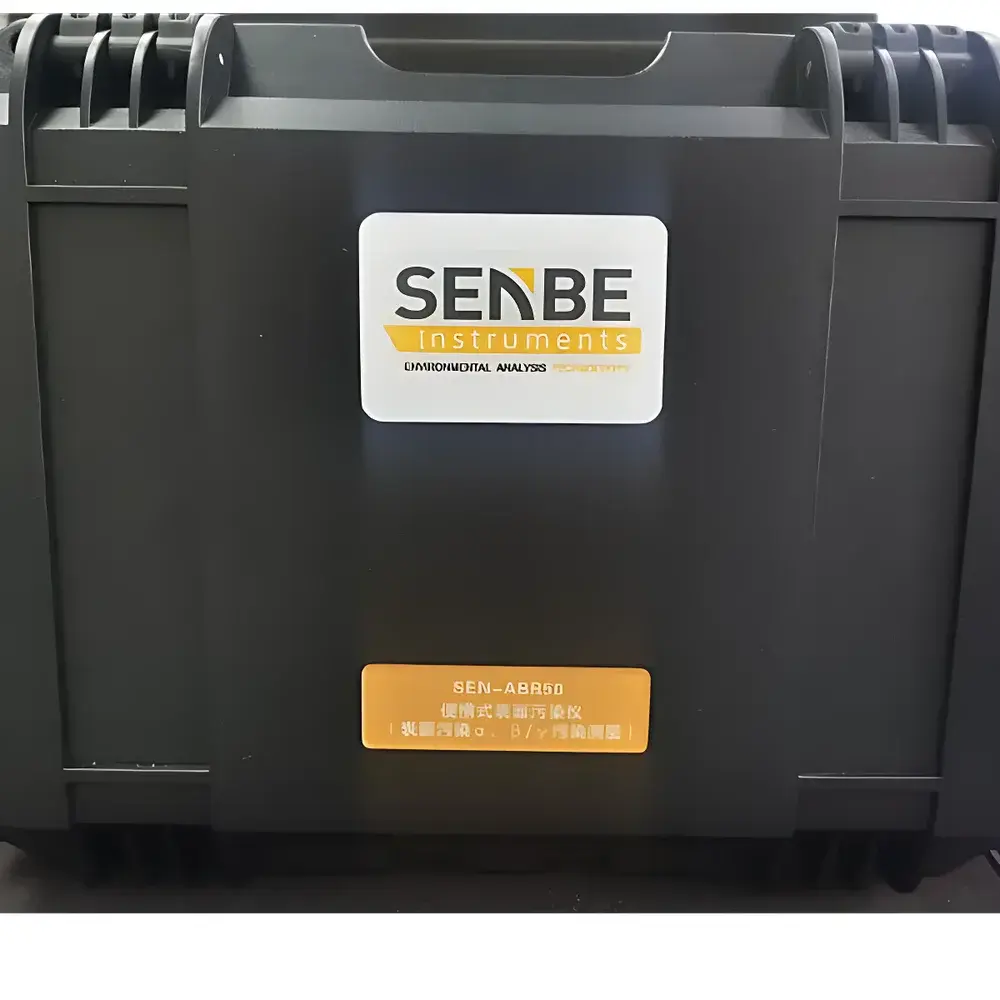
SENBE SEN-ABR50 Portable Alpha/Beta Surface Contamination Monitor
| Brand | SENBE |
|---|---|
| Origin | Jiangsu, China |
| Manufacturer Type | Direct Manufacturer |
| Instrument Category | Domestic |
| Model | SEN-ABR50 |
| Instrument Type | Portable |
| Measurement Target | Solid Surfaces |
| Detector Technology | Plastic Scintillation Detector (Alpha/Beta/Gamma Discriminative) |
| Energy Response | Alpha (≥3 MeV), Beta (≥150 keV), Gamma (≥50 keV) |
| Display | Backlit LCD |
| Alarm | Adjustable Threshold with Real-Time Background Compensation |
| Power Supply | Rechargeable Li-ion Battery (≥12 h continuous operation) |
| Compliance | Meets IEC 60846-1:2014 and GB/T 10257–2022 for portable radiation contamination monitors |
Overview
The SENBE SEN-ABR50 Portable Alpha/Beta Surface Contamination Monitor is a field-deployable, solid-state radiation survey instrument engineered for rapid, simultaneous detection and discrimination of alpha, beta, and gamma surface contamination on solid materials. It operates on the principle of pulse shape discrimination (PSD) in dual-layer plastic scintillation detection—where alpha particles induce distinct, slower-decay light pulses compared to faster beta/gamma-induced signals—enabling real-time spectral separation without gas-filled proportional counters or external probe attachments. Designed for operational readiness in time-sensitive radiological response scenarios, the SEN-ABR50 delivers quantitative surface activity measurements (in Bq/cm²) across heterogeneous surfaces including concrete, stainless steel, plastic, and painted substrates. Its lightweight chassis (≤1.8 kg), ergonomic grip, and IP54-rated enclosure ensure reliable performance in outdoor environments, controlled zones, and mobile command units.
Key Features
- Integrated dual-threshold PSD algorithm for autonomous alpha/beta/gamma event classification without hardware switching or calibration drift.
- Self-compensating background subtraction: continuously monitors ambient beta/gamma flux during measurement and dynamically adjusts alarm thresholds to maintain consistent false-alarm rates (<0.5% at 0.1 µSv/h).
- Backlit monochrome LCD with intuitive icon-driven menu navigation; supports English and simplified Chinese language modes.
- No gas refilling or high-voltage maintenance required—plastic scintillator exhibits stable light yield over temperature range −10 °C to +50 °C.
- Real-time dose rate estimation (µSv/h) alongside contamination mapping (cpm → Bq/cm² conversion per ISO 7503-1:2019 calibration protocols).
- USB-C interface for firmware updates and raw pulse data export; internal memory stores ≥2,000 measurement records with timestamp, GPS tag (optional external module), and operator ID.
Sample Compatibility & Compliance
The SEN-ABR50 is validated for direct contact scanning of planar and moderately curved solid surfaces—including PPE, equipment housings, floor tiles, and transport containers—with minimum detectable activity (MDA) of ≤0.04 Bq/cm² for 239Pu (alpha) and ≤0.3 Bq/cm² for 90Sr/90Y (beta) under 10 s dwell time (per ASTM D3648-18 Annex A2). It conforms to IEC 60846-1:2014 (Radiation protection instrumentation – Ambient and/or directional dose equivalent (rate) meters and/or monitors for beta, X and gamma radiation) and national standard GB/T 10257–2022 (Portable instruments for surface contamination monitoring). All factory calibrations are traceable to CNIM (China National Institute of Metrology) reference sources; full calibration certificate included with each unit.
Software & Data Management
Data acquisition and reporting are managed via SENBE’s proprietary PC-based software suite (SEN-View v3.2), compatible with Windows 10/11. The software enables spectral review, region-of-interest (ROI) analysis, batch report generation in PDF/CSV formats, and audit-trail logging compliant with GLP and ISO/IEC 17025 requirements. Each measurement record contains embedded metadata: detector serial number, UTC timestamp, battery voltage, ambient temperature, user-defined location code, and alarm status flags. Exported datasets support integration into LIMS platforms via ODBC drivers and meet FDA 21 CFR Part 11 criteria when configured with digital signature and electronic log-in controls.
Applications
- Radiological emergency response: rapid screening of personnel, vehicles, and cargo at border checkpoints (customs, ports) and incident perimeters.
- Nuclear facility operations: routine wipe test verification, decommissioning surveys, and spent fuel handling zone monitoring.
- Public health laboratories: environmental sampling validation for food safety, drinking water infrastructure, and hospital radio-pharmacy QC.
- Environmental enforcement: field verification of remediation endpoints at legacy uranium processing sites and NORM-contaminated industrial zones.
- Academic and regulatory training: hands-on instruction in ALARA principles, contamination control workflows, and IAEA Safety Standards implementation.
FAQ
Does the SEN-ABR50 require periodic recalibration?
Yes—annual calibration against certified 241Am (alpha), 90Sr/90Y (beta), and 137Cs (gamma) sources is recommended per ISO/IEC 17025 and manufacturer specifications.
Can it distinguish between alpha emitters such as 238U and 239Pu?
No—it provides gross alpha count rate with energy discrimination above ~3 MeV but does not perform isotopic identification; use with alpha spectrometry systems for nuclide-specific analysis.
Is the instrument suitable for wet or dusty surfaces?
It is rated IP54 for limited dust ingress and water splashes; however, direct measurement on visibly contaminated or non-uniformly wet surfaces may reduce counting efficiency and requires procedural correction per ISO 7503-2:2019.
What is the typical MDA for alpha contamination on stainless steel?
0.032 Bq/cm² (1σ, 10 s count time, background ≤0.1 cpm), verified using 239Pu reference standards on electropolished 316L substrate.
Does the device support Bluetooth or Wi-Fi connectivity?
Not natively—the current architecture relies on USB-C wired transfer for data integrity and cybersecurity compliance in regulated environments; wireless modules are under evaluation for future firmware release.







