
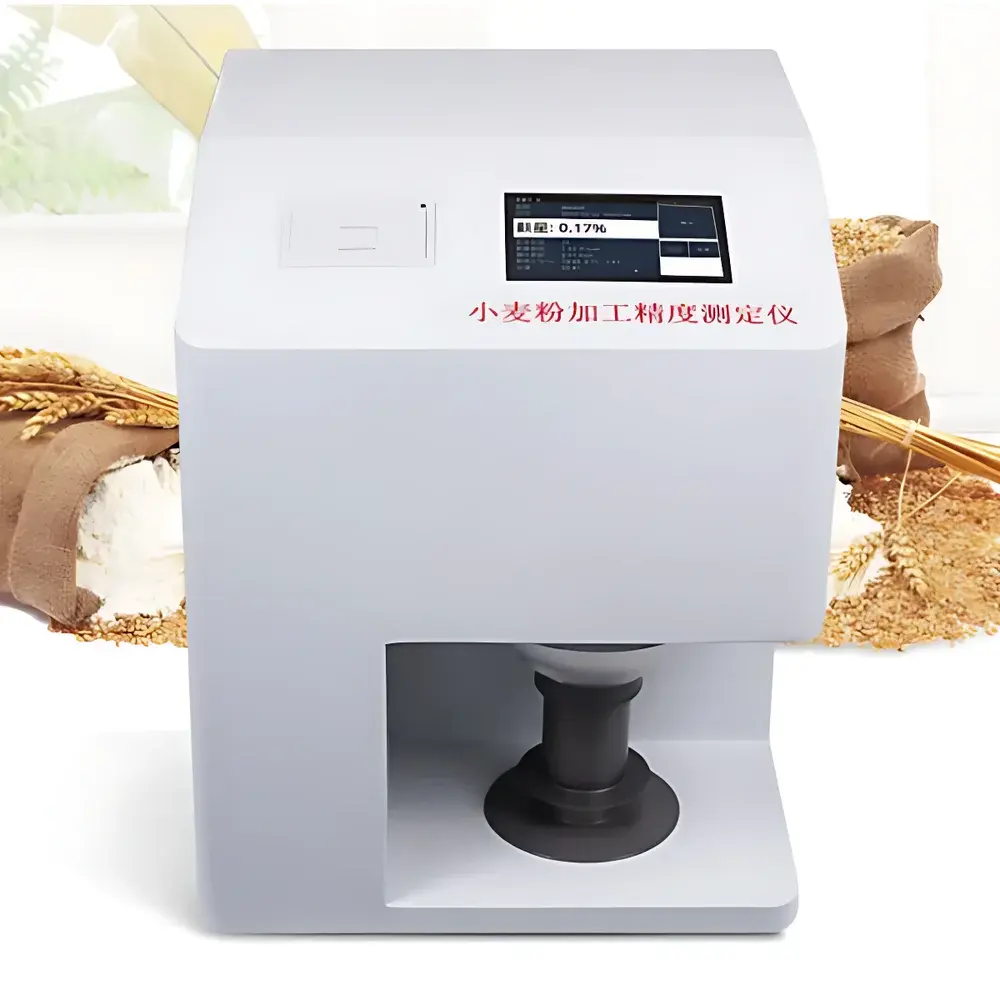
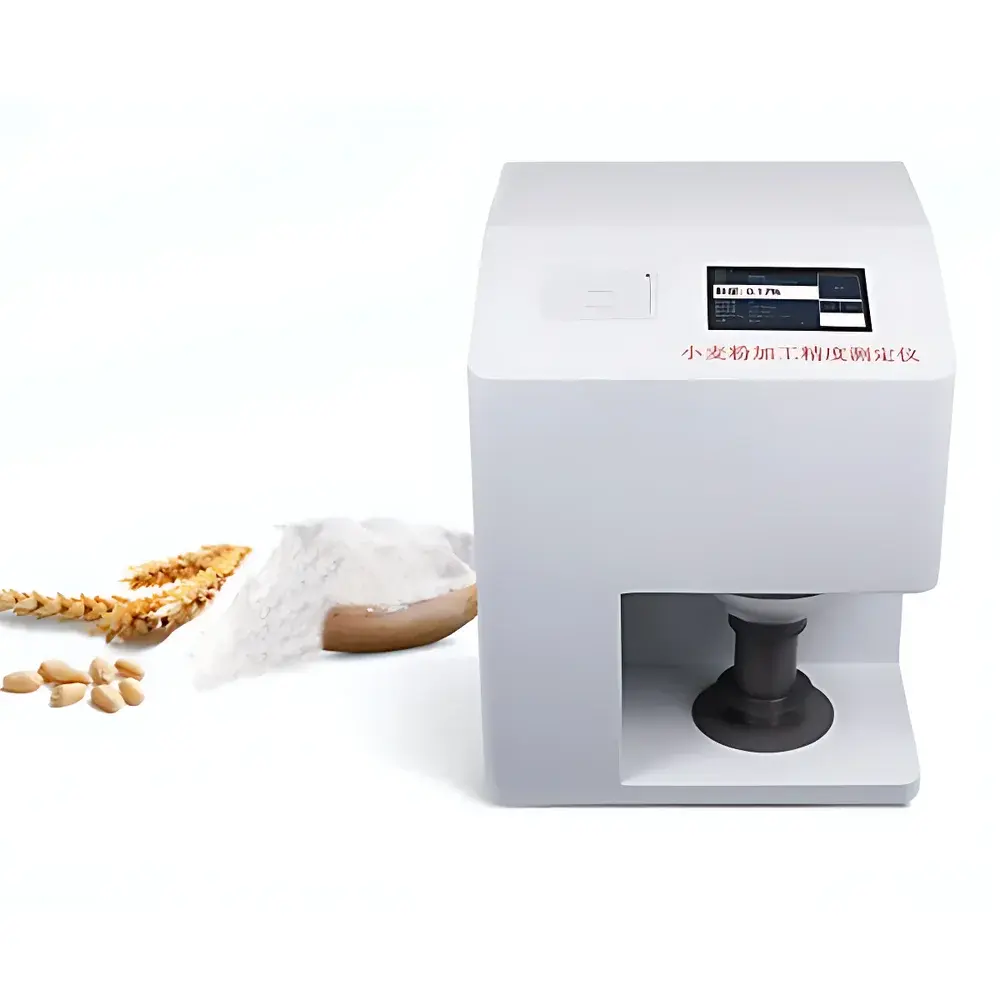
Senbe SEN582 Wheat Flour Milling Precision Analyzer
| Brand | Senbe |
|---|---|
| Origin | Jiangsu, China |
| Manufacturer Type | Direct Manufacturer |
| Model | SEN582 |
| Light Source | Simulated D65 Illuminant |
| Color Space | CIE L*a*b* |
| Bran Speck Content | Ratio of bran speck area to total sample surface area (%) |
| Whiteness | Blue-light Whiteness (Wb) |
| Display | Large LCD Touchscreen |
| Whiteness Resolution | ≤0.1 |
| Bran Speck Repeatability | Relative difference between duplicate measurements < 10% of arithmetic mean |
| Colorimetric Repeatability | ΔE*ab ≤ 0.5 |
| Preheat Time | 30 min |
| Power Supply | 220 V ±10%, 50 Hz |
| Operating Temperature | 0–40 °C |
| Relative Humidity | ≤85% RH |
| Compliance | GB/T 27628–2011, Verified by National Grain Quality Inspection Center |
Overview
The Senbe SEN582 Wheat Flour Milling Precision Analyzer is an optical metrology instrument engineered for objective, quantitative assessment of milling refinement in wheat flour—specifically targeting color uniformity, bran speck contamination, and whiteness. It operates on the principle of standardized reflectance photometry under controlled D65 illuminant conditions, aligned with CIE 1976 L*a*b* color space conventions. Unlike subjective visual grading, this system digitizes critical quality attributes—including L* (lightness), a* (red–green axis), b* (yellow–blue axis), and blue-light whiteness (Wb)—to deliver traceable, operator-independent results. The analyzer captures high-resolution surface images of flour samples placed on a calibrated measurement stage, then applies image segmentation algorithms to identify and quantify bran specks based on chromatic and morphological thresholds. Its design satisfies the metrological rigor required for routine QC in flour mills, grain inspection laboratories, and regulatory testing centers operating under national grain quality frameworks.
Key Features
- Optically stable D65-simulated illumination source with spectral power distribution compliant with ISO/CIE standards for colorimetry.
- Integrated dual-mode analysis: simultaneous CIE L*a*b* colorimetry and automated bran speck quantification (area ratio %, speck count per unit area, average speck size).
- Large-format capacitive touchscreen interface with intuitive workflow navigation, real-time preview, and on-device result validation.
- Built-in thermal printer supporting GLP-compliant output: date/time stamp, sample ID, operator code, raw metrics (L*, a*, b*, Wb, bran area %), and ΔE*ab deviation from reference.
- Preheat stabilization protocol (30 min) ensures thermal equilibrium of optical path and sensor array, minimizing drift during extended batch runs.
- Whiteness resolution ≤0.1 Wb units and colorimetric repeatability ΔE*ab ≤0.5 meet the precision thresholds defined in GB/T 27628–2011 for inter-laboratory comparability.
Sample Compatibility & Compliance
The SEN582 accepts standard 50 mm diameter circular flour samples compacted to consistent thickness (per GB/T 27628–2011 Section 6.2). It supports both milled soft and hard wheat flours, including bleached and unbleached grades, without recalibration. All measurement protocols conform to the mandatory requirements of GB/T 27628–2011 “Grain and Oil Inspection – Determination of Color and Bran Specks in Wheat Flour”, including sampling preparation, illumination geometry (0°/d diffuse), and data reporting format. The instrument has undergone formal applicability verification by the National Grain Quality Inspection and Testing Center (China National Grain Administration), confirming alignment with certified reference materials for bran speck content and color standards. While not FDA 21 CFR Part 11–validated out-of-the-box, its audit trail functionality (timestamped printouts, non-editable raw values) supports GMP-aligned documentation practices in export-oriented milling facilities.
Software & Data Management
The embedded firmware implements deterministic image acquisition and pixel-based threshold segmentation—no cloud dependency or third-party software required. Measurement data are stored locally in non-volatile memory with timestamp, operator ID (manually entered), and sample batch code. Export options include USB-stick transfer of CSV files containing full parameter sets (L*, a*, b*, Wb, bran area %, speck count/mm², ΔE*ab vs. calibration standard). No proprietary drivers or OS-specific utilities are needed; exported datasets integrate natively with LIMS platforms, Excel-based QC dashboards, or statistical process control (SPC) software. Firmware updates are delivered via encrypted USB firmware image—no internet connection required, preserving network isolation in regulated environments.
Applications
- Quality assurance in commercial flour mills: monitoring consistency across grinding passes, sifter efficiency, and bleaching efficacy.
- Regulatory compliance testing for domestic and export shipments subject to grain quality specifications (e.g., China’s Grain Circulation Regulations, ASEAN food import requirements).
- R&D evaluation of new wheat varieties: correlating kernel hardness, starch damage, and bran fragmentation behavior with final flour appearance metrics.
- Supplier qualification: objective benchmarking of incoming flour lots against contractual milling precision thresholds (e.g., ≤0.8% bran area, L* ≥92.5).
- Training and standardization: replacing subjective grader panels with reproducible digital references in laboratory proficiency programs.
FAQ
Does the SEN582 require annual recalibration by an external service provider?
No. The instrument includes factory-traceable ceramic white calibration tile and integrated self-diagnostic routines. Users perform daily verification using the supplied tile; full recalibration is only necessary if physical impact, prolonged storage outside 0–40 °C, or optical component replacement occurs.
Can it measure wholemeal or high-extraction flours with high bran content?
Yes—though GB/T 27628–2011 defines its primary scope as refined flour (extraction rate ≤75%), the SEN582’s dynamic range accommodates bran area percentages up to 8.5%. Algorithm thresholds may be adjusted within firmware for research-grade applications beyond standard compliance.
Is the thermal printer compatible with label stock or only plain paper?
The integrated printer uses standard 58 mm thermal paper rolls (no adhesive backing). Custom labeling requires external thermal label printers interfaced via USB export.
How does the system handle ambient lighting interference during operation?
The measurement chamber is fully enclosed with light-tight gasketing. Internal D65 illumination dominates ambient contributions; no darkroom installation is required—even under typical laboratory fluorescent lighting.
What is the minimum sample mass required for valid measurement?
Per GB/T 27628–2011, 10.0 g of flour is compacted into a 50 mm-diameter mold at 10 kPa pressure. Sample preparation tools (mold, compaction plunger, pressure gauge) are included with the instrument.
Related Products






