
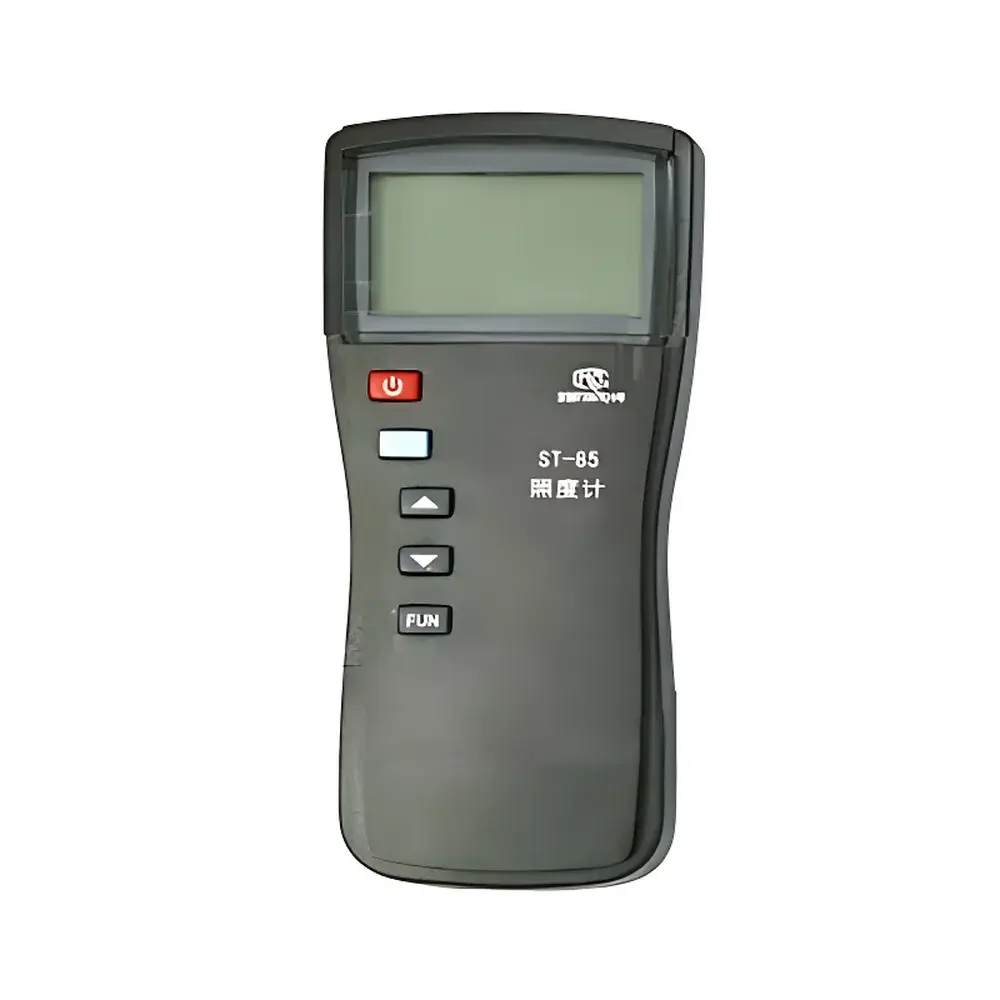
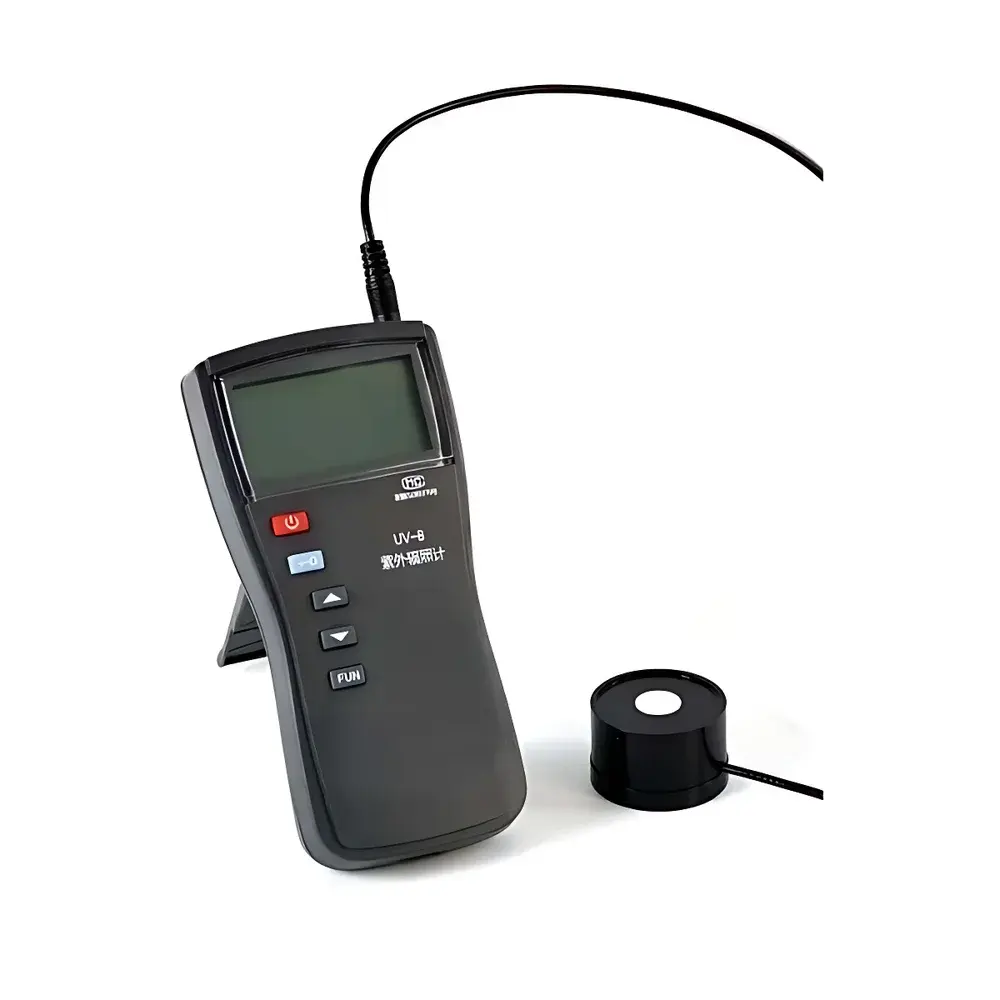
Senbe ST-85 Digital Illuminance Meter with Silicon Photocell Sensor
| Brand | Senbe |
|---|---|
| Origin | Jiangsu, China |
| Manufacturer Type | Manufacturer |
| Country of Origin | China |
| Model | ST-85 |
| Instrument Type | Silicon Photocell-Based Illuminance Meter |
| Measurement Range | 0.1–199.9 × 10³ lx |
| Relative Indication Error | < ±4.0% |
| V(λ) Matching Error (f₁) | < 6.0% |
| Cosine Correction Error (f₂) | < 4.0% |
| Nonlinearity Error (f₃) | < ±1.0% |
| Range Switching Error (f₄) | < ±1.0% |
| Fatigue Error (f₅) | < −0.5% |
| Response Time | < 1 s |
| Operating Temperature | 0–40 °C |
| Operating Humidity | < 85% RH |
| Dimensions | 160 mm × 78 mm × 43 mm |
| Weight | 0.2 kg |
| Power Supply | 6F22 9 V alkaline battery (non-rechargeable) |
| Total Power Consumption | < 0.1 VA |
| Display | Backlit LCD |
| Range Selection | Manual/Automatic |
| Output Interface | USB digital output with redundant power capability |
| Additional Functions | Data hold, low-battery indicator, auto power-off delay, tactile key operation with audible beep feedback |
Overview
The Senbe ST-85 is a precision digital illuminance meter engineered for reliable, repeatable measurement of visible light intensity in photometric units (lux). It operates on the fundamental principle of photopic spectral response—utilizing a calibrated silicon photocell sensor whose responsivity closely approximates the CIE standard luminosity function V(λ). This enables traceable quantification of illuminance from diverse artificial and natural light sources—including incandescent, fluorescent, high-pressure sodium (HPS), metal halide, and solid-state LED lighting—under real-world environmental conditions. Designed with industrial-grade SMT (Surface Mount Technology) assembly and ultra-low-power digital ICs, the ST-85 delivers stable performance across extended operational cycles without thermal drift or signal saturation. Its streamlined ergonomic housing ensures secure handheld use during field surveys, while rigorous factory calibration—covering spectral mismatch (f₁), cosine angular response (f₂), linearity (f₃), range transition fidelity (f₄), and long-term photodiode fatigue (f₅)—ensures compliance with international photometric metrology expectations for Class L (general-purpose) illuminance instrumentation per ISO/CIE guidelines.
Key Features
- High-fidelity silicon photocell sensor with factory-applied V(λ)-matched spectral correction and NIST-traceable cosine diffuser for accurate angular response
- Auto-ranging measurement capability spanning 0.1 to 199,900 lux with resolution down to 0.1 lx in lowest range
- Backlit LCD display with intuitive icon-driven interface and real-time unit indication (lx)
- Manual and automatic range selection modes for controlled data acquisition workflows
- Digital USB output supporting direct connection to PCs or data loggers; includes redundant power path to maintain sensor bias during host communication
- Low-battery warning indicator and programmable auto-shutdown (delayed by user-selectable timeout)
- Data hold function for freezing instantaneous readings during transient or hard-to-access measurements
- Tactile membrane keypad with integrated audible feedback (beep) for positive actuation confirmation
- Robust mechanical design: IP54-rated enclosure (dust-protected, splash-resistant), lightweight (200 g), and compact footprint (160 × 78 × 43 mm)
Sample Compatibility & Compliance
The ST-85 is validated for use with broadband visible light sources emitting between 380 nm and 780 nm, including continuous-spectrum (incandescent), line-emission (fluorescent, HPS), and multi-peak (white LED) emitters. Its optical head meets ANSI/IESNA RP-27.1-15 requirements for photometric sensor classification and conforms to the essential metrological criteria defined in CIE Publication 69 and ISO 50001 Annex D for lighting energy audits. While not certified to IEC 61000-4 electromagnetic immunity standards out-of-box, its analog front-end architecture minimizes susceptibility to common-mode noise in industrial settings. The instrument supports GLP-compliant documentation through timestamped USB data export and is suitable for routine verification under ISO/IEC 17025-accredited laboratory quality systems when operated within specified environmental limits (0–40 °C, <85% RH non-condensing).
Software & Data Management
The ST-85 interfaces natively with Windows-based configuration and logging software via standard USB CDC (Communication Device Class) protocol—requiring no proprietary drivers. Raw illuminance values are transmitted as ASCII-encoded floating-point strings at configurable intervals (1–10 Hz), enabling integration into LabVIEW, MATLAB, Python (pySerial), or custom SCADA environments. All exported datasets include embedded metadata: UTC timestamp, active range index, battery status flag, and error code (e.g., overload, under-range, sensor fault). Audit trails are preserved through sequential file naming and optional CSV header annotations compliant with FDA 21 CFR Part 11 electronic record requirements when paired with validated third-party acquisition platforms.
Applications
- Lighting system commissioning and maintenance in commercial buildings, hospitals, schools, and manufacturing facilities
- Photobiological safety assessments per IEC 62471 for LED lighting products
- Agricultural photoperiod monitoring in greenhouses and vertical farms
- Environmental health and safety (EHS) evaluations of workplace illumination against OSHA 1910.303 and EN 12464-1 thresholds
- Research-grade luminance mapping in optics labs and material reflectance studies
- Calibration transfer and cross-checking of integrating sphere reference standards
- Field validation of daylight harvesting control systems and smart lighting networks
FAQ
What is the spectral response accuracy of the ST-85 relative to the CIE V(λ) curve?
The sensor’s f₁ matching error is guaranteed <6.0%, verified per CIE S 010/E:2022 using calibrated monochromator-based spectral irradiance sources.
Does the ST-85 support external trigger synchronization for pulsed light measurements?
No—this model lacks hardware trigger input; it is optimized for steady-state and slowly varying illuminance signals (response time <1 s).
Can the USB interface supply power to the instrument during data logging?
Yes—the USB port provides redundant bias voltage to sustain sensor operation and memory retention even if the internal 9 V battery depletes during prolonged transfers.
Is firmware upgrade capability available?
Firmware is factory-programmed and read-only; no field-upgrade path is provided to preserve metrological integrity and regulatory traceability.
What calibration documentation is supplied with each unit?
Each ST-85 ships with a manufacturer’s calibration certificate listing measured f₁–f₅ errors, serial-numbered reference standard IDs, and environmental test conditions—valid for 12 months from date of issue.



