
Senis SENM3Dx Triaxial CMOS Hall Magnetic Field Sensor IC
| Brand | Auniontech (Hao Liang Optoelectronics) |
|---|---|
| Origin | Shanghai, China |
| Manufacturer Type | Authorized Distributor |
| Product Category | Domestic |
| Model Designation | Gaussmeter / Teslameter |
| Pricing | Available Upon Request |
Overview
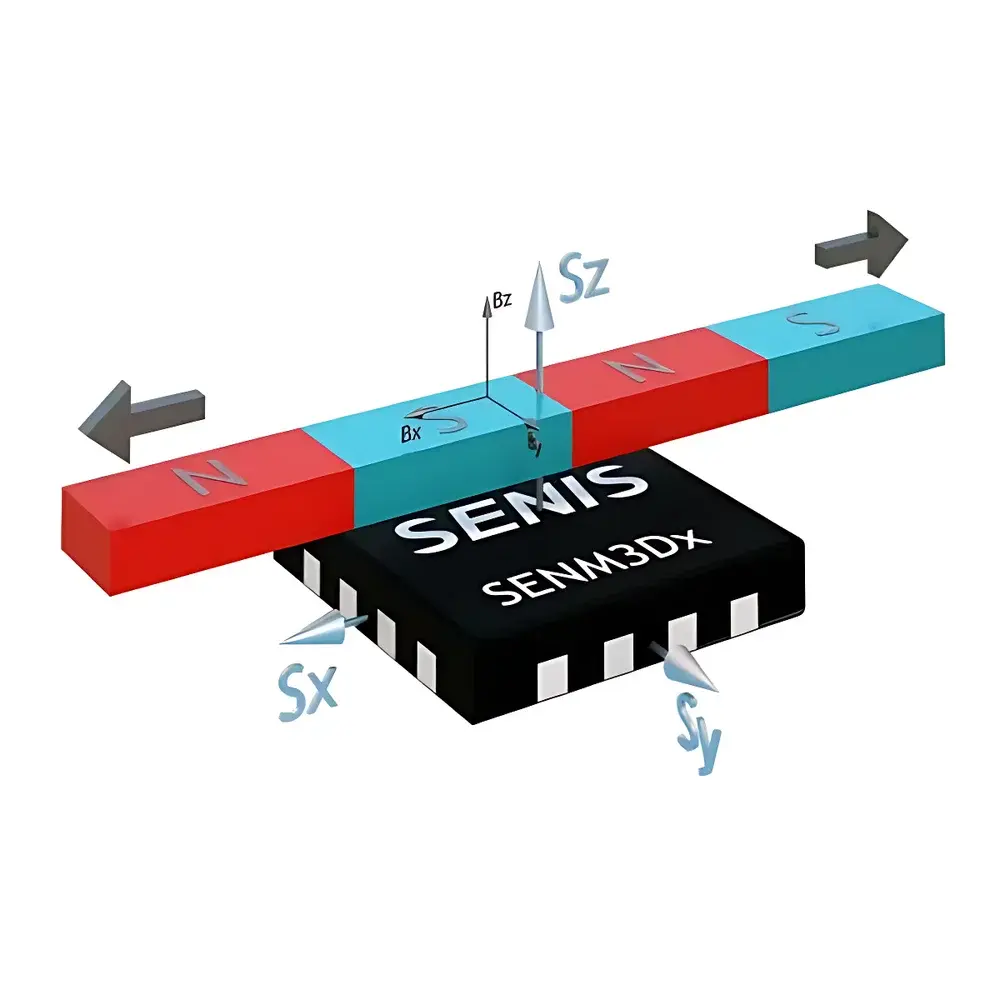
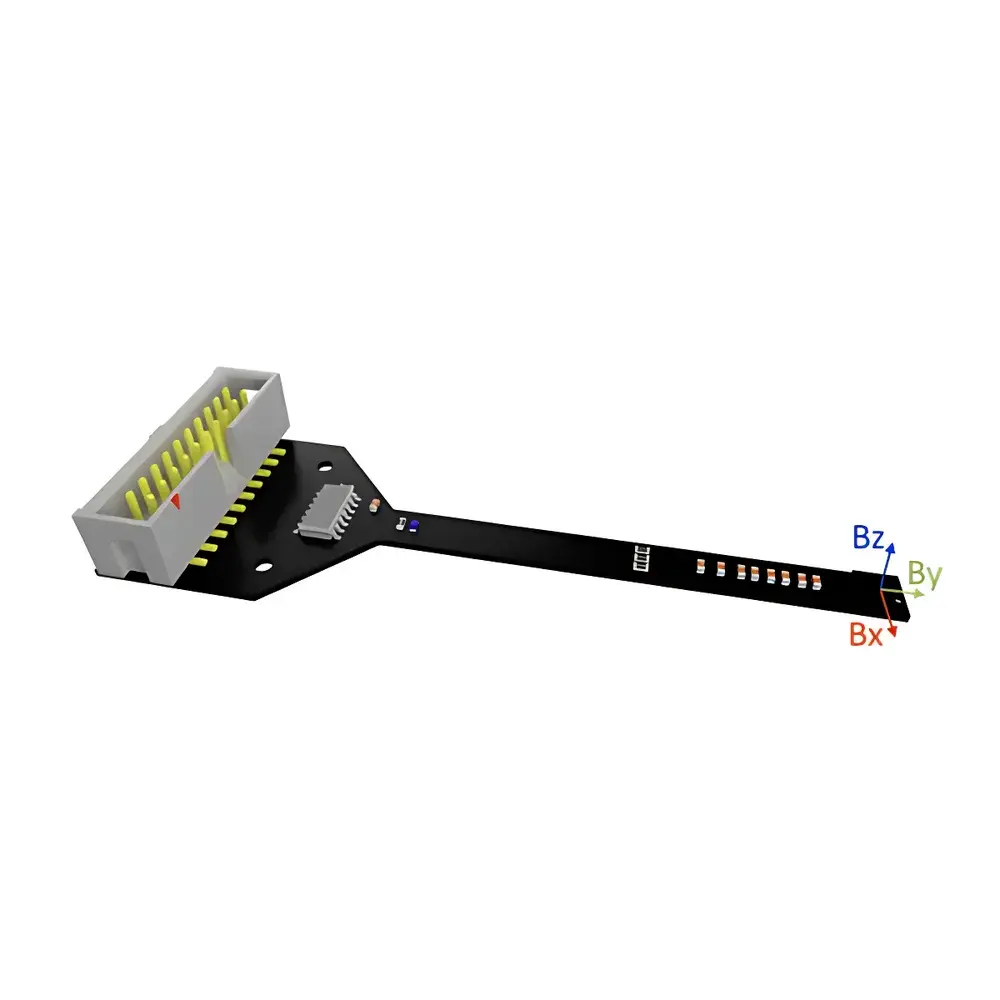
The Senis SENM3Dx is a monolithic, triaxial CMOS Hall-effect magnetic field sensor IC engineered for high-fidelity vector magnetometry in research-grade and industrial metrology applications. Unlike conventional single-axis or stacked multi-chip solutions, the SENM3Dx integrates three mutually orthogonal Hall sensing elements—two vertical and one horizontal—within a single 100 µm × 100 µm die area, enabling simultaneous, time-synchronized acquisition of all three Cartesian magnetic flux density components (Bx, By, Bz) at a common spatial point. This architecture eliminates inter-sensor misalignment errors and ensures intrinsic orthogonality with angular deviation < 0.1°, a direct result of lithographic precision enabled by advanced CMOS process control. The sensor operates on the principle of the planar and vertical Hall effect, enhanced by rotating current biasing to suppress offset drift, 1/f noise, and planar Hall artifacts. With analog bandwidth spanning DC to 300 kHz, it supports both static field mapping and dynamic magnetic event capture—including pulsed fields, rotating machinery signatures, and transient eddy current responses. Its field-sensitive volume (FSV) is confined to 100 µm × 100 µm × 10 µm, positioned ~750 µm beneath the package surface, delivering exceptional spatial resolution critical for micro-magnetic characterization and near-field scanning.
Key Features
- Monolithic triaxial CMOS Hall sensor with integrated orthogonal element array (1 horizontal + 2 vertical)
- Field-sensitive volume: 100 µm × 100 µm × 10 µm; surface proximity: ~750 µm below package top
- Magnetic resolution: ≤1 µT (RMS, full-scale dependent); angular orthogonality error < 0.1°
- Configurable measurement modes: 1D, 2D, or full 3D vector output
- Six selectable full-scale ranges: ±40 mT, ±100 mT, ±400 mT, ±1 T, ±2 T, ±4 T
- Analog bandwidth: DC to 300 kHz (−3 dB), suitable for transient and AC field analysis
- On-chip temperature sensor (±0.5 °C accuracy) co-located with FSV for thermal compensation
- Integrated calibration engine: real-time correction of sensitivity, offset, noise, and thermal drift
- Flexible output interfaces: differential analog (±2 V FS), PWM (1 MHz carrier), and SPI (up to 10 Mbps, 16-bit data + status)
- Programmable digital comparator with user-defined thresholds per axis
Sample Compatibility & Compliance
The SENM3Dx is designed for integration into OEM instrumentation platforms requiring traceable, miniaturized magnetic field sensing—particularly in environments where spatial fidelity, thermal stability, and signal integrity are non-negotiable. It complies with JEDEC JESD47 reliability standards for integrated circuits and meets RoHS 2011/65/EU and REACH (EC 1907/2006) material restrictions. While not certified as a standalone measuring instrument per IEC 61000-4-x EMC standards, its low-noise analog front-end and differential signaling support compliance when embedded in properly shielded host systems. For metrological traceability, the sensor’s on-chip calibration coefficients are stored in OTP memory and can be referenced against NIST-traceable Helmholtz coil calibrations during system-level validation. It is widely deployed in GLP-compliant labs for magnetic characterization of permanent magnets, soft magnetic materials, and current-carrying conductors under ISO 5725 (accuracy of measurement methods) and ASTM A977/A977M (magnetic property testing of soft magnetic materials).
Software & Data Management
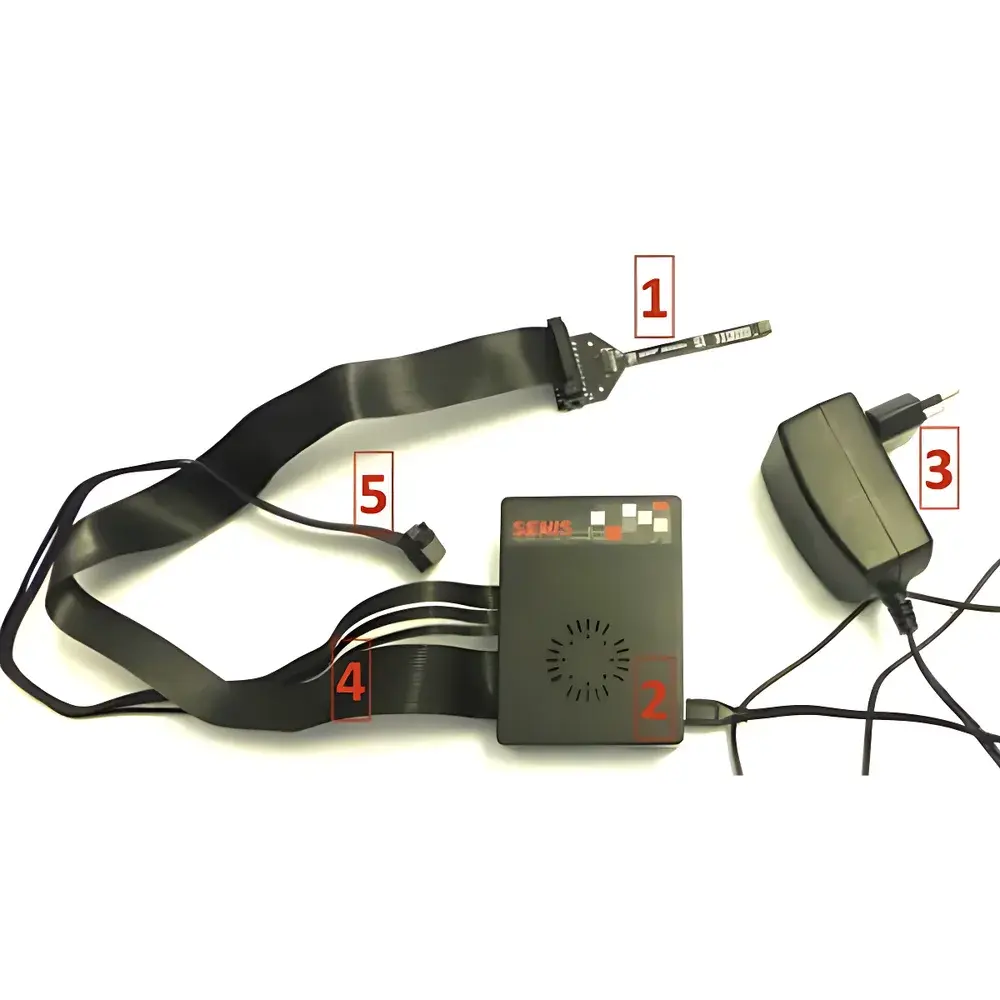
The SENM3Dx evaluation kit includes open-source firmware libraries (C/C++ and Python) supporting SPI register configuration, real-time streaming, and batch logging. Host-side software enables synchronized multi-sensor array operation, 3D field vector visualization (quiver plots, field line tracing), and automated calibration workflows. All raw and compensated data streams include embedded timestamps and temperature metadata, facilitating post-acquisition thermal drift correction. For regulated environments, optional firmware extensions support audit trails, user access control, and 21 CFR Part 11–compliant electronic signatures when deployed within validated instrument control systems. Data export formats include CSV, HDF5, and MATLAB .mat—ensuring compatibility with MATLAB, Python (NumPy/SciPy), and LabVIEW-based analysis pipelines.
Applications
- High-resolution 3D magnetic field mapping in magnet design, magnetic shielding validation, and stray field assessment
- Micro-position sensing in precision motion stages, robotic end-effectors, and MEMS-based inertial units
- Non-contact current sensing via Ampere’s law (with known conductor geometry and distance)
- Multi-probe magnetic anomaly detection arrays for NDT of ferromagnetic structures
- Reference-grade probe heads for benchtop gaussmeters and automated test equipment (ATE)
- Dynamic field monitoring in electric motor R&D, wireless power transfer systems, and MRI fringe field studies
- Calibration reference sensors for magnetic field simulators and Helmholtz coil systems
FAQ
What is the typical total harmonic distortion (THD) across the full operating bandwidth?
THD is ≤0.05% at 1 kHz and full scale, measured with 100 mT range; increases marginally at higher frequencies but remains <0.3% up to 300 kHz.
Does the sensor support automatic gain switching between ranges during operation?
Yes—SPI-controlled range switching occurs in <10 µs with no output glitch; auto-ranging logic is implemented externally via host MCU.
Is the on-chip temperature sensor calibrated against external references?
Yes—factory-calibrated to ±0.5 °C over −40 °C to +125 °C; calibration coefficients stored in OTP memory and accessible via SPI.
Can multiple SENM3Dx sensors be synchronized for phase-coherent array measurements?
Yes—external trigger input (TRIG_IN) enables hardware synchronization across up to 32 nodes with sub-microsecond timing alignment.
What is the maximum junction temperature before thermal shutdown activates?
Thermal protection engages at 150 °C junction temperature; normal continuous operation is rated up to 125 °C ambient (derated per PCB thermal design).



