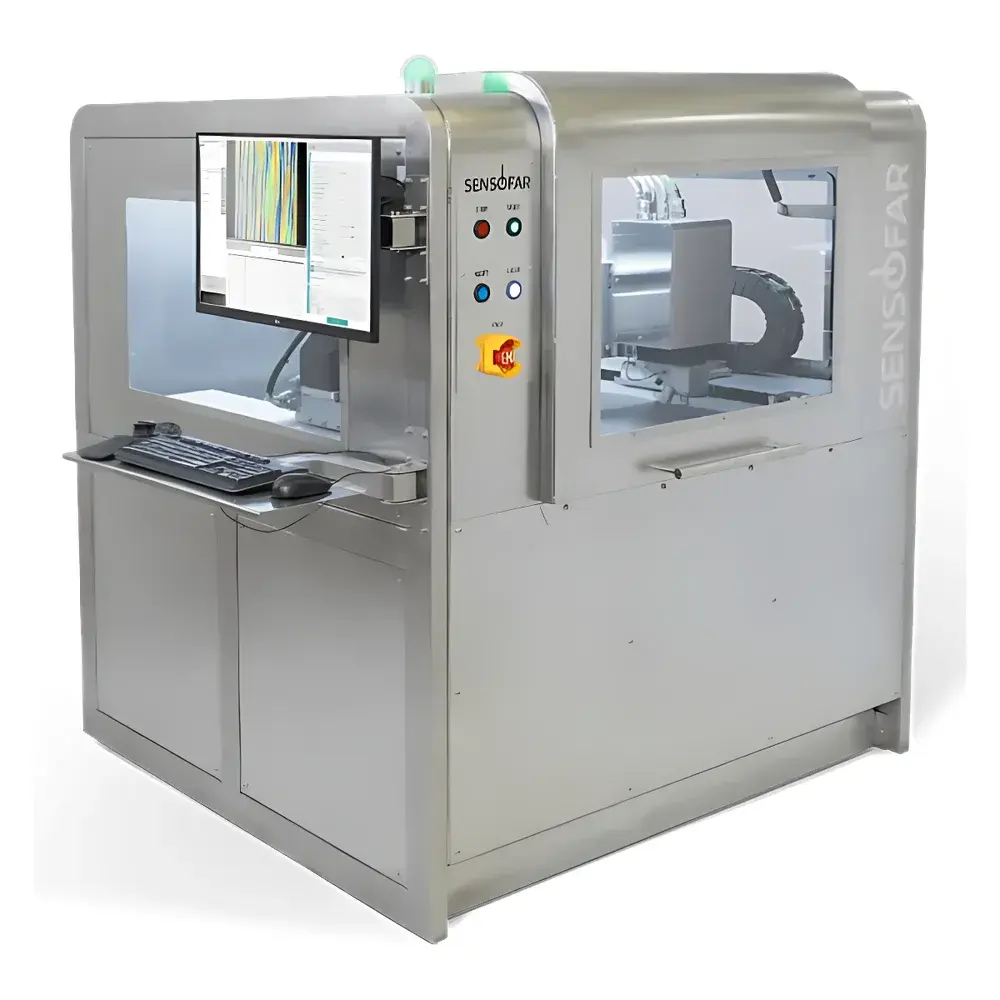
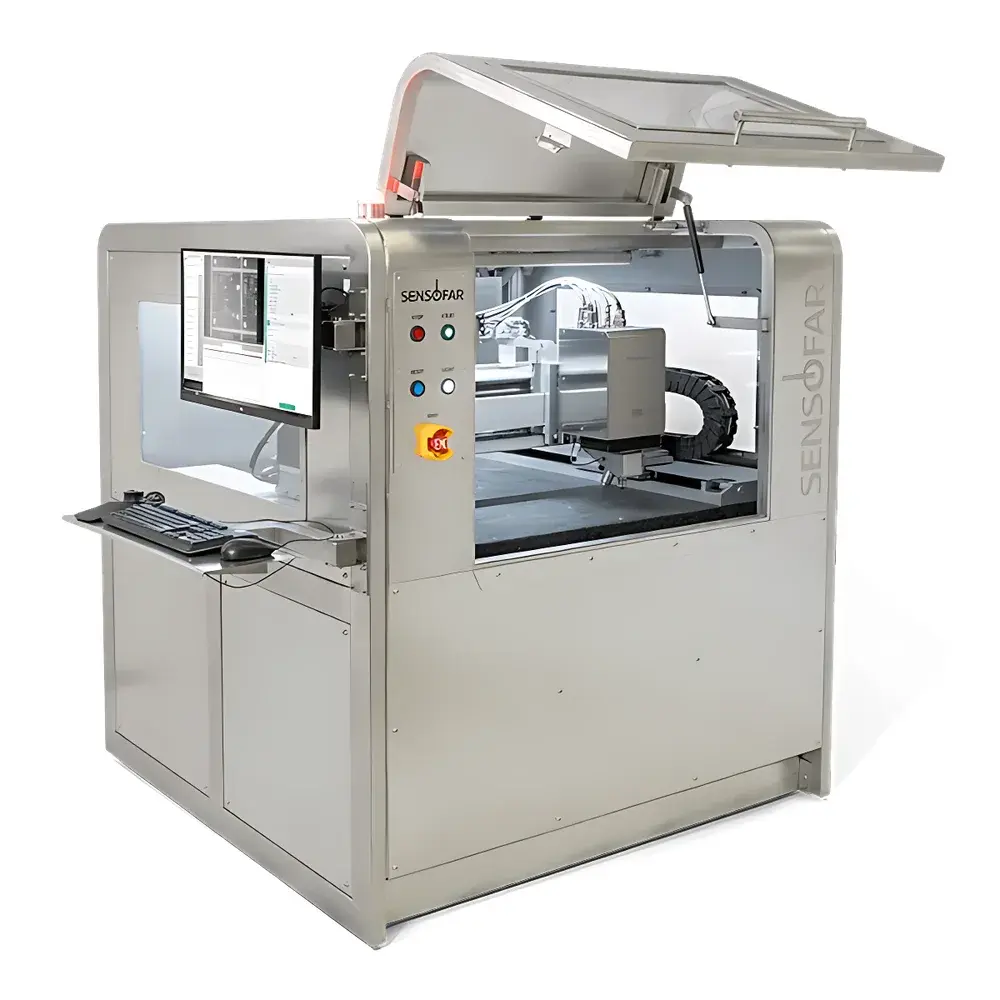
Sensofar S neox Grand Format Non-Contact 3D Profilometer
| Brand | Sensofar |
|---|---|
| Origin | Spain |
| Model | S neox Grand Format |
| Measurement Principle | White-Light Interferometry |
| Sample Stage Travel | 600 × 600 mm |
| XY Scanning Speed | Up to 1 m/s |
| Stage Type | Closed-Loop龙门 (Gantry) |
| Optical Modalities | Interferometry, Confocal, AI-Powered Multi-Focal Stack Fusion |
| Cleanroom Compatibility | ISO Class 1 |
| Housing Material | Stainless Steel |
| Software Suite | SensoSCAN (acquisition), SensoPRO (automated analysis), SensoVIEW (advanced metrology) |
Overview
The Sensofar S neox Grand Format is a high-precision, non-contact 3D profilometer engineered for large-area surface topography and geometric metrology in demanding industrial environments—including semiconductor wafer inspection, advanced packaging, MEMS fabrication, and consumer electronics manufacturing. Based on white-light interferometry (WLI), the system delivers sub-nanometer vertical resolution and traceable height measurements across macro-scale samples up to 600 × 600 mm. Its closed-loop gantry architecture ensures mechanical stability and positional repeatability independent of sample mass—eliminating thermal drift and stage sag common in open-frame systems. Unlike conventional profilometers limited to single-mode operation, the S neox Grand Format integrates three complementary optical measurement modalities—phase-shifting interferometry (PSI), vertical scanning interferometry (VSI), and confocal microscopy—intelligently selected or fused via AI-driven multi-focal stack alignment. This tri-modal adaptability enables robust characterization of diverse surface types: ultra-flat silicon wafers, patterned dielectric stacks, rough machined metals, and transparent or semi-transparent thin films.
Key Features
- 600 × 600 mm motorized XY stage with closed-loop feedback control, supporting payloads >50 kg without performance degradation
- Maximum scanning speed of 1 m/s—enabling rapid full-field acquisition for high-throughput inline quality control
- S neox Cleanroom measurement head certified to ISO Class 1; constructed entirely from electropolished stainless steel to minimize particle shedding
- Tri-modal optical engine: simultaneous support for WLI (for smooth surfaces), confocal (for high-slope or low-reflectivity features), and AI-enhanced multi-focus fusion (for complex topographies spanning multiple depth-of-field layers)
- Integrated vibration isolation platform compatible with standard cleanroom floor specifications (e.g., SEMI F47-compliant)
- Modular illumination: adjustable LED-based white-light source with selectable coherence length optimization per measurement mode
Sample Compatibility & Compliance
The S neox Grand Format accommodates substrates ranging from 100 mm wafers to full 12-inch (300 mm) wafers, reticles, display panels, and PCB assemblies. Its non-contact nature eliminates risk of surface damage during measurement—critical for fragile low-k dielectrics, etched microstructures, and coated optics. The system complies with ISO 25178-2 (areal surface texture parameters), ISO 10360-5 (coordinate measuring machine acceptance testing), and ASTM E2927-18 (standard test method for 3D surface topography using interferometric microscopy). All measurement data logs include embedded metadata required for GLP/GMP audit trails—including operator ID, timestamp, environmental conditions (optional sensor integration), and instrument calibration status. Optional 21 CFR Part 11 compliance packages are available for regulated medical device and pharmaceutical packaging applications.
Software & Data Management
Acquisition, automation, and analysis are unified under Sensofar’s native software suite. SensoSCAN provides intuitive workflow configuration, real-time preview, and scriptable measurement sequencing—including grid-based tile stitching, auto-focus routines, and conditional trigger logic based on surface reflectivity or slope thresholds. SensoPRO extends functionality through a plugin architecture compliant with .NET Framework standards; pre-certified plugins support automated defect classification (e.g., pit/scratch detection per SEMI D32), step-height verification against GD&T callouts, and statistical process control (SPC) charting aligned with MSA guidelines. SensoVIEW serves as the metrology-grade analysis environment: it implements ISO 25178-6–compliant filtering (Gaussian, spline, robust polynomial), supports custom parameter derivation via Python scripting, and exports traceable reports in PDF/A-1b or XML formats compliant with ASME Y14.5 and ISO 1101 geometric tolerancing frameworks.
Applications
- Semiconductor front-end: trench depth uniformity, CMP endpoint monitoring, gate oxide thickness mapping
- Advanced packaging: solder bump coplanarity, underfill void detection, RDL line width/height metrology
- Micro-optics: lenslet array form error, diffractive optical element (DOE) phase profile validation
- Consumer electronics: glass cover lens scratch quantification, haptic button actuation surface flatness, AR/VR waveguide roughness assessment
- Automotive sensors: MEMS mirror flatness, LiDAR emitter window transmission surface integrity
FAQ
What surface roughness parameters does the system compute in accordance with ISO 25178?
It calculates all primary areal parameters including Sa, Sq, Sz, Ssk, Sku, Sdr, and functional parameters such as Spc, Vmp, Vmc, and Vvv—each traceable to NIST-traceable reference standards.
Can the system perform automated pass/fail inspection against GD&T specifications?
Yes—via SensoPRO’s GD&T plugin, which imports STEP AP242 files, extracts nominal geometry, computes deviations (e.g., flatness, parallelism, position), and generates SPC-ready summary statistics.
Is remote calibration and maintenance supported?
The system supports secure remote diagnostics via TLS-encrypted VNC; annual calibration services include on-site verification against NPL or PTB traceable artifacts and issuance of ISO/IEC 17025-accredited certificates.
How is data integrity ensured during long-duration batch measurements?
All acquisitions generate SHA-256 checksums; raw interferograms and processed datasets are stored in hierarchical data format (HDF5) with embedded provenance metadata, enabling full reproducibility and forensic audit capability.