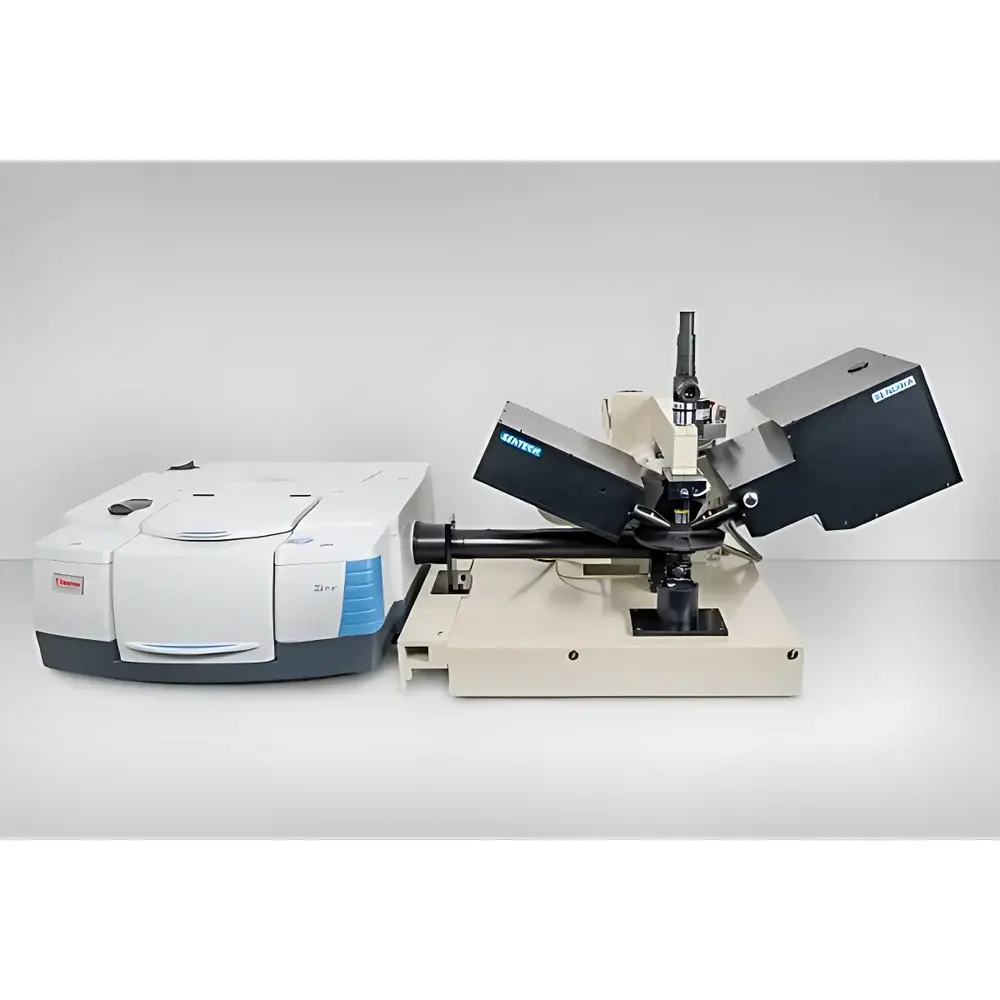
SENTECH SENDIRA FTIR Spectroscopic Ellipsometer
| Brand | SENTECH |
|---|---|
| Origin | Germany |
| Model | SENDIRA |
| Spectral Range | 400–6,000 cm⁻¹ (1.7–25 µm) |
| Detector Options | DTGS or MCT |
| Integrated FTIR Platform | Compatible with Thermo Fisher iS50 |
| Software | SpectraRay/4 + Dedicated FTIR Control Suite |
| Optical Configuration | Purged ellipsometer optics, motorized goniometer, horizontal sample stage, auto-collimating telescope |
| Application Domain | Vibrational spectroscopic ellipsometry for thin-film metrology |
Overview
The SENTECH SENDIRA FTIR Spectroscopic Ellipsometer is a benchtop, purged ellipsometric platform engineered for quantitative vibrational spectroscopic analysis of thin films and layered structures in the mid-infrared spectral region. Unlike conventional visible/NIR ellipsometers, the SENDIRA integrates a high-performance Fourier Transform Infrared (FTIR) spectrometer—typically configured with a Thermo Fisher Scientific iS50—as its light source and detection backbone. It operates on the physical principle of polarization-modulated infrared reflection-absorption ellipsometry (PM-IRRAS-ellipsometry), where changes in the amplitude ratio (Ψ) and phase difference (Δ) of reflected p- and s-polarized IR radiation are measured across wavenumbers. These ellipsometric parameters are directly sensitive to molecular vibrational modes, enabling simultaneous extraction of film thickness, complex refractive index (n + ik), chemical composition, molecular orientation, and carrier concentration in doped semiconductors. The instrument’s spectral coverage from 400 to 6,000 cm⁻¹ (1.7–25 µm) encompasses fundamental stretching, bending, and lattice vibration bands critical for dielectrics (e.g., SiO₂, SiNₓ), transparent conductive oxides (TCOs), organic semiconductors (e.g., P3HT, PTB7), and 2D materials.
Key Features
- Full FTIR-based spectroscopic ellipsometry with native wavenumber resolution down to 0.5 cm⁻¹ (configurable), optimized for vibrational mode discrimination.
- Integrated purge system maintaining <10 ppm H₂O/CO₂ in optical path—essential for minimizing atmospheric absorption interference in the IR fingerprint region.
- Computer-controlled motorized goniometer enabling precise incidence angle selection (typically 45°–75°) with ±0.01° repeatability, critical for depth-sensitive multilayer modeling.
- Horizontal sample stage accommodating wafers up to 200 mm diameter; compatible with vacuum chuck or thermal stage add-ons for in-situ process monitoring.
- Dual-detector support: Standard DTGS for broad-band stability and signal-to-noise optimization; optional liquid-N₂-cooled MCT for enhanced sensitivity in low-absorbance spectral windows.
- Auto-collimating telescope for rapid optical alignment and beam centering—reducing setup time and operator dependency.
Sample Compatibility & Compliance
The SENDIRA supports characterization of both rigid and flexible substrates including silicon wafers, glass, sapphire, polymer foils, and metal-coated surfaces. It is routinely deployed in semiconductor fabrication environments for metrology of gate dielectrics, passivation layers, and epitaxial stacks where optical transparency in the visible range is absent but IR-active vibrations persist. The system complies with ISO/IEC 17025 requirements for calibration traceability when used with NIST-traceable reference standards. Data acquisition and reporting workflows align with GLP and GMP documentation expectations, including full audit trails for measurement parameters, environmental logs (purge gas flow, chamber humidity), and raw interferogram storage. While not FDA 21 CFR Part 11–certified out-of-the-box, the SpectraRay/4 software architecture supports configurable electronic signatures and user access controls required for regulated environments upon customer-specific validation.
Software & Data Management
Control and analysis are performed via SENTECH’s SpectraRay/4 platform—a modular, scriptable environment supporting advanced regression modeling (e.g., Bruggeman effective medium approximation, anisotropic layer formalism) and library-assisted peak assignment. Raw interferograms and Ψ(ν), Δ(ν) spectra are stored in HDF5 format with embedded metadata (date/time, instrument ID, purge status, detector type). A dedicated FTIR control module enables synchronized aperture, mirror velocity, and apodization parameter management. Batch processing supports multi-site mapping (X-Y motorized stage optional) and time-resolved studies (e.g., thermal annealing, gas exposure). Export formats include CSV, XML, and ASTM E2983-compliant spectral exchange files for cross-platform interoperability with third-party modeling tools (e.g., WVASE, CompleteEASE).
Applications
- Thickness and optical constants of ultra-thin (<5 nm) high-k dielectrics (HfO₂, Al₂O₃) on Si, where conventional reflectometry lacks sensitivity.
- Quantification of C–H, C=O, and Si–O bond densities in plasma-enhanced atomic layer deposition (PE-ALD) films via peak area integration in ν(C–H) ~2800–3000 cm⁻¹ and ν(Si–O) ~1000–1100 cm⁻¹ regions.
- Orientation analysis of conjugated polymer chains in OPV active layers using dichroic ratio calculations from in-plane vs. out-of-plane vibrational transitions.
- Free-carrier concentration profiling in doped GaN or SiC through Drude model fitting of Reststrahlen band broadening in the far-IR.
- In-line QC of anti-reflective coatings on photovoltaic glass, leveraging rapid single-angle acquisition (<60 s per spectrum) and automated pass/fail thresholding.
FAQ
What FTIR spectrometers are officially supported?
Thermo Fisher Scientific iS50 is the reference platform; compatibility with Nicolet iS10 and Bruker Vertex series is available under custom integration agreements.
Can the SENDIRA measure buried interfaces in opaque stacks?
Yes—its IR penetration depth (up to several microns in low-absorbing matrices) and phase-sensitive detection enable reconstruction of sub-surface layer properties inaccessible to visible ellipsometry.
Is cryogenic sample cooling supported?
The base configuration includes ambient temperature operation; liquid nitrogen cryostat integration is possible via third-party stage modules with electrical feedthroughs and vacuum flange compatibility.
How is calibration maintained over long-term operation?
SPECTRA-RAY/4 includes built-in routines for daily verification using certified Si/SiO₂ reference wafers; SENTECH recommends annual factory recalibration traceable to PTB (Physikalisch-Technische Bundesanstalt).
Does the system support real-time data acquisition during dynamic processes?
Yes—time-resolved ellipsometry mode captures sequential spectra at rates up to 1 spectrum per second (depending on resolution and co-adds), suitable for monitoring thermal desorption or gas-phase reaction kinetics.