
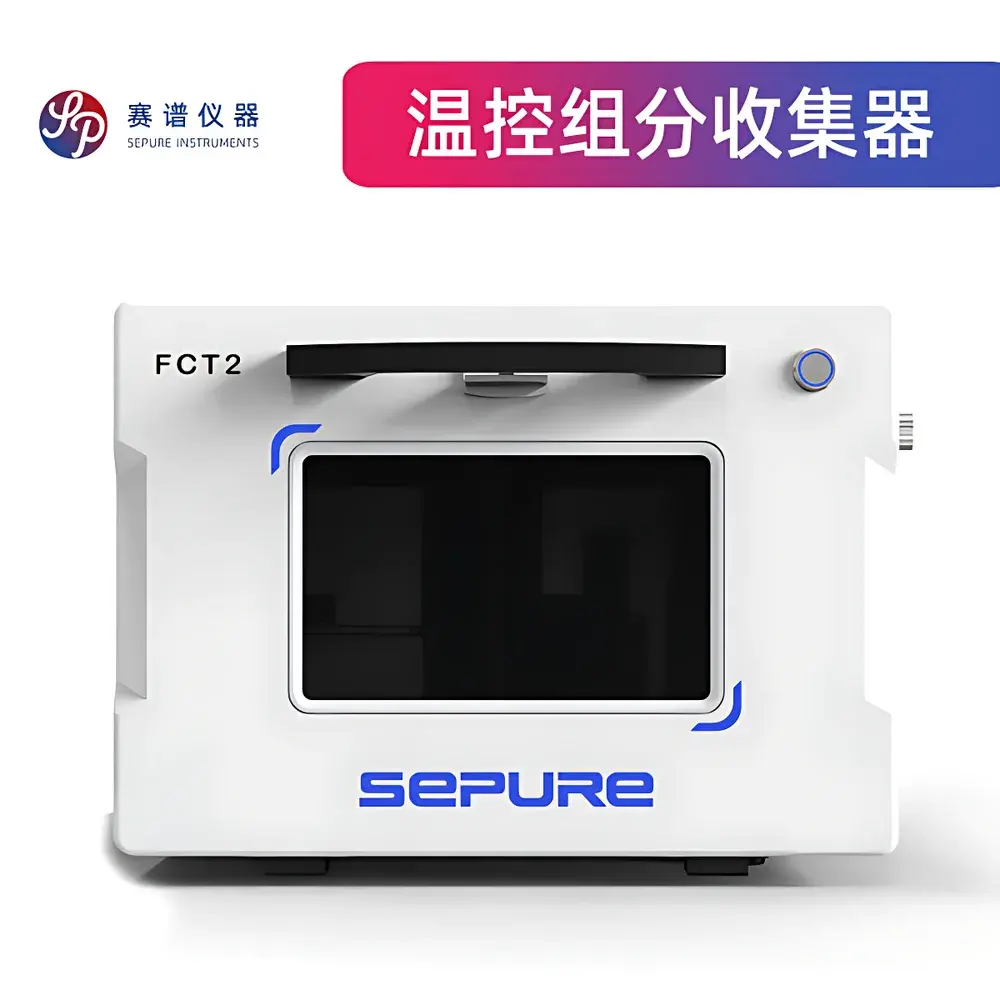
Sepure FCT2 Temperature-Controlled Fraction Collector
| Brand | Sepure Instruments |
|---|---|
| Origin | Jiangsu, China |
| Manufacturer Type | OEM Manufacturer |
| Model | FCT2 |
| Price Range | USD 42,000 – 70,000 |
| Cooling Temperature Range | 5–15 °C |
| Ambient Operating Temperature | 15–35 °C |
| Max Flow Rate | 300 mL/min |
| Liquid-Wetted Materials | PEEK, FFKM, PP, PFA |
| Tube Rack Options | 11 mm, 13 mm, 16 mm, 30 mm ID |
| Collection Modes | Fixed Volume, Trigger-Based (TTL/Analog), Cyclic, Time-Programmed (Stepwise) |
| Power Input | 100–240 VAC, 50–60 Hz |
| Output | 24 VDC / 9.2 A |
| Dimensions (W×H×D) | 390 × 310 × 502 mm |
| Weight | 16 kg |
| RFID Integration | Yes |
| Sealed Dust-Resistant Enclosure | Yes |
| Independent Refrigeration & PID Temperature Control | Yes |
Overview
The Sepure FCT2 Temperature-Controlled Fraction Collector is an engineered solution for high-fidelity fraction collection in protein purification workflows, particularly where thermal stability and sample integrity are critical. Designed to integrate seamlessly with fast protein liquid chromatography (FPLC), high-performance liquid chromatography (HPLC), and gravity-flow chromatography systems, the FCT2 employs a closed-loop refrigeration system with PID-controlled thermal regulation to maintain precise temperature setpoints between 5 °C and 15 °C—within the optimal range for preserving labile proteins, enzymes, and antibody fragments during elution and storage. Unlike ambient-only collectors, the FCT2 actively manages thermal drift across extended runs, minimizing denaturation risk and supporting reproducible downstream analysis including SDS-PAGE, mass spectrometry, and functional assays. Its modular architecture supports both benchtop and cabinet-integrated deployments, and its compact footprint (390 × 310 × 502 mm) enables efficient use of controlled-environment laboratory space without compromising accessibility or serviceability.
Key Features
- Independent thermoelectric cooling system with real-time PID feedback control, ensuring ±0.5 °C temperature stability across the full 5–15 °C operating range
- Dust-sealed enclosure compliant with IP54-rated ingress protection, preventing particulate contamination during prolonged unattended operation
- RFID-enabled tube rack recognition: automatically detects rack type (11 mm, 13 mm, 16 mm, 30 mm ID, or 96-well plate) and loads corresponding collection geometry and volume calibration profiles
- Multi-mode collection logic: fixed-volume, analog/TTL-triggered, time-programmed (with programmable step intervals), and cyclic collection—all configurable via front-panel interface or remote command protocol
- Chemically inert fluid path constructed entirely from PEEK, FFKM, polypropylene (PP), and perfluoroalkoxy (PFA), ensuring compatibility with aggressive solvents (e.g., guanidine HCl, urea, low-pH buffers) and minimizing leachables
- Ergonomic tilt-adjustable display and intuitive one-touch cooling activation reduce operator error and accelerate method setup
Sample Compatibility & Compliance
The FCT2 accommodates standard chromatographic collection formats without adapter modification, including microcentrifuge tubes, conical-bottom vials, and ANSI/SLAS-compliant 96-well plates—enabling direct compatibility with automated liquid handlers and plate readers. All wetted materials meet USP Class VI biocompatibility requirements and exhibit negligible extractables per ICH Q5E guidelines. The unit operates within ambient conditions of 15–35 °C and relative humidity ≤80% non-condensing, making it suitable for ISO Class 7 cleanroom-adjacent environments. While not certified as GMP-grade hardware, its design supports GLP/GMP-aligned practices: audit-trail-capable configuration logs (via optional Ethernet module), user-accessible calibration records, and traceable firmware versioning facilitate regulatory documentation for QC laboratories under FDA 21 CFR Part 11 and EU Annex 11 frameworks.
Software & Data Management
The FCT2 operates natively via an embedded Linux-based controller with a 5.0-inch capacitive touchscreen interface. It supports ASCII-based serial communication (RS-232/RS-485) and Modbus TCP for integration with third-party chromatography data systems (CDS), including Waters Empower, Thermo Chromeleon, and AKTA Unicorn. Collection event timestamps, temperature logs, and rack position metadata are stored internally (16 GB eMMC) with CSV export capability. Optional Ethernet connectivity enables secure remote monitoring, scheduled firmware updates, and centralized logging via Syslog or MQTT protocols—aligning with modern lab informatics infrastructure. No proprietary software license is required for basic operation; advanced scripting (e.g., conditional collection based on UV peak height) is supported through open API endpoints.
Applications
- Preparative purification of monoclonal antibodies (mAbs) and bispecific constructs requiring cold-chain continuity from elution to storage
- Native PAGE fraction collection under non-denaturing conditions where thermal aggregation must be suppressed
- Multi-step affinity chromatography workflows involving His-tag, Protein A, or ion-exchange resins with pH- or salt-sensitive eluates
- Automated library generation for structural biology (e.g., SEC-MALS fractions collected at 8 °C for subsequent cryo-EM grid preparation)
- QC release testing of therapeutic proteins, where fraction-level temperature history contributes to batch record completeness
FAQ
Does the FCT2 support integration with AKTA systems?
Yes—the FCT2 accepts TTL and analog trigger signals from GE Cytiva (now Cytiva) AKTA platforms and supports native Modbus TCP handshake for bidirectional status reporting and collection parameter synchronization.
What is the maximum allowable backpressure when using the FCT2 in-line?
The collector imposes <1 psi pressure drop at 300 mL/min flow rate with standard 1/16″ tubing; no active pressure regulation is provided, and upstream pump or column pressure must remain within system-rated limits (≤10 MPa typical for FPLC).
Can temperature calibration be performed onsite by the user?
Yes—calibration is accessible via service menu using NIST-traceable PT100 reference probes; offset adjustments are stored per sensor channel and persist across power cycles.
Is the RFID reader compatible with custom-labeled racks?
The system reads ISO 15693-compliant passive tags only; custom racks require embedding of manufacturer-coded RFID elements during fabrication—third-party unlabeled racks will default to manual geometry selection.
What maintenance is required for the refrigeration module?
No consumables or periodic refrigerant recharge is needed; the thermoelectric cooler has no moving parts and is rated for >50,000 hours MTBF. Annual verification of condensate drain integrity and heatsink dust accumulation is recommended.
Related Products




