
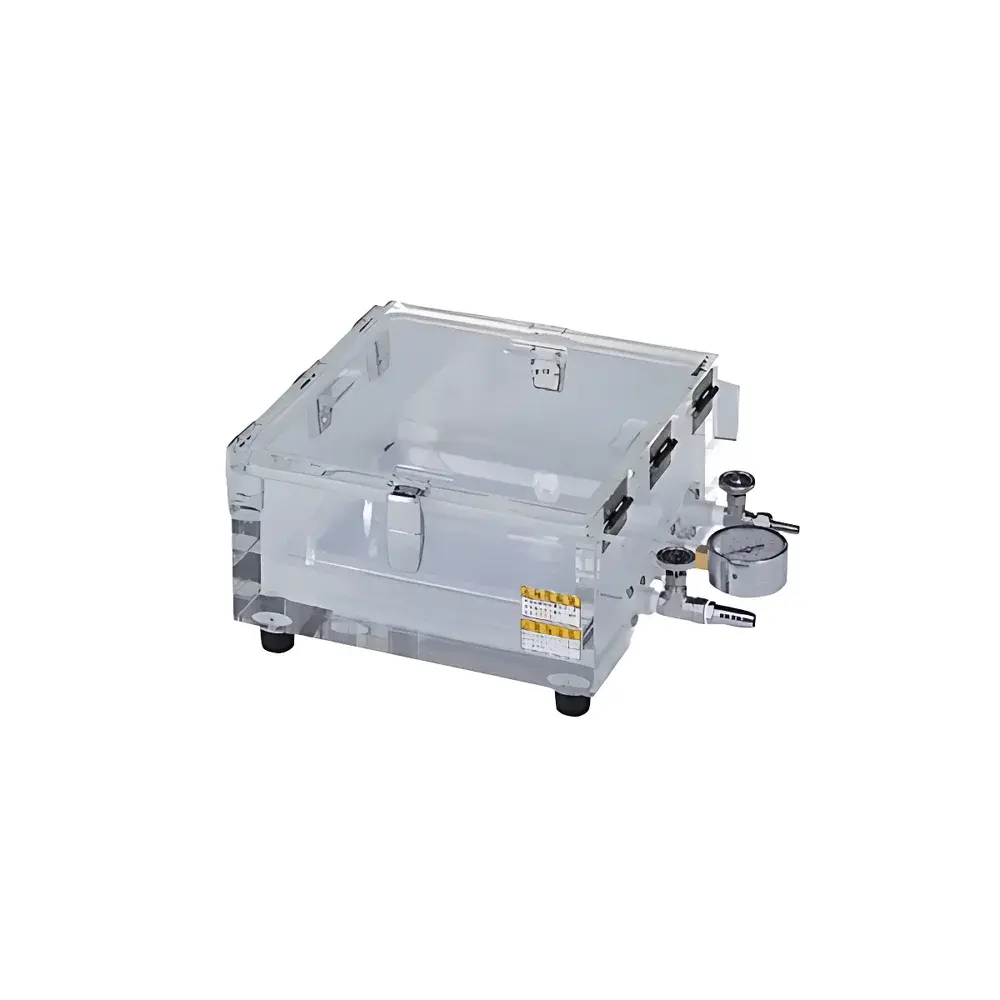
AS ONE VS Series Vacuum Desiccator Cabinet
| Brand | AS ONE |
|---|---|
| Origin | Japan |
| Manufacturer | AS ONE Corporation |
| Type | Vacuum Desiccator Cabinet |
| Model | VS-1-070-01 |
| Chamber Volume | 7 L |
| Internal Dimensions | 260 × 260 × 100 mm |
| External Dimensions (excl. protrusions) | 300 × 300 × 170 mm |
| Maximum Achievable Vacuum | 133 Pa |
| Construction | Main Body & Viewing Panel — 20 mm Thick Optical-Grade PMMA (Polymethyl Methacrylate) |
| Weight | 10 kg |
| Included Accessories | Analog Vacuum Gauge (0–760 Torr / 0–101 kPa), Silicone Mat (1 pc), Dual-Port Vacuum Valve (Small Port OD φ8 mm, Large Port OD φ14 mm) |
Overview
The AS ONE VS Series Vacuum Desiccator Cabinet is a precision-engineered, compact vacuum storage and drying system designed for moisture-sensitive sample preservation, solvent-free dehydration, and long-term stability testing in analytical, pharmaceutical, and materials science laboratories. Unlike conventional forced-air ovens or ambient desiccators, the VS cabinet operates on a sealed negative-pressure principle—removing atmospheric moisture and oxygen to inhibit hydrolysis, oxidation, and microbial growth without thermal stress. Its fully transparent PMMA chamber enables real-time visual monitoring of samples under vacuum without compromising integrity. Engineered for reliability and operator safety, the unit features an oil-free, lubricant-free sealing system using high-compression silicone gaskets—eliminating contamination risks associated with grease-based vacuum interfaces and ensuring compliance with ISO 14644 cleanroom-compatible handling protocols.
Key Features
- Optical-grade 20 mm thick PMMA chamber wall—provides exceptional impact resistance, UV stability, and distortion-free visibility up to 92% light transmittance.
- Dual-port vacuum valve assembly (φ8 mm and φ14 mm ports) enables flexible integration with external vacuum pumps, gas purging manifolds, or inert atmosphere lines (e.g., N₂ or Ar).
- Analog vacuum gauge calibrated across 0–760 Torr (0–101 kPa), offering immediate, drift-free pressure verification without software dependency or battery requirements.
- Compact footprint (300 × 300 × 170 mm external) optimized for benchtop use—ideal for QC labs with space constraints or as a dedicated storage module adjacent to gloveboxes or analytical instruments.
- Silicone mat included as standard—chemically inert, non-shedding, and rated for continuous use from −60 °C to +200 °C, supporting both room-temperature vacuum storage and low-heat desorption protocols.
- No internal heating elements—designed exclusively for vacuum-only operation, preventing thermal degradation of thermolabile compounds such as oligonucleotides, reference standards, hygroscopic salts, and lithium battery cathode materials.
Sample Compatibility & Compliance
The VS cabinet accommodates a broad range of sample formats including glass vials (up to 100 mL), aluminum weighing pans, ceramic crucibles, polymer films, and printed circuit boards. Its absence of internal heaters and oil-free seal design meets critical requirements for ASTM E145-22 (Standard Specification for Gravity-Convection and Forced-Ventilation Ovens) Annex A2 criteria on non-thermal drying environments. The unit supports GLP-aligned documentation workflows when paired with external calibrated vacuum sensors and loggers. While not a Class I medical device, its construction materials comply with USP for polymeric packaging components, and the PMMA chamber satisfies ISO 10993-5 cytotoxicity screening prerequisites for indirect sample contact.
Software & Data Management
The VS-1-070-01 is a standalone mechanical system with no embedded firmware, microcontroller, or digital interface—ensuring zero cybersecurity exposure, no firmware update dependencies, and full electromagnetic compatibility (EMC) in RF-intensive lab environments (e.g., adjacent to NMR or mass spectrometry suites). Vacuum status is monitored exclusively via the analog gauge, eliminating data logging by default. For regulated environments requiring audit trails, users may integrate third-party USB or RS-485 vacuum transducers (e.g., MKS Baratron series) with validated LIMS or ELN platforms compliant with FDA 21 CFR Part 11 for electronic record retention.
Applications
- Stabilization of hygroscopic reference standards (e.g., potassium hydrogen phthalate, sodium chloride) prior to gravimetric calibration.
- Storage of X-ray diffraction (XRD) powder samples to prevent surface hydration that alters Bragg peak intensities.
- Pre-conditioning of Li-ion battery electrode coatings before SEM/EDS analysis to avoid beam-induced artifact formation.
- Desiccation of HPLC vial septa and autosampler vials to minimize background water vapor in headspace GC analyses.
- Long-term archiving of archival film, museum specimens, and forensic evidence where oxidative aging must be suppressed.
- Controlled humidity staging in thin-film fabrication processes involving sol-gel precursors or perovskite ink deposition.
FAQ
Can the VS cabinet be used with a vacuum pump that delivers ≤10 Pa?
Yes—the chamber’s rated ultimate vacuum (133 Pa) is compatible with single-stage rotary vane or diaphragm pumps; deeper vacuums are permissible but do not improve desiccation efficacy for most solid-phase applications.
Is the PMMA chamber resistant to acetone or chloroform exposure?
No—PMMA is soluble in ketones and chlorinated solvents; direct contact with such solvents will cause crazing or dissolution. Use only ethanol, isopropanol, or aqueous cleaning agents.
Does AS ONE provide IQ/OQ documentation for this model?
No—this is a Class I laboratory tool per ISO 13485 definitions; qualification support is available through third-party service providers using AS ONE’s dimensional and material certification documents.
Can multiple VS cabinets be manifolded to a single pump?
Yes—using appropriate vacuum-rated tubing and isolation valves, up to four units may be operated in parallel while maintaining stable pressure control.
What is the expected service life of the silicone gasket under daily vacuum cycling?
When operated within specified pressure range and cleaned per AS ONE Technical Bulletin TB-VS-02, the gasket maintains sealing integrity for ≥5,000 cycles or five years of typical lab usage (20 cycles/week).



