
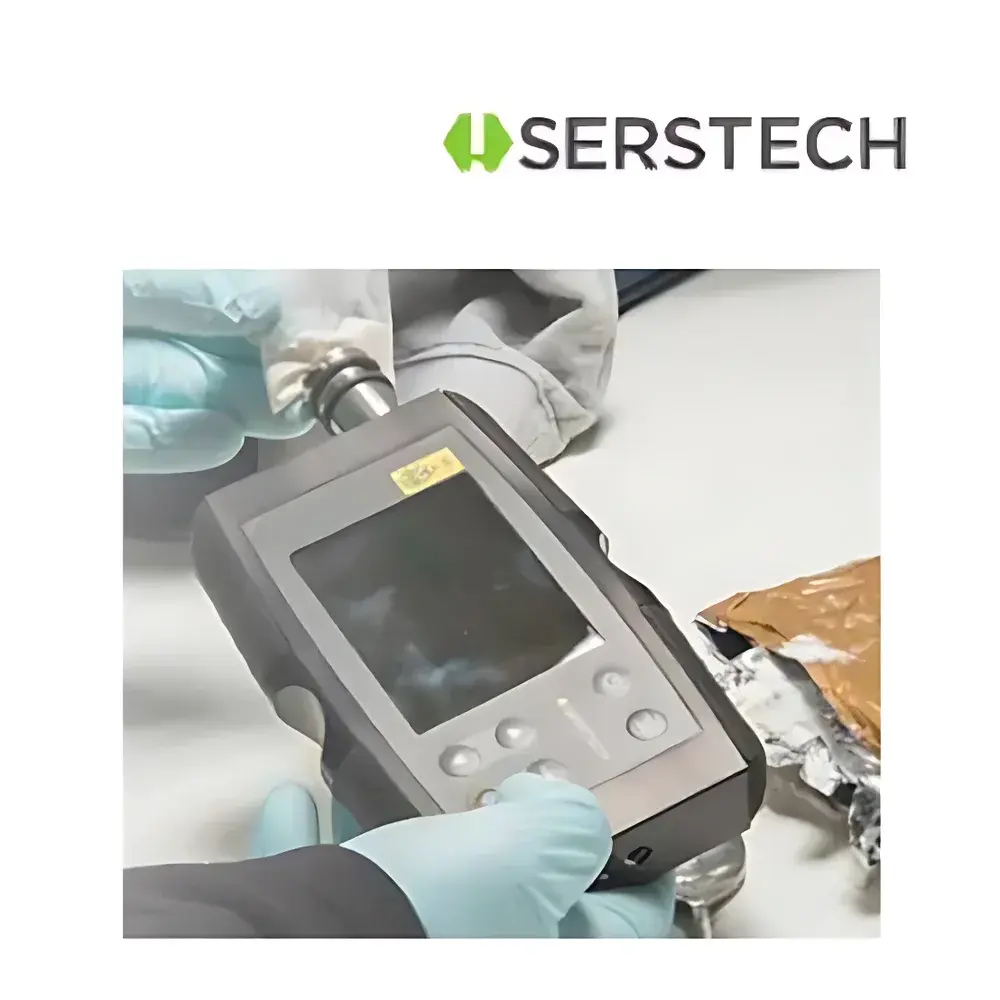
Serstech 100 Indicator Handheld Raman Spectrometer
| Brand | Serstech |
|---|---|
| Origin | Sweden |
| Model | Serstech 100 Indicator |
| Instrument Type | Handheld Raman Spectrometer |
| Spectral Range | 400–2300 cm⁻¹ |
| Spectral Resolution | 8–10 cm⁻¹ |
| Spatial Resolution | <1 nm |
| Minimum Wavenumber | 400 cm⁻¹ |
| Spectral Reproducibility | <1 cm⁻¹ |
| Laser Excitation Wavelength | 785 nm |
| Laser Power Class | Class 3B (max. 300 mW) |
| Detector | Linear CCD Array |
| Onboard Memory | 16 GB (up to 100,000 spectra) |
| Data Formats | Text, .txt, .csv, .jcamp |
| Interface | USB 2.0 |
| Battery Life | >8 hours continuous operation |
| Weight | 650 g |
| Dimensions | 15.8 × 10.1 × 2.9 cm |
Overview
The Serstech 100 Indicator is a compact, battery-powered handheld Raman spectrometer engineered for rapid, non-destructive molecular identification of solid and liquid samples in field, laboratory, and industrial environments. Based on dispersive Raman spectroscopy with 785 nm laser excitation, the instrument delivers high-fidelity spectral data across a broad wavenumber range (400–2300 cm⁻¹), enabling reliable detection of organic compounds, pharmaceuticals, polymers, explosives, illicit substances, and inorganic materials. Its lightweight architecture (650 g) and ergonomic design support true one-handed operation, while its robust optical path—optimized for minimal fluorescence interference and stable signal-to-noise performance—ensures consistent spectral acquisition under variable ambient conditions. The system operates without consumables or alignment procedures, making it suitable for routine use by non-specialist personnel following minimal training.
Key Features
- Ultra-portable form factor: 650 g weight and palm-sized dimensions (15.8 × 10.1 × 2.9 cm) enable extended field deployment and point-of-need analysis.
- High-speed identification: Delivers definitive chemical identification in seconds for solids and liquids using preloaded reference library of 14,000+ compounds.
- User-customizable spectral database: Supports creation, editing, and validation of proprietary libraries via intuitive software interface; compatible with ASTM E1840 and ISO/IEC 17025-compliant spectral metadata tagging.
- Class 3B 785 nm laser source: Optimized for reduced fluorescence in colored or complex matrices; maximum output power of 300 mW ensures sufficient signal intensity for low-concentration or weak-scattering samples.
- Linear CCD array detector: Provides stable, low-noise spectral acquisition with reproducibility better than ±1 cm⁻¹ across repeated measurements—critical for trend monitoring and batch verification.
- Onboard 16 GB storage: Accommodates up to 100,000 full-resolution spectra with embedded timestamps, GPS coordinates (optional), operator ID, and measurement parameters.
- Extended operational autonomy: Rechargeable lithium-ion battery supports >8 hours of continuous spectral acquisition and library matching without external power.
Sample Compatibility & Compliance
The Serstech 100 Indicator is validated for direct analysis of unprepared solid powders, tablets, crystals, gels, and transparent or translucent liquids—including aqueous solutions, solvents, and suspensions. It requires no sample preparation, contact probes, or calibration standards for routine identification. The instrument complies with IEC 61000-6-3 (EMC emissions), IEC 61000-6-2 (immunity), and laser safety standards IEC 60825-1:2014 (Class 3B). Its spectral output meets analytical traceability requirements for GLP and GMP environments when used with documented library management protocols. While not FDA 21 CFR Part 11–certified out-of-the-box, audit-ready data export (.jcamp, .csv) and full metadata logging support integration into validated laboratory information management systems (LIMS) and electronic lab notebooks (ELN).
Software & Data Management
The bundled Serstech Analyze software provides real-time spectral acquisition, peak-matching against reference libraries, and customizable reporting templates. All spectra are stored with complete provenance: instrument ID, operator credentials, date/time stamp, laser power setting, integration time, and environmental metadata (if connected to optional sensors). Export formats include ASCII text, comma-separated values (.csv), and JCAMP-DX v6—enabling interoperability with third-party chemometric tools (e.g., MATLAB, Python scikit-learn, Unscrambler). Software updates are delivered via secure HTTPS channel with SHA-256 signature verification. Remote firmware upgrades preserve calibration integrity and maintain spectral fidelity per NIST-traceable reference checks.
Applications
- Pharmaceutical quality control: Rapid verification of raw materials, excipients, and finished dosage forms against pharmacopeial monographs (USP, EP).
- Hazardous material screening: On-site identification of unknown solids or liquids in emergency response, customs inspection, and border security operations.
- Forensic science: Non-invasive analysis of trace evidence including drugs of abuse, explosives residues, and counterfeit consumer goods.
- Polymer and composite manufacturing: In-line verification of resin composition, filler content, and degradation markers during production.
- Academic research: Teaching spectroscopy fundamentals and supporting exploratory studies in materials chemistry and surface science.
FAQ
Is the Serstech 100 Indicator suitable for quantitative analysis?
It is primarily designed for qualitative identification and verification. Quantitative applications require method-specific validation, including linearity assessment, limit of detection determination, and matrix-matched calibration.
Can the instrument be used through transparent packaging?
Yes—Raman signals can be acquired through glass, plastic films, and clear polymer containers, provided the container material does not produce interfering Raman bands or excessive fluorescence.
Does the system require annual recalibration?
No scheduled recalibration is required. Spectral stability is maintained via internal wavelength reference and temperature-compensated optics; users may perform optional verification using NIST-traceable polystyrene or silicon standards.
How is data integrity ensured during transfer from device to PC?
All exported files include cryptographic checksums (MD5/SHA-256), and the software logs every export event with user ID, timestamp, and file hash—supporting audit trails in regulated environments.
What operating systems are supported by the desktop software?
Serstech Analyze is compatible with Windows 10/11 (64-bit) and macOS 12–14; Linux support is available via command-line CLI tools and open-source JCAMP parsers.






