
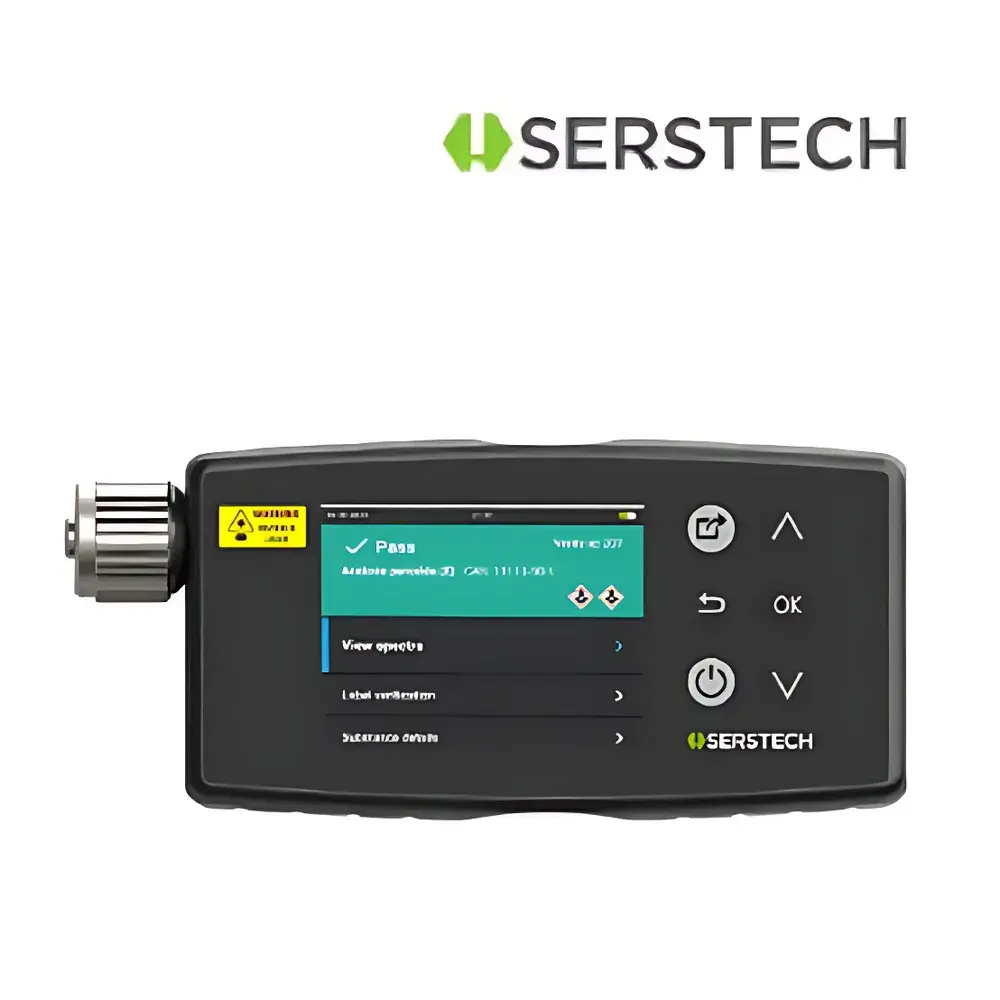
Serstech Arx+ Handheld Raman Spectrometer
| Brand | Serstech |
|---|---|
| Origin | Sweden |
| Model | Arx+ |
| Instrument Type | Handheld Raman Spectrometer |
| Spectral Range | 400–2300 cm⁻¹ |
| Spectral Resolution | 8–10 cm⁻¹ |
| Minimum Wavenumber | 400 cm⁻¹ |
| Spectral Repeatability | <1 cm⁻¹ |
| Laser Excitation Wavelength | 785 nm |
| Display | 3.5-inch color TFT with LED backlight |
| Onboard Storage | 16 GB (up to 100,000 spectra) |
| Operating Temperature | −20 to +50 °C |
| Storage Temperature | −30 to +50 °C |
| Battery Life | Up to 8 hours continuous operation |
| Weight | 590 g |
| IP Rating | IP67 |
| Focus Mechanism | Automatic focus |
| Detection Time | 0.01–60 s (manual or auto-triggered) |
| Sample Compatibility | Solids, liquids, powders, tablets |
| Regulatory Compliance | Fully compliant with FDA 21 CFR Part 11, supports IQ/OQ/PQ documentation |
Overview
The Serstech Arx+ Handheld Raman Spectrometer is an engineered solution for rapid, non-destructive molecular identification in field and regulated laboratory environments. Based on dispersive Raman spectroscopy with a stabilized 785 nm diode laser excitation source, the Arx+ delivers high-fidelity spectral data across a broad wavenumber range (400–2300 cm⁻¹), optimized for pharmaceutical excipients, active pharmaceutical ingredients (APIs), polymers, explosives, and illicit substances. Its compact form factor—weighing only 590 g—and robust IP67-rated enclosure enable reliable deployment in manufacturing suites, warehouse receiving bays, quality control labs, customs checkpoints, and field forensics. Unlike benchtop systems requiring optical alignment or environmental stabilization, the Arx+ integrates thermally compensated optics and automatic focusing, eliminating user-dependent setup variability and ensuring consistent spectral acquisition across operators and shifts.
Key Features
- True handheld ergonomics: Lightweight design (590 g) with balanced weight distribution and intuitive button layout for one-handed operation during extended inspections.
- Regulatory-ready architecture: Full compliance with FDA 21 CFR Part 11—including electronic signatures, audit trails, role-based access control, and immutable data logging—validated through documented IQ/OQ/PQ protocols.
- Integrated barcode scanner: Enables direct sample ID linkage to LIMS or ERP systems; automatically associates spectral acquisitions with batch numbers, material codes, or container identifiers.
- Automatic focus system: Eliminates manual lens adjustment or sample-specific adapters; maintains optimal focal distance across heterogeneous sample surfaces (e.g., tablets, blister packs, powder vials).
- On-device spectral management: 16 GB internal storage supports >100,000 spectra with metadata tagging (operator, timestamp, location, pass/fail status); exportable in ASTM E131-compliant .SPA or .CSV formats.
- Ruggedized industrial design: IP67-rated housing withstands dust ingress, accidental immersion (up to 1 m for 30 min), and repeated cleaning with ethanol or isopropanol—critical for GMP-compliant environments.
Sample Compatibility & Compliance
The Arx+ accommodates raw materials, finished dosage forms, packaging components, and intermediate blends without sample preparation. It reliably acquires spectra from opaque solids (e.g., coated tablets), translucent gels, volatile liquids (in sealed containers), and fine powders—even through amber glass vials or polyethylene bags. All spectral libraries—including Serstech’s factory database of >1,200 pharmaceutical reference standards (APIs, excipients, coatings)—are structured per ICH Q5C and USP guidelines for spectral similarity assessment. The instrument supports method validation per ASTM E2529-22 (Standard Guide for Raman Spectroscopy in Pharmaceutical Analysis) and aligns with EU GMP Annex 11 requirements for computerized system validation.
Software & Data Management
ChemDash software provides a validated, locked-down interface for spectral acquisition, library matching, and report generation. Each spectrum captures full instrument metadata (laser power, integration time, detector temperature, calibration coefficients) and embeds digital signatures upon finalization. Audit trails record all user actions—including library edits, threshold adjustments, and result overrides—with timestamps and operator IDs. Custom databases can be created, version-controlled, and synchronized across fleets via encrypted USB transfer or secure cloud sync (optional). Reports comply with ALCOA+ principles (Attributable, Legible, Contemporaneous, Original, Accurate) and export as PDF/A-2b or printed hard copies with embedded QR codes linking to raw data archives.
Applications
- Pharmaceutical QC: Identity testing of incoming raw materials per USP and Ph. Eur. 2.2.48; verification of blend uniformity and tablet coating integrity.
- GMP manufacturing support: Real-time release testing (RTRT) of intermediates; in-line verification of cleaning validation swabs.
- Supply chain security: Rapid screening of suspect shipments at ports or distribution centers for counterfeit or diverted products.
- Forensic analysis: Field identification of narcotics, explosives precursors, and hazardous chemicals without sample transfer.
- Academic & industrial R&D: Reaction monitoring, polymorph screening, and formulation stability studies using portable spectral acquisition.
FAQ
Does the Arx+ require annual recalibration or factory service?
No. The instrument uses a permanently aligned, thermally stabilized optical path and self-validating wavelength calibration routine executed before each measurement session. No consumables or external calibration standards are required.
Can spectral libraries be shared across multiple Arx+ units in a facility?
Yes. Custom or updated libraries are distributed as encrypted .LIB files via USB drive or secure network share, maintaining version consistency and traceability across devices.
Is the Arx+ suitable for use in cold-chain inspection environments?
Yes. With operational capability down to −20 °C and IP67 sealing, it functions reliably in refrigerated warehouses, cold rooms, and outdoor winter conditions without condensation-related performance loss.
How does the system handle fluorescence interference common in pharmaceutical samples?
The 785 nm excitation wavelength minimizes fluorescence background in most organic matrices; combined with real-time baseline correction algorithms and adjustable integration times, it ensures high signal-to-noise ratios even for highly fluorescent excipients such as lactose or PVP.
What training is required for QC technicians to operate the Arx+ independently?
A standardized 4-hour competency-based training module covers instrument handling, spectral acquisition, library search logic, report generation, and basic troubleshooting—sufficient for unassisted daily use under GLP/GMP conditions.





