
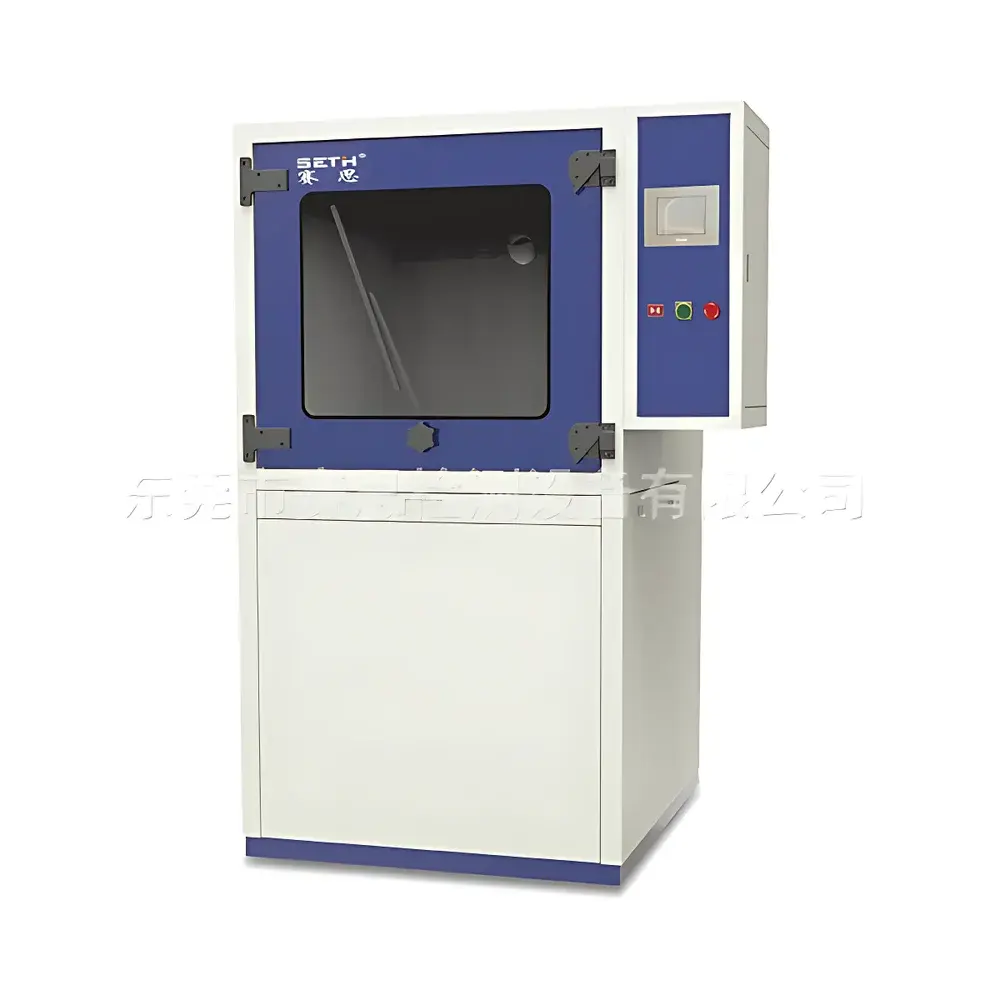
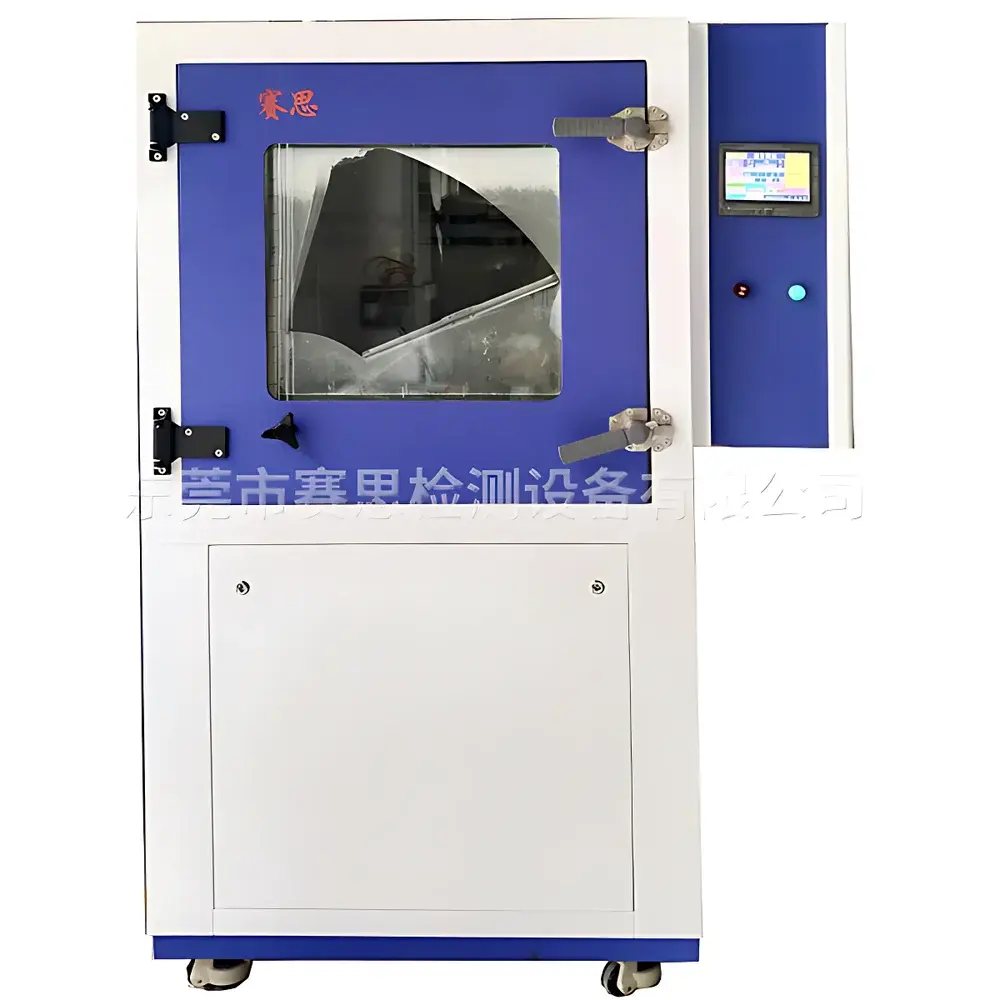
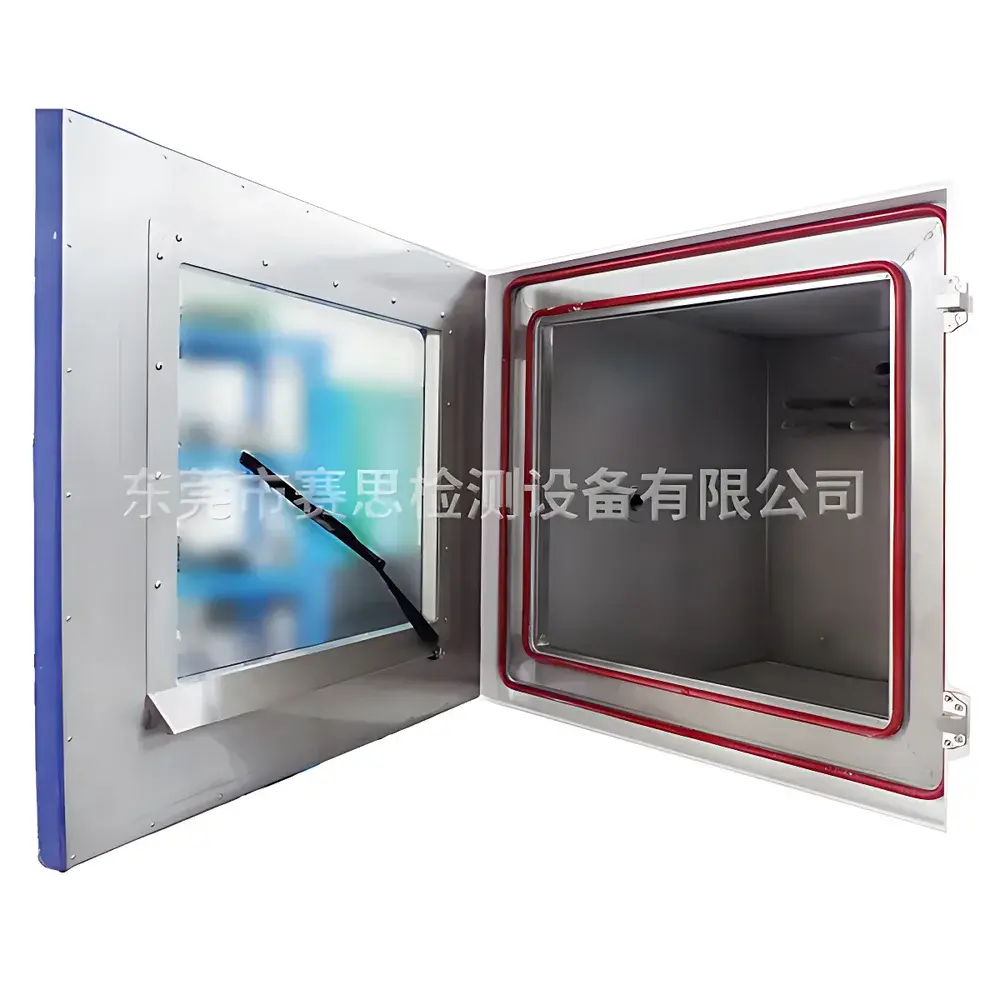
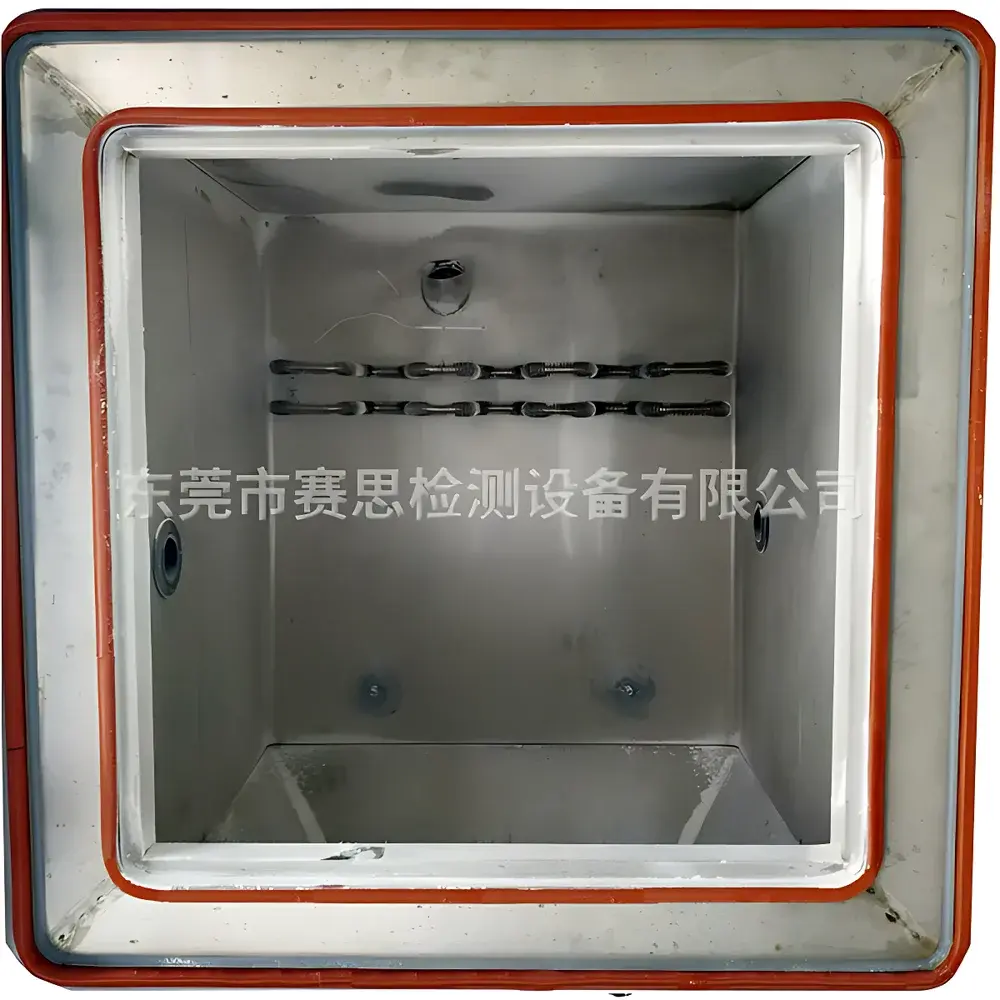
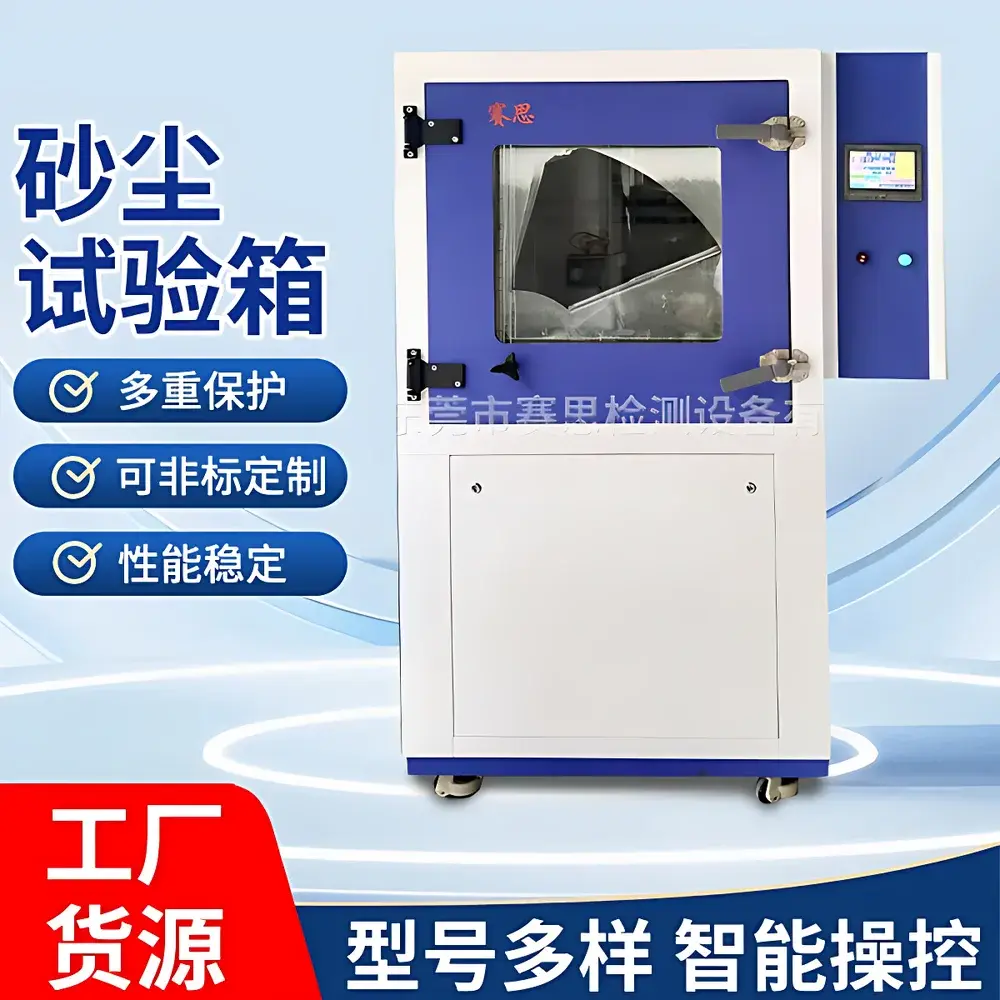
SETH SE-SC800B Sand and Dust Test Chamber
| Brand | SETH |
|---|---|
| Origin | Guangdong, China |
| Manufacturer Type | Direct Manufacturer |
| Product Category | Domestic |
| Model | SE-SC800B |
| Sand Composition | 97–99% SiO₂ (silicon dioxide) |
| Sand Blasting Concentration | 1.1 g/m³ ±0.25 g/m³ to 2.2 g/m³ ±0.5 g/m³ |
| Sand Blasting Air Velocity | 0–29 m/s |
| Dust Concentration | 0.1–10.6 g/m³ ±7 g/m³ |
| Dust Air Velocity | 8.9 m/s ±1.2 m/s |
Overview
The SETH SE-SC800B Sand and Dust Test Chamber is an engineered environmental simulation system designed to evaluate the ingress protection (IP) performance of enclosures—specifically compliance with IP5X (dust protected) and IP6X (dust tight) requirements per IEC 60529 and ISO 20623. It replicates real-world airborne particulate exposure using controlled aerodynamic suspension of standardized test dust and sand, enabling quantitative assessment of sealing integrity, abrasion resistance, and functional reliability under sustained particulate loading. The chamber operates on a closed-loop vertical “O-type” airflow principle, where high-efficiency centrifugal fans generate laminar-to-turbulent air streams that entrain and recirculate calibrated particulates across the test specimen surface. Unlike open-loop systems, this architecture ensures consistent particle velocity profiles, reproducible mass concentration delivery, and minimal operational consumables—critical for GLP-compliant durability validation in automotive, defense, and outdoor electronics development.
Key Features
- Stainless steel inner chamber (304 SS) with powder-coated carbon steel outer enclosure and polyurethane thermal insulation for structural rigidity and long-term corrosion resistance
- Programmable PLC-based control system with touch HMI interface supporting multi-stage test sequencing: pre-conditioning, dust/sand introduction, dynamic exposure, and post-test purge cycles
- Dual-mode particulate delivery: independent sand (SiO₂, 97–99% purity) and dust (dry talc, 75–100 µm median particle size) supply modules with gravimetric dosing accuracy ≤±3% of setpoint
- Adjustable air velocity range: 0–29 m/s for sand blasting mode; fixed 8.9 m/s ±1.2 m/s for standardized dust testing per IEC 60529 Annex B
- Real-time monitoring of airborne particulate concentration via optical scattering sensor (calibrated traceably to NIST-traceable reference aerosols)
- Integrated sample mounting platform with 360° rotational capability and electrical feedthroughs rated for IP67 operation during active cycling
Sample Compatibility & Compliance
The SE-SC800B accommodates specimens up to 800 mm × 800 mm × 800 mm (W×D×H), with optional custom fixture integration for automotive lighting assemblies, military-grade connectors, UAV housings, and outdoor telecom cabinets. It supports full-cycle testing per IEC 60529, MIL-STD-810H Method 510.7 (Sand and Dust), and ISO 16750-4 (Road vehicles — Environmental conditions and testing for electrical and electronic equipment). All test parameters—including air velocity, concentration tolerance bands, exposure duration, and dwell intervals—are configurable to align with internal qualification protocols or third-party certification audits. Data logging meets FDA 21 CFR Part 11 requirements when paired with optional audit-trail-enabled software modules.
Software & Data Management
The standard control firmware includes built-in data logging at 1 Hz resolution for wind speed, concentration, elapsed time, and cycle stage status. Optional SETH TestSuite™ software (v3.2+) provides PC-based remote operation, automated report generation (PDF/CSV), trend analysis with statistical process control (SPC) overlays, and export-compatible metadata tagging for LIMS integration. All test records include timestamped operator ID, calibration certificate references, and version-controlled parameter sets—ensuring full traceability for ISO 17025-accredited laboratories and OEM quality assurance departments.
Applications
- Automotive: Validation of headlamp seals, HVAC actuator housings, battery pack gaskets, and ADAS sensor covers against desert sand intrusion
- Electronics: IP rating verification for solar inverters, smart grid meters, railway signaling controllers, and base station RF enclosures
- Defense & Aerospace: Environmental stress screening of avionics cooling ducts, weapon system control panels, and ground vehicle vision systems per MIL-STD-810H
- Industrial IoT: Long-term reliability assessment of edge computing nodes deployed in mining, oilfield, or agricultural environments
- Research: Particle deposition kinetics studies, filter media efficiency benchmarking, and seal material wear modeling under variable velocity/concentration regimes
FAQ
What standards does the SE-SC800B comply with for dust and sand testing?
It is fully aligned with IEC 60529 (IP5X/IP6X), ISO 20623, MIL-STD-810H Method 510.7, and ISO 16750-4. Calibration documentation includes traceability to national metrology institutes.
Can the chamber operate with both dust and sand in the same test cycle?
No—dust and sand modes are mutually exclusive due to differing particle density, suspension dynamics, and required airflow profiles. Switching requires manual module reconfiguration and system recalibration.
Is the talc used for dust testing certified to ISO 12103-1 A2 Fine Test Dust specification?
Yes, SETH supplies optional ISO-certified A2 test dust with full CoA (Certificate of Analysis) including particle size distribution (PSD) by laser diffraction and moisture content <0.1% w/w.
Does the system support automated pass/fail evaluation based on functional testing during exposure?
Not natively—but the chamber’s electrical feedthroughs and programmable relay outputs allow integration with external functional testers (e.g., continuity monitors, CAN bus analyzers) for synchronized pass/fail logic triggering.
What maintenance intervals are recommended for the airflow sensors and cyclonic separator?
Optical concentration sensors require quarterly zero calibration; the cyclonic separator and filter banks must be inspected after every 50 hours of cumulative sand operation or before each high-concentration test series.



