
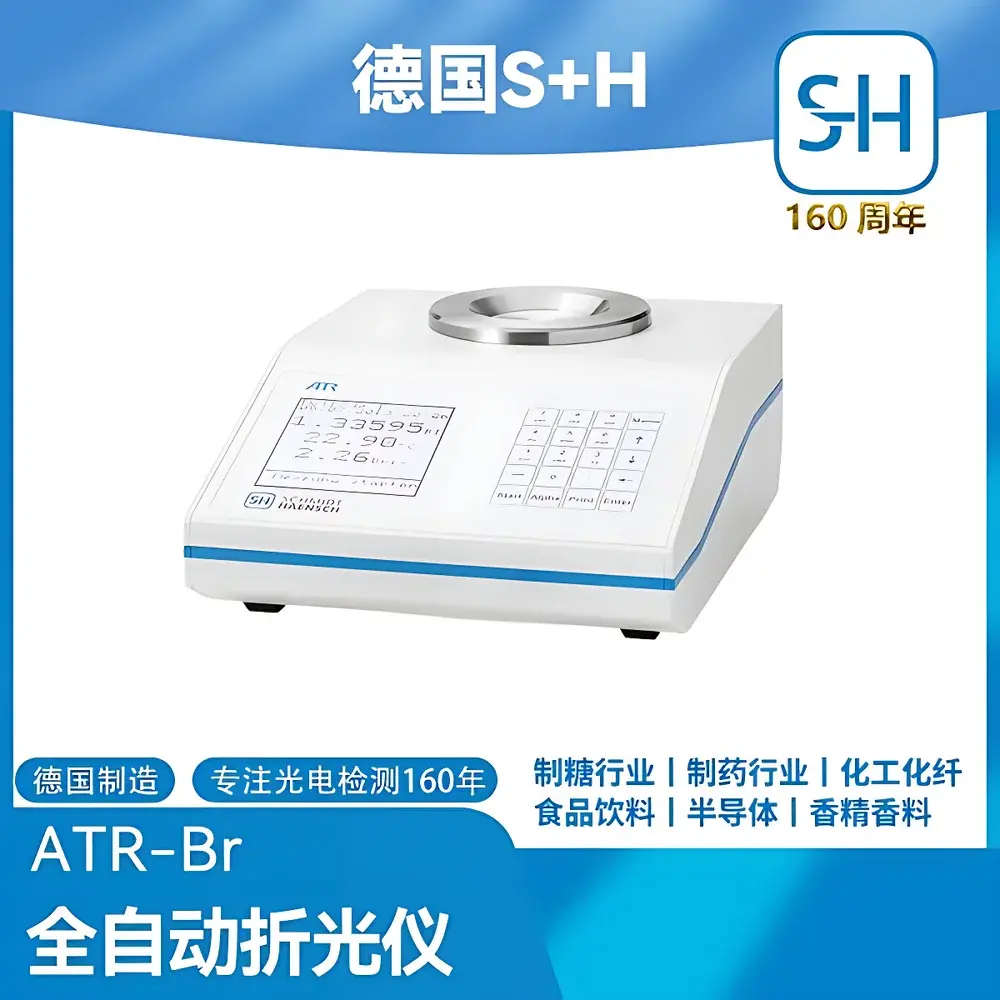
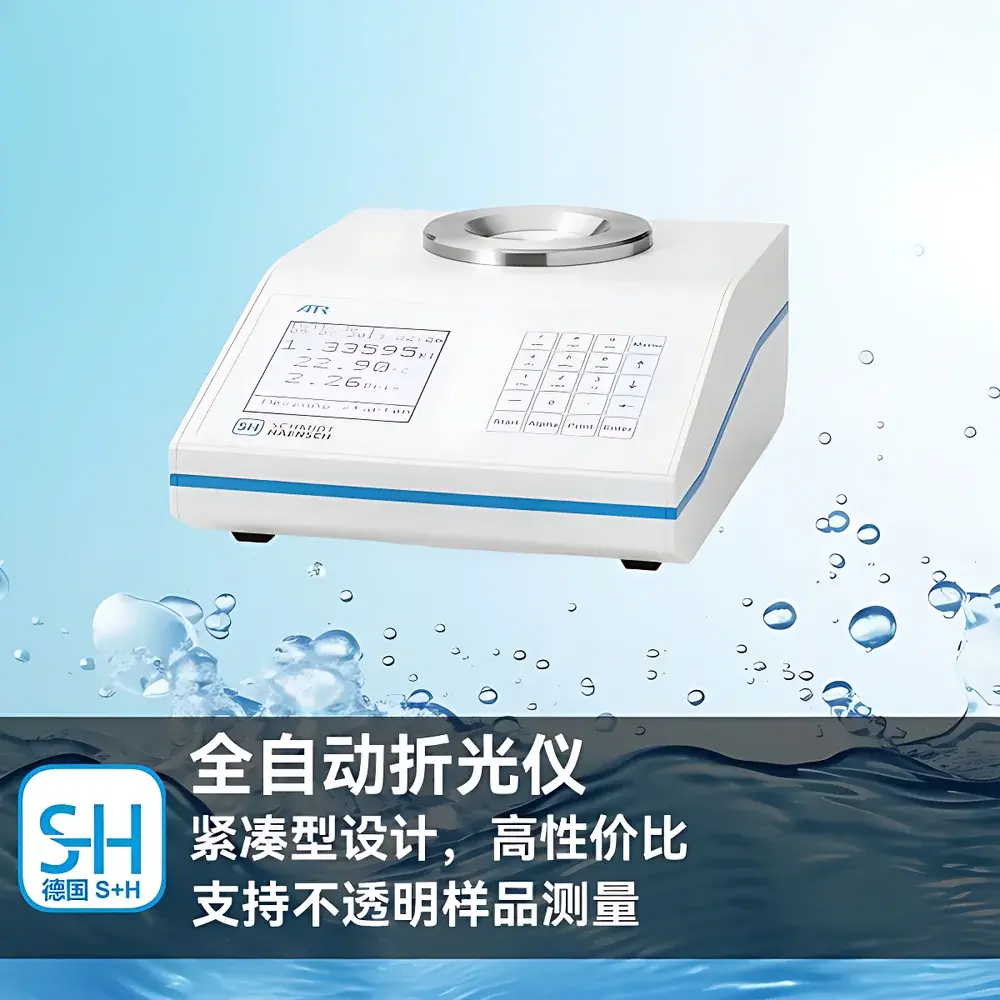
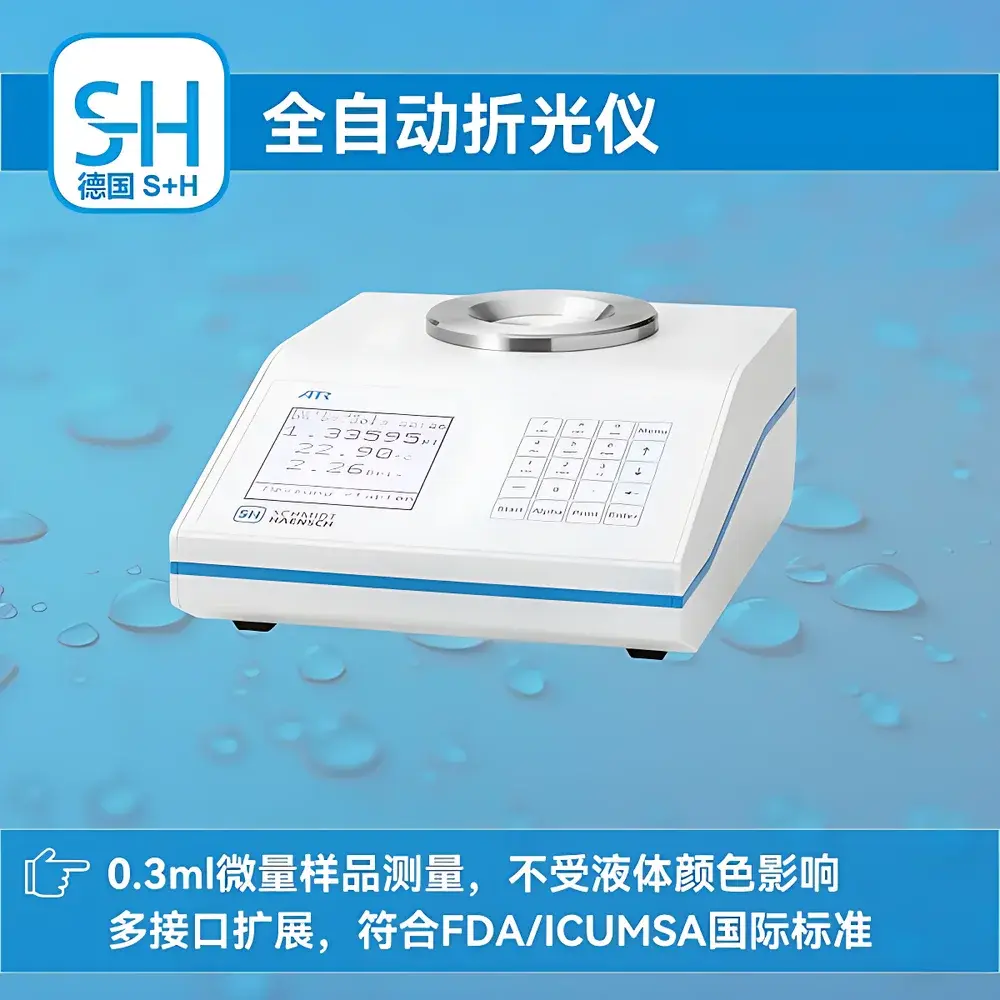
S+H ATR-BR Automated Refractometer
| Brand | S+H (Schmidt+Haensch) |
|---|---|
| Origin | Germany |
| Manufacturer Type | Original Equipment Manufacturer (OEM) |
| Product Category | Benchtop Refractometer |
| Display | Digital LCD & Optional 7-inch Touchscreen |
| Measurement Range | 1.32000–1.58000 RI / 0–100 %Brix |
| Resolution | 0.00001 RI / 0.01 %Brix |
| Accuracy | ±0.00002 RI / ±0.02 %Brix |
| Sample Volume | 0.3 mL |
| Temperature Compensation | Built-in NTC sensor with automatic compensation (no external thermostat required) |
| Optical System | Sapphire prism assembly with birefringence-corrected design |
| Detector | High-sensitivity CCD imaging sensor |
| Interfaces | USB, RS232, Ethernet (LAN) |
| Compliance | ISO 21648, ASTM D1218, USP <851>, GLP-compliant data logging |
Overview
The S+H ATR-BR Automated Refractometer is a benchtop optical measurement instrument engineered for high-precision refractive index (RI) and Brix determination in industrial quality control and R&D laboratories. It operates on the principle of total internal reflection (ATR—Attenuated Total Reflection), utilizing a sapphire prism interface and a high-resolution CCD detector to capture the critical angle of incident light at the sample-prism boundary. Unlike traditional Abbe-type refractometers relying on manual visual alignment, the ATR-BR automates optical alignment, signal acquisition, and calculation—delivering repeatable, operator-independent results traceable to SI units. Its design eliminates dependence on ambient temperature stabilization, as an integrated NTC temperature sensor enables real-time, algorithm-driven refractive index correction per ISO 21648 and ASTM D1218 protocols. The instrument is calibrated using certified reference standards traceable to PTB (Physikalisch-Technische Bundesanstalt), ensuring metrological integrity across its full RI range (1.32000–1.58000) and Brix span (0–100 %).
Key Features
- Sub-micron RI resolution of 0.00001 RI and Brix resolution of 0.01 %, validated per ISO/IEC 17025-accredited procedures
- Automated measurement cycle: <3 seconds from sample application to result display, including auto-zero, auto-focus, and critical-angle detection
- Low-volume sample handling: 0.3 mL requirement minimizes reagent consumption and reduces cross-contamination risk during high-throughput screening
- Dual-interface operation: Supports both tactile keypad and optional 7-inch capacitive touchscreen with intuitive icon-based navigation
- Birefringence-compensated sapphire prism optics—resistant to chemical corrosion, thermal drift, and mechanical abrasion over extended service life (>15 years typical in sugar refinery environments)
- Embedded firmware with configurable measurement modes: single-point RI, Brix, concentration (user-defined calibration curves), and multi-point validation sequences
Sample Compatibility & Compliance
The ATR-BR accommodates aqueous solutions, organic solvents, syrups, emulsions, and viscous liquids (up to ~500 mPa·s) without dilution or pre-filtration. Its sapphire prism surface tolerates pH 0–14 exposure and common industrial cleaning agents (e.g., 10 % NaOH, 5 % HNO₃). Instrument compliance extends beyond physical robustness: data acquisition and storage meet FDA 21 CFR Part 11 requirements when used with optional audit-trail-enabled software; electronic records support ALCOA+ principles (Attributable, Legible, Contemporaneous, Original, Accurate, Complete, Consistent, Enduring, Available). It satisfies ISO 21648 (refractometry for food and beverage), ASTM D1218 (hydrocarbon refractive index), and USP <851> (refractometric assay of pharmaceutical excipients).
Software & Data Management
Firmware includes embedded data management supporting up to 10,000 measurement records with timestamp, operator ID, sample ID, temperature, and raw critical-angle values. Export formats include CSV, PDF reports (with digital signature capability), and XML for LIMS integration. Optional PC software (S+H RefraSoft Pro) provides advanced curve fitting (polynomial, exponential, custom equations), statistical process control (SPC) charting, and automated report generation compliant with GLP/GMP documentation standards. All communication interfaces—USB 2.0, RS232 (3-wire), and Gigabit Ethernet—support secure, authenticated data transfer and remote firmware updates.
Applications
- Sugar & Starch Processing: Real-time Brix monitoring of cane/beet juice, molasses, and syrup streams; eliminates reliance on water-bath thermostats and manual interpolation tables
- Food & Beverage QA: Quantification of soluble solids in fruit juices, dairy concentrates, wine must, and plant-based beverages; supports HACCP critical control point verification
- Chemical Manufacturing: In-process concentration control of NaOH, H₂SO₄, HCl, glycols, and polymer solutions; replaces titration where speed and non-destructive analysis are prioritized
- Pharmaceutical Production: Identity testing and purity assessment of solvents (e.g., ethanol, propylene glycol), active pharmaceutical ingredient (API) solutions, and ophthalmic formulations per USP monographs
- Biotechnology: Monitoring cell culture media osmolality proxies, fermentation broth sugar depletion, and buffer composition consistency
FAQ
Does the ATR-BR require external temperature control for accurate measurements?
No. It incorporates a high-stability NTC temperature sensor directly adjacent to the prism interface, enabling real-time, physics-based RI compensation across 10–40 °C without external chillers or baths.
Can the instrument store custom calibration curves for proprietary formulations?
Yes. Up to 20 user-defined concentration–RI correlation models can be stored and recalled, supporting polynomial, linear, and exponential regression equations.
Is the sapphire prism susceptible to scratching by particulate-laden samples?
The prism surface is rated Mohs 9 and includes an anti-adhesion coating; routine cleaning with lint-free wipes and deionized water restores optical performance—even after repeated use with suspended solids.
How is measurement traceability maintained during routine operation?
Each unit ships with a PTB-traceable calibration certificate. Internal verification uses two certified reference fluids (nD = 1.43200 and 1.52000 at 20 °C); automated self-checks log deviations exceeding ±0.00001 RI.
What cybersecurity provisions exist for network-connected units?
Ethernet interface supports TLS 1.2 encryption, role-based access control (admin/operator/guest), and configurable password policies aligned with IEC 62443-3-3 SL2 requirements.



