
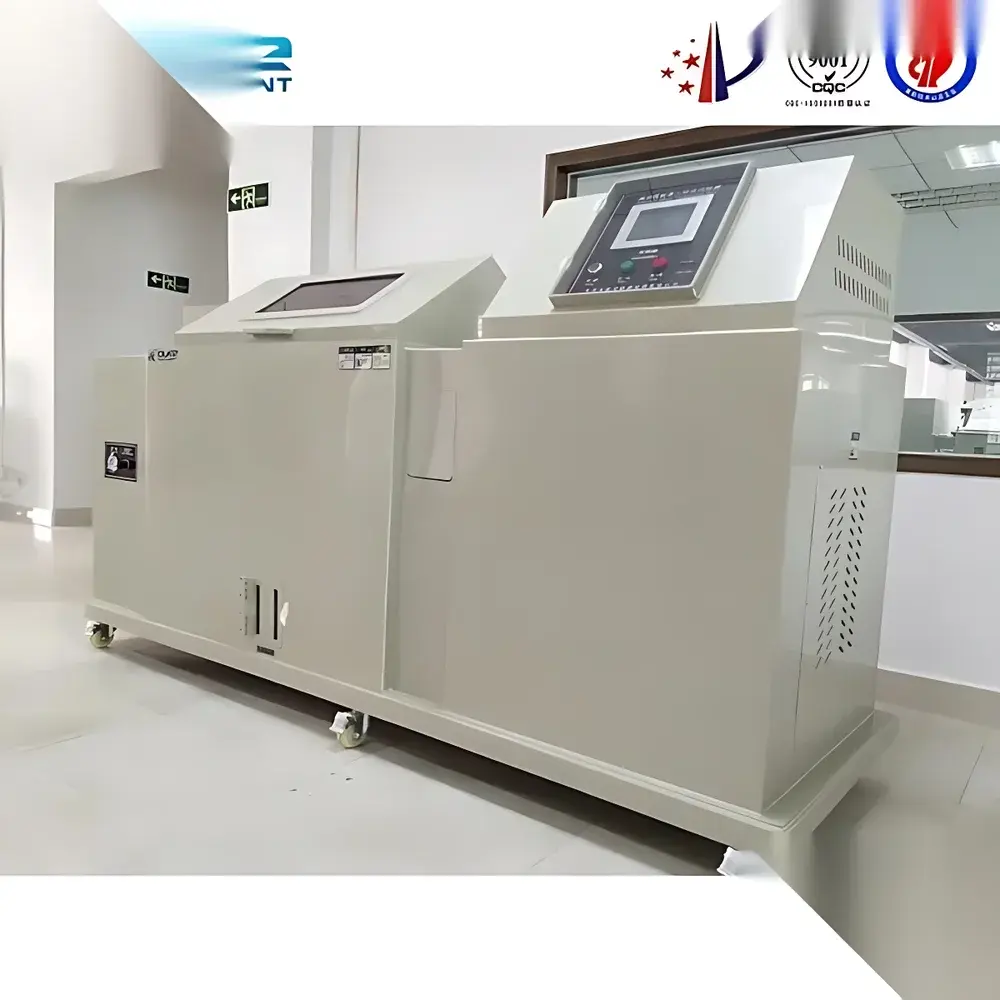
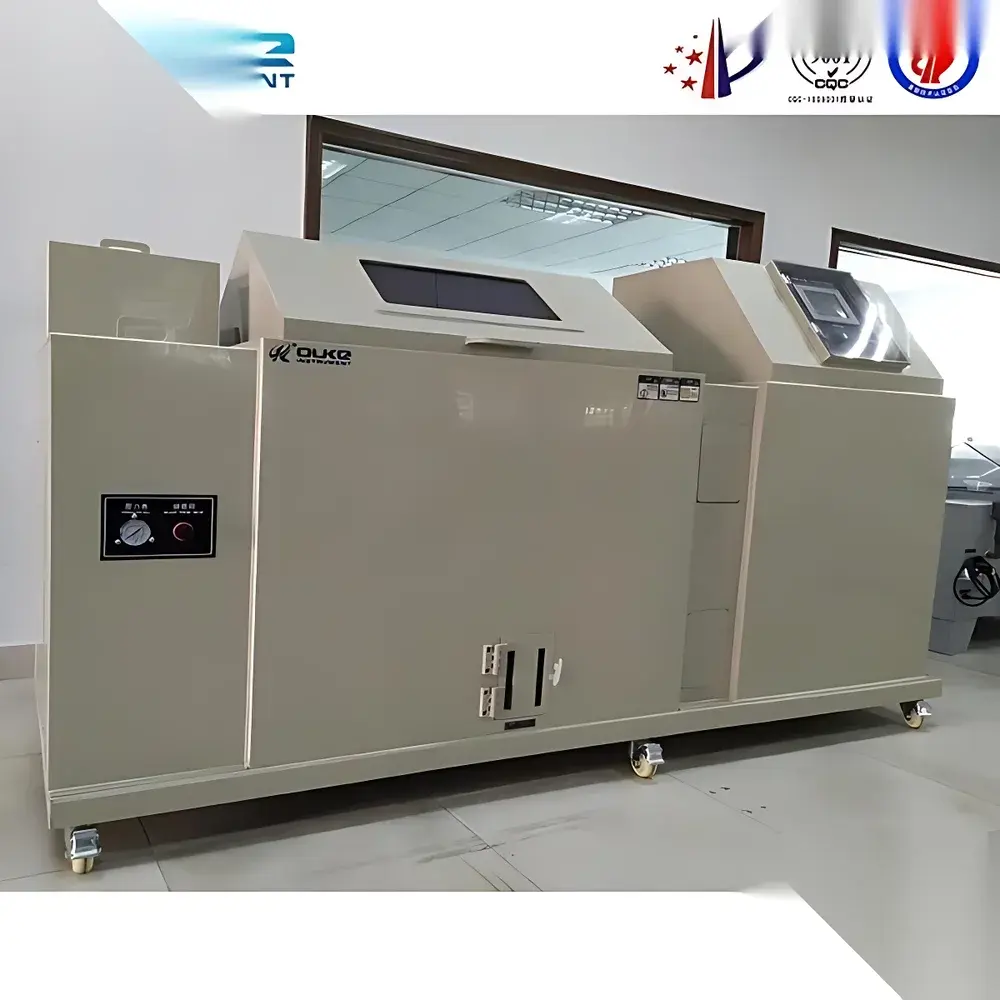
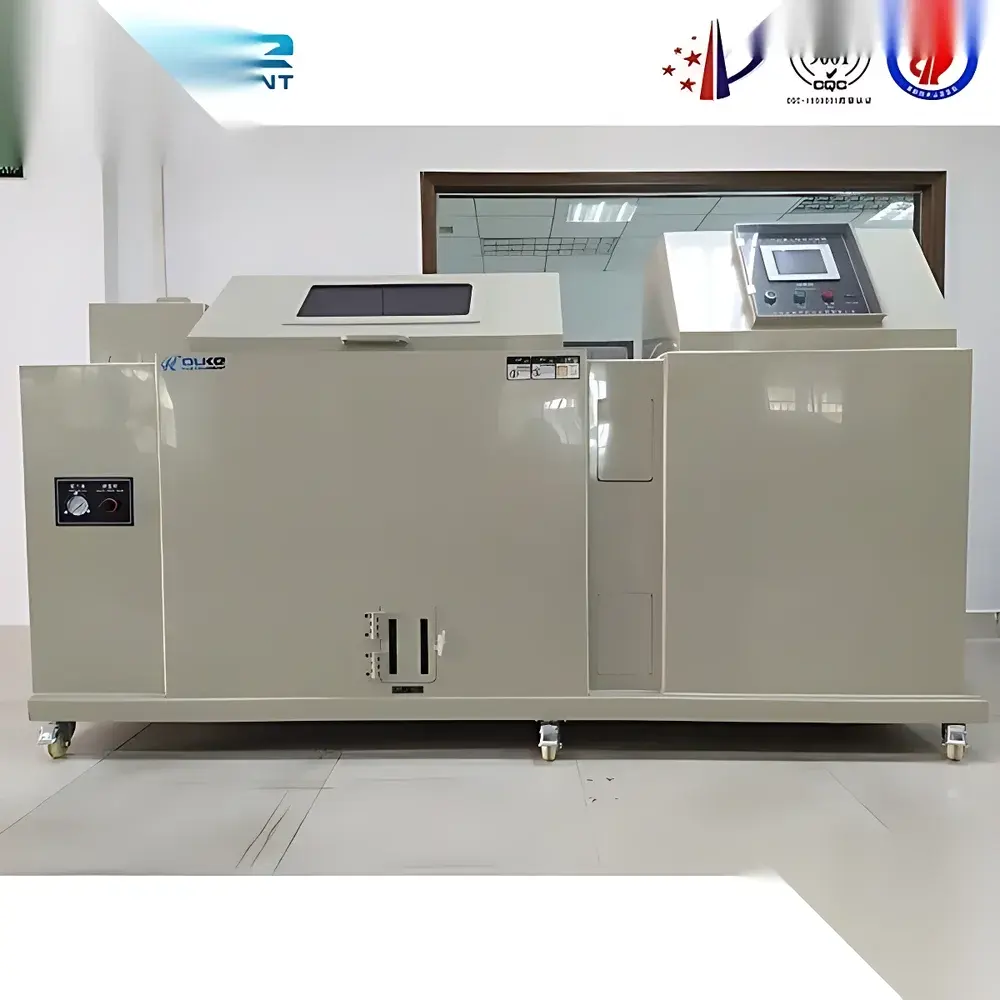
OK-SH Series Fiberglass-Reinforced Polymer (FRP) Salt Spray Test Chamber
| Brand | OK Instrumentation |
|---|---|
| Origin | Imported |
| Manufacturer Type | Authorized Distributor |
| Temperature Range | +5°C to 55°C |
| Humidity Range | 85–95% RH |
| Temperature Uniformity | ≤ ±2°C |
| Temperature Fluctuation | ≤ ±0.5°C |
| Salt Spray Deposition Rate | 1–2 mL / 80 cm²·h |
| Spray Mode | Continuous or Cyclic |
| Test Timer | 1–999 s/min/h adjustable |
| Power Consumption | 1.3–1.8 kW (model-dependent) |
| Compliance | ASTM B117, ISO 9227, JIS Z2243, GB/T 2423.17 |
| Chamber Construction | Monolithic FRP body with high-temp fusion welding |
| Safety Features | Low-water cutoff, over-temperature cutoff, low-salt-level alarm, visual/audible warning system |
Overview
The OK-SH Series Fiberglass-Reinforced Polymer (FRP) Salt Spray Test Chamber is a precision-engineered environmental test system designed to simulate accelerated corrosive conditions in accordance with internationally recognized standards—including ASTM B117, ISO 9227, JIS Z2243, and GB/T 2423.17. It operates on the principle of continuous or cyclic atomization of a standardized sodium chloride (NaCl) solution under controlled temperature and humidity, enabling quantitative evaluation of corrosion resistance in metallic coatings, electroplated finishes, anodized layers, and protective organic films. Unlike stainless steel or PVC chambers, the monolithic FRP construction provides exceptional long-term resistance to chloride-induced degradation, eliminating galvanic corrosion risks at weld seams and ensuring structural integrity over decades of operation. The chamber’s sealed water-trap lid design prevents salt fog leakage, while its transparent acrylic viewing window allows real-time visual monitoring of specimen behavior without interrupting test continuity.
Key Features
- Monolithic FRP chamber body formed via high-temperature fusion welding—no seams, no leaks, zero maintenance corrosion vulnerability
- Tower-type spray system with integrated ceramic-filtered nozzle assembly; eliminates crystallization and ensures uniform salt deposition (1–2 mL/80 cm²·h, gravimetrically verifiable)
- High-accuracy PID temperature controller (±0.1°C deviation) with optional Fuji, RKC, or Honeywell digital displays
- Dual-mode spray control: selectable continuous or programmable cyclic operation with independent on/off timing
- Comprehensive safety architecture: low-water-level power cutoff, dual-stage thermal overload protection (electronic + mechanical), audible/visual alarm for low salt solution level
- Front-access hinged side doors with industrial-grade locking mechanism—designed for rapid inspection and component servicing without disassembly
- Micro-printer interface supporting time-stamped data logging and real-time deposition curve plotting; print interval, speed, and format configurable via front-panel menu
Sample Compatibility & Compliance
The OK-SH chamber accommodates specimens up to 750 × 1100 × 500 mm (W × D × H) in the largest model (OK-SH-750), with standardized test racks and non-reactive FRP support fixtures included. All internal surfaces are chemically inert to 5 wt% NaCl solution, pH 6.5–7.2, and compatible with modified salt solutions (e.g., CuCl₂-accelerated AASS per ASTM G85 Annex A5). The system meets full traceability requirements for GLP and ISO/IEC 17025 laboratories: temperature and spray duration parameters are logged with timestamped audit trails, and calibration certificates for the PID controller and deposition collector are provided with each unit. Optional I/O interfaces support integration into centralized lab management systems compliant with FDA 21 CFR Part 11 for electronic record integrity.
Software & Data Management
While the base configuration features embedded microcontroller-based logic with local keypad navigation, optional PC-based software (OK-LogSuite v3.2) enables remote monitoring, multi-chamber synchronization, automated report generation (PDF/CSV), and statistical analysis of corrosion onset time, blister count (per ISO 4628-2), and rust creepage (per ASTM D1654). All logged data includes operator ID, environmental setpoints, actual chamber readings, and alarm event timestamps—fully compliant with ISO 17025 clause 7.7 on result reporting and traceability. Printer consumables are standard thermal rolls (57 mm width), with >10,000-line capacity per roll and field-replaceable print head modules.
Applications
This chamber serves critical validation functions across aerospace OEM supply chains (per AMS 2700), automotive Tier-1 coating suppliers (VDA 6.3 process audits), medical device manufacturers evaluating stainless steel implant passivation (ISO 10993-15), and electronics contract manufacturers testing conformal coating adhesion (IPC-CC-830B). It is routinely deployed in QC labs for incoming material verification (e.g., zinc-nickel plating on fasteners), R&D screening of novel anti-corrosion inhibitors, and failure analysis of field-return components exhibiting white rust or pitting. Its FRP construction makes it uniquely suitable for testing highly reactive alloys (e.g., magnesium AZ31, aluminum 7075-T6) where metallic chamber walls could introduce cross-contamination.
FAQ
Does the chamber require external compressed air?
Yes—clean, oil-free, dry compressed air (minimum 2–3 bar, ISO 8573-1 Class 2:2:2) must be supplied externally; air regulator and moisture trap are recommended upstream.
Is distilled water mandatory for the salt solution?
Yes—conductivity must remain below 5 µS/cm to prevent uncontrolled electrolytic effects; deionized water with resistivity ≥1 MΩ·cm is required per ASTM B117.
Can the chamber operate unattended for extended cycles?
Yes—integrated safety interlocks and auto-shutdown protocols allow fully autonomous 999-hour tests; remote status monitoring is supported via optional RS485/Modbus RTU.
What maintenance intervals are recommended?
Weekly: nozzle inspection and filter cleaning; quarterly: PID sensor calibration verification; annually: full system performance validation using NIST-traceable reference thermistors and calibrated deposition collectors.
Are replacement parts available globally?
All FRP structural components, spray towers, and control modules are stocked in EU and APAC distribution hubs; lead time for non-stock items is ≤12 business days.



