
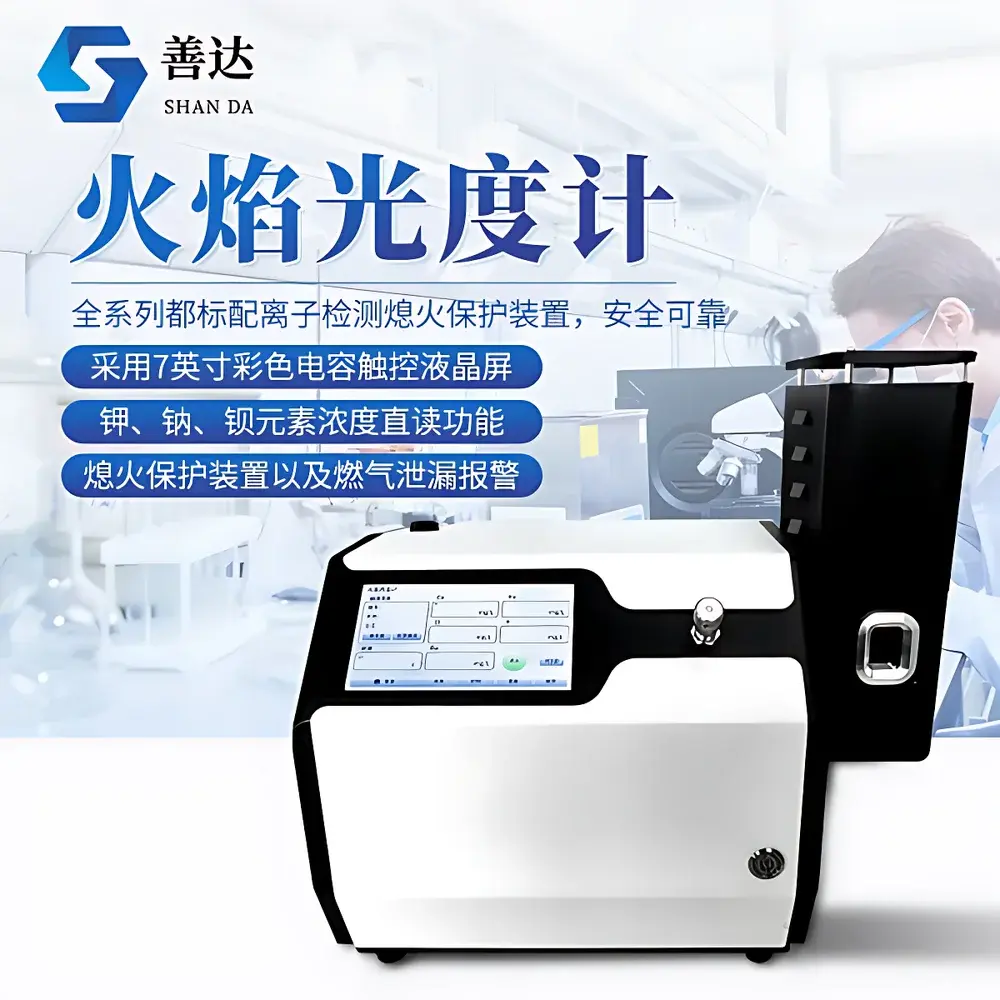
Shanda SD-FP7450 Flame Photometer
| Brand | Shanda |
|---|---|
| Model | SD-FP7450 |
| Origin | Shandong, China |
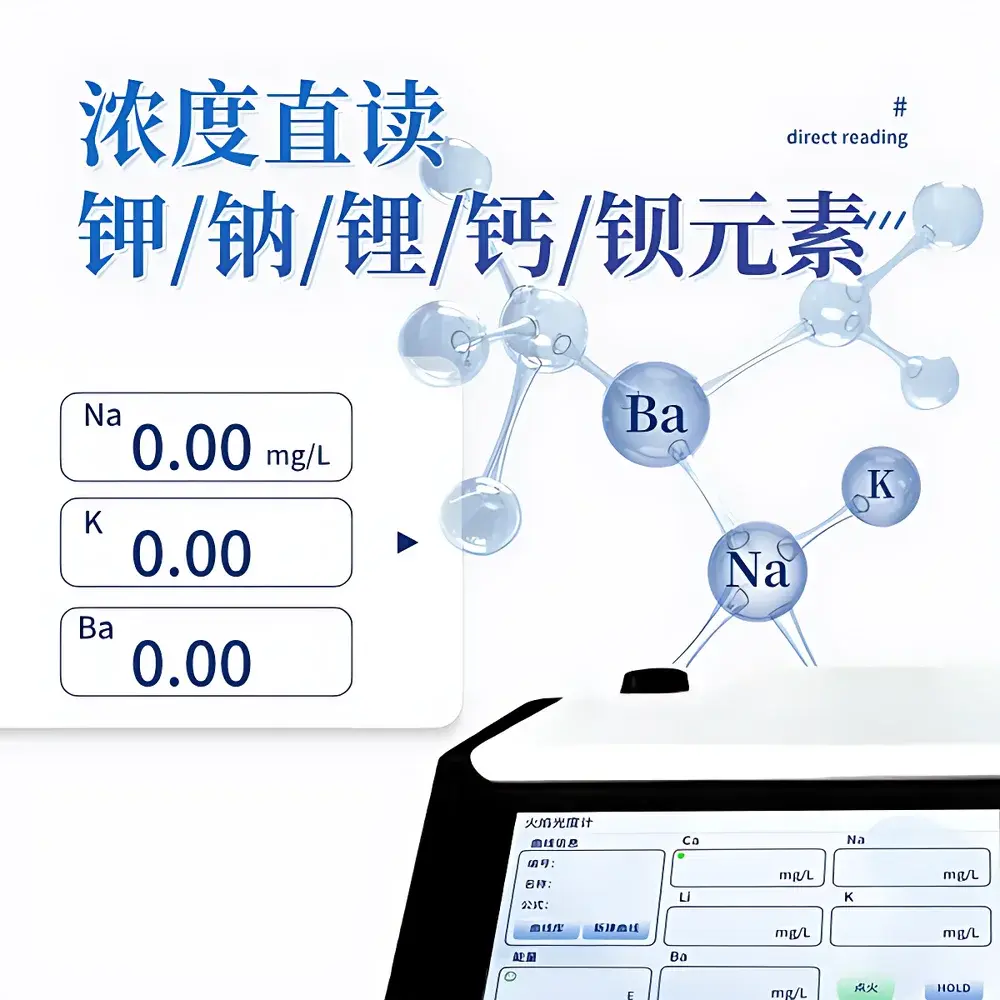
| Detection Elements | K, Na, Li, Ca, Ba |
| Number of Channels | 5 |
| Measurement Range | 0.000–999.9 / 0–65535 (arbitrary units) |
| Detection Limits (mmol/L) | K ≤ 0.004, Na ≤ 0.008, Li ≤ 0.015, Ca ≤ 0.050, Ba ≤ 0.044 |
| Linearity Error (mmol/L) | K ≤ 0.005, Na ≤ 0.03, Li ≤ 0.021, Ca ≤ 0.075, Ba ≤ 0.066 |
| Response Time | ≤ 8 s |
| Nebulization Rate | < 6 mL/min |
| Stability | ≤ 3% RSD over 15 s |
| Repeatability | ≤ 3% RSD |
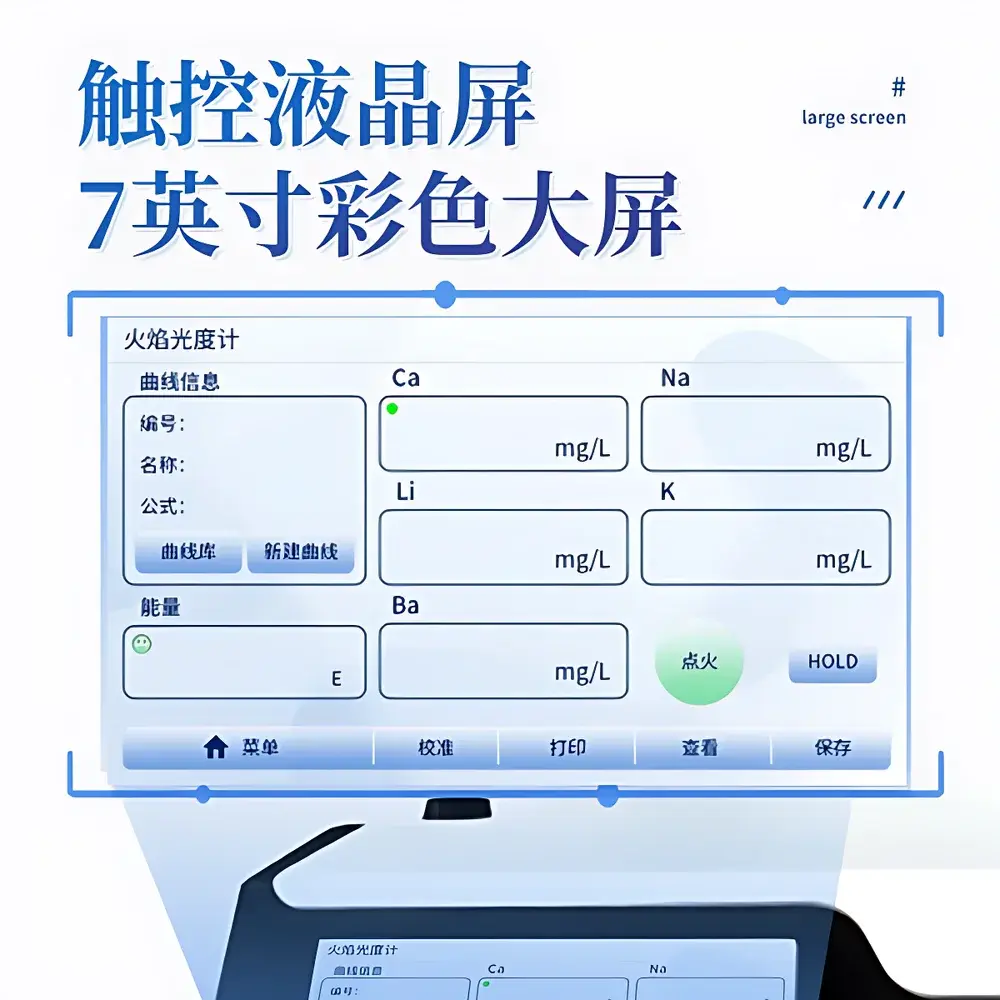
| Display | 7-inch capacitive color touchscreen |
| Output | Concentration values and relative emission intensity |
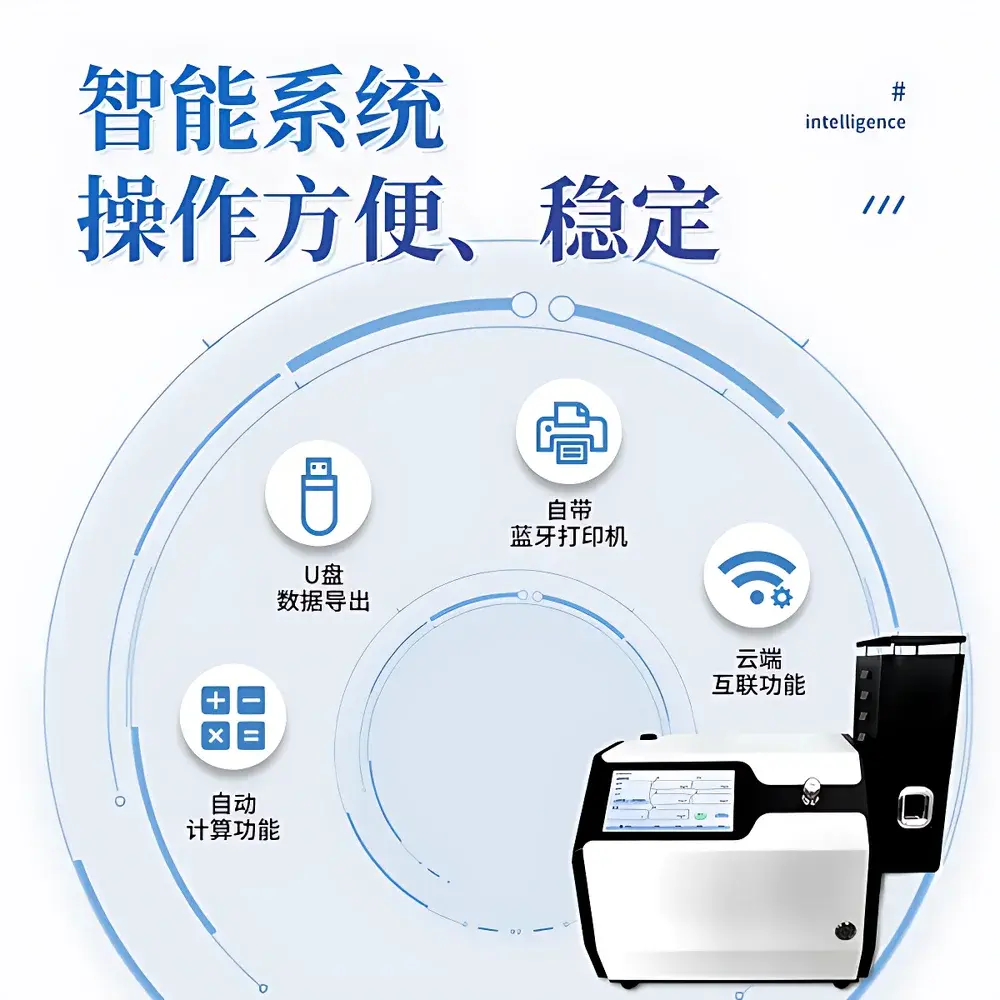
| Data Output | Built-in Bluetooth thermal printer, USB interface, optional PC software |
| Graphical Display | Real-time calibration curve and signal trend plotting |
| Compliance | Designed for routine quantitative analysis in accordance with ISO 11097:2010 (Water quality — Determination of sodium and potassium — Flame photometric method) and ASTM D1293 (Standard Test Methods for Electrical Conductivity and pH of Water) |
Overview
The Shanda SD-FP7450 Flame Photometer is a benchtop atomic emission spectrometer engineered for rapid, reliable quantification of alkali and alkaline earth metals—including potassium (K), sodium (Na), lithium (Li), calcium (Ca), and barium (Ba)—in aqueous samples. Operating on the principle of flame atomic emission spectroscopy (FAES), the instrument atomizes liquid samples via pneumatic nebulization, introduces them into a stable air-propane flame (~1700 °C), and measures the characteristic wavelength-specific photon emission intensities of excited metal ions. These intensities are linearly proportional to analyte concentration within defined dynamic ranges, enabling direct calibration against standard solutions. The SD-FP7450 is purpose-built for high-throughput environmental, clinical, agricultural, and industrial laboratories requiring regulatory-compliant, cost-effective elemental analysis without the complexity or capital cost of ICP-OES systems.
Key Features
- Five independent optical channels with interference-filter-based wavelength isolation (e.g., 766.5 nm for K, 589.0 nm for Na), eliminating spectral overlap and enabling simultaneous or sequential multi-element measurement.
- 7-inch capacitive color touchscreen interface supporting intuitive navigation, real-time signal visualization, calibration curve plotting, and on-device data review—no external computer required for routine operation.
- Optimized burner head and nebulizer design delivering stable flame geometry and consistent aerosol generation at <6 mL/min uptake rate, minimizing sample consumption and improving long-term signal stability.
- Integrated Bluetooth thermal printer provides immediate hard-copy output of calibration reports, sample results, and trend graphs—fully traceable without third-party peripherals.
- Dual-range digital readout (0.000–999.9 and 0–65535 arbitrary units) accommodates both low-concentration environmental waters and high-salt biological or fertilizer extracts without manual range switching.
- USB host port enables firmware updates, data export to USB storage devices, and connection to optional PC-based analytical software supporting GLP audit trails and 21 CFR Part 11–compliant user authentication.
Sample Compatibility & Compliance
The SD-FP7450 accepts clarified aqueous solutions with total dissolved solids (TDS) < 0.5%. Samples require minimal pretreatment—typically filtration (0.45 µm) and dilution if matrix effects exceed tolerance. It complies with ISO 11097:2010 for sodium and potassium determination in water and aligns with ASTM D1293 for conductivity-correlated cation profiling. While not a GMP-grade system, its repeatability (≤3% RSD), stability metrics, and calibration verification protocols support use in ISO/IEC 17025-accredited testing laboratories performing routine QA/QC in food, soil extract, serum, and wastewater applications. All calibration and sample run logs are timestamped and exportable for internal audit documentation.
Software & Data Management
A dedicated Windows-compatible software suite (optional) extends functionality beyond onboard capabilities: automated multi-point calibration with forced-zero and outlier rejection, batch sample sequencing with ID tagging, statistical summary (mean, SD, CV%), report generation in PDF/CSV, and secure user account management. The software maintains full electronic records—including operator ID, date/time stamps, calibration history, and raw intensity values—enabling compliance with FDA 21 CFR Part 11 when configured with digital signatures and audit trail activation. Data integrity is preserved via write-protected storage and automatic backup to network drives or cloud repositories.
Applications
- Environmental monitoring: Quantification of Na⁺ and K⁺ in drinking water, surface water, and leachates per EPA Method 200.7 (modified).
- Clinical chemistry: Rapid serum/plasma sodium and potassium screening in point-of-care and core lab settings where throughput outweighs ultra-trace sensitivity requirements.
- Agricultural testing: Soil extract analysis (e.g., Mehlich-3, ammonium acetate) for exchangeable K⁺, Ca²⁺, and Mg²⁺ (via Ba²⁺ surrogate calibration).
- Fertilizer and feed analysis: Quality control of K₂O and Na₂O content in granular and liquid formulations.
- Pharmaceutical excipient testing: Sodium content verification in APIs and buffers per USP <231> guidance (when validated for specificity).
FAQ
What flame gas is required for operation?
The SD-FP7450 uses laboratory-grade propane and compressed air; no acetylene or nitrous oxide is needed. A standard propane cylinder with pressure regulator (0.5–1.0 bar output) and oil-free air compressor (≥5 L/min @ 4 bar) are sufficient.
Can the instrument measure magnesium or iron?
No. The SD-FP7450 is optimized for Group I and II elements with strong, low-excitation-energy emission lines. Mg and Fe exhibit weak or complex spectra in air-propane flames and require higher-temperature flames or alternative techniques (e.g., AAS or ICP).
Is method validation support included?
Yes—the instrument includes a comprehensive validation protocol guide covering specificity, linearity (r² ≥ 0.999), LOD/LOQ determination, precision (repeatability and intermediate precision), and robustness testing per ICH Q2(R2). Application notes for water, serum, and soil matrices are available upon request.
How often must the optical filters be replaced?
Under normal use (≤8 h/day), interference filters retain >95% transmission for ≥5 years. No scheduled replacement is required; performance is verified during annual preventive maintenance using NIST-traceable emission standards.
Does the system support external autosamplers?
Not natively. However, the USB and RS-232 interfaces (via optional adapter) allow integration with third-party XYZ autosamplers through custom script execution in the PC software environment.




