
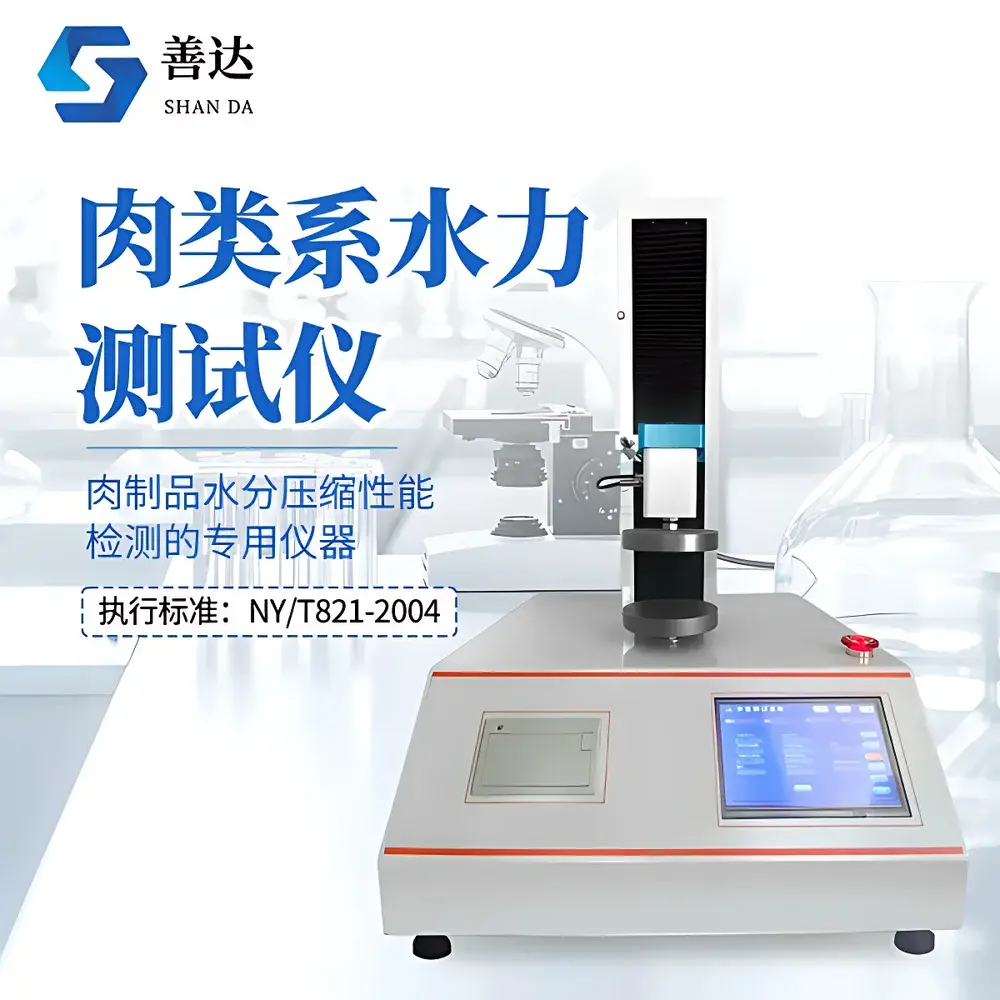

Shanda SD-RXS Meat Water-Holding Capacity (WHC) Tester
| Brand | Shanda |
|---|---|
| Model | SD-RXS |
| Origin | Shandong, China |
| Measurement Principle | Compression-based Gravimetric Method (NY/T 821–2004) |
| Force Range | 0–3000 N |
| Resolution | 0.1 N |
| Accuracy | ±1% FS |
| Compression Speed | 1–300 mm/min |
| Dwell Time | 1–3600 s |
| Deformation Range | 1–70 mm |
| Platen Diameter | 110 mm |
| Parallelism | <0.05 mm |
| Dimensions | 450 × 450 × 680 mm |
| Weight | ~45 kg |
| Power Supply | AC 220 V, 50 Hz |
Overview
The Shanda SD-RXS Meat Water-Holding Capacity (WHC) Tester is a dedicated mechanical compression instrument engineered for standardized quantitative assessment of water-holding capacity in fresh and processed meat samples. WHC is a critical physicochemical parameter reflecting the ability of myofibrillar proteins to retain intrinsic moisture under external stress—directly influencing yield during processing (e.g., curing, smoking, freezing), cooking loss, juiciness, tenderness, and shelf-life stability. This instrument implements the gravimetric compression method specified in China’s agricultural industry standard NY/T 821–2004, which defines WHC as the percentage ratio of expressed water mass to initial sample mass after controlled uniaxial compression. The system operates on a precision electromechanical platform integrating high-fidelity load sensing, programmable displacement control, and time-synchronized force application—enabling reproducible, operator-independent measurement of drip loss, purge loss, or pressure-induced exudation.
Key Features
- High-accuracy load cell calibrated to ≤±1% full-scale error—exceeding ISO 7500-1 Class 1 requirements for static force measurement;
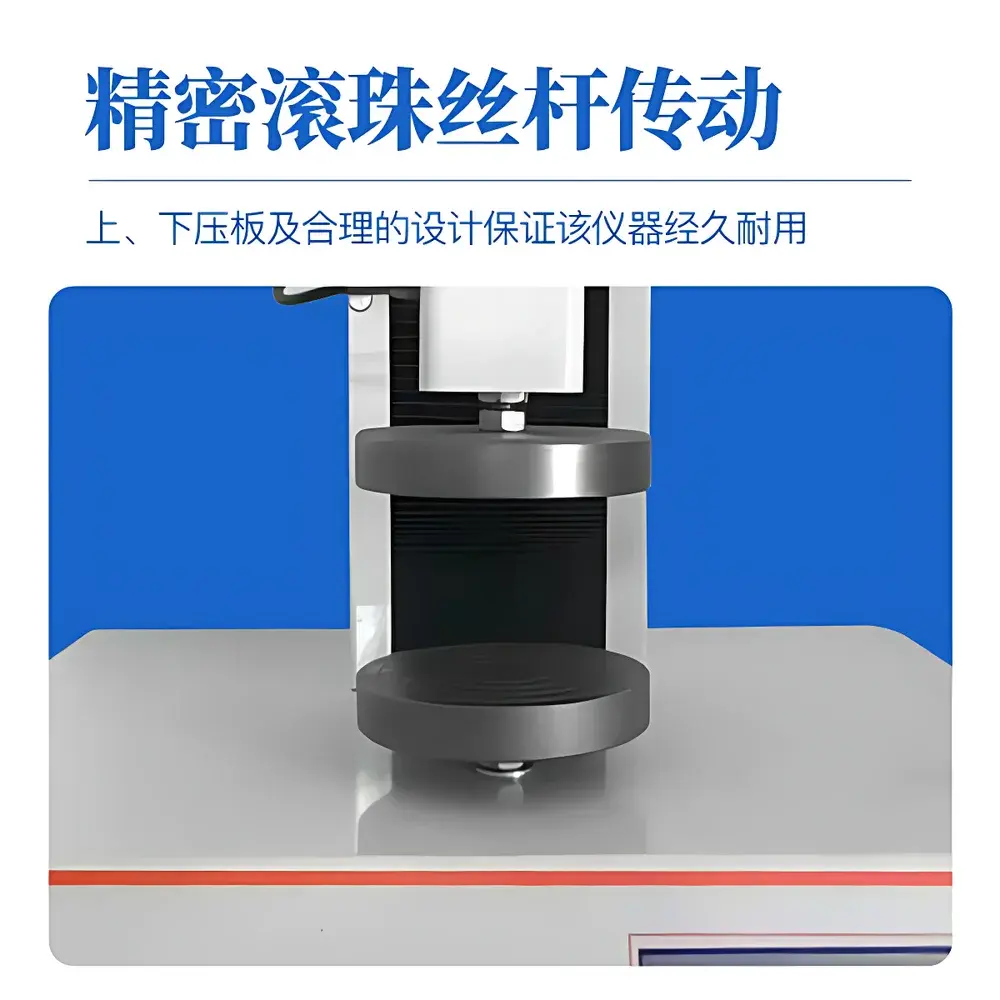
- Preloaded recirculating ball screw drive with backlash-free transmission, ensuring consistent loading rate and minimal hysteresis across repeated cycles;
- 110 mm diameter parallel platens with surface flatness maintained to <0.05 mm deviation—minimizing edge effects and non-uniform stress distribution;
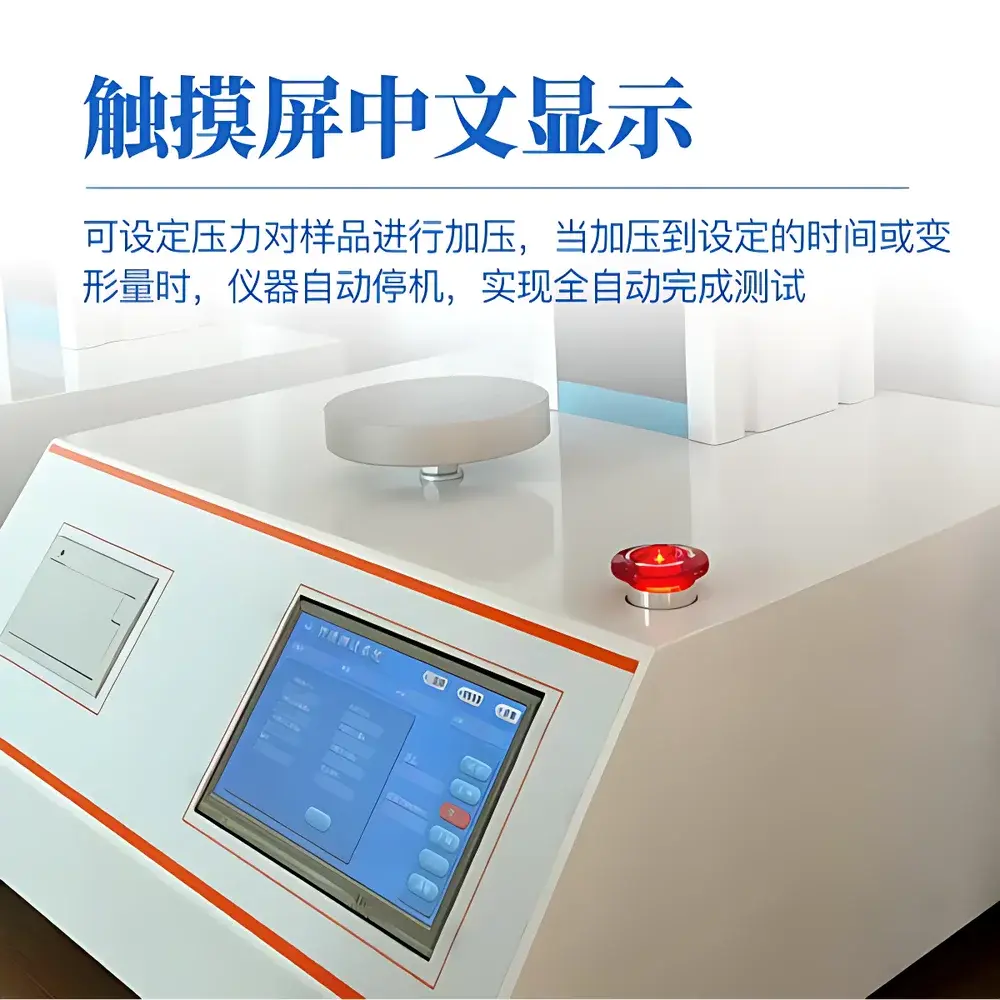
- Intuitive 7-inch resistive touchscreen interface supporting multi-step test protocols: user-defined target force, dwell duration (1–3600 s), deformation limit (1–70 mm), or hybrid termination criteria;
- Integrated thermal printer for immediate hardcopy output of raw data (pre-compression weight, post-compression weight, calculated WHC %, timestamp, operator ID);
- Brushless DC motor with closed-loop speed control enables precise compression velocities from 1 to 300 mm/min and rapid return at 1300 mm/min—reducing cycle time without compromising mechanical integrity.
Sample Compatibility & Compliance
The SD-RXS accommodates cylindrical or cuboidal meat specimens up to 110 mm in diameter and 70 mm in height—including pork loin, beef semitendinosus, chicken breast, and comminuted sausages. Sample preparation follows NY/T 821–2004 guidelines: equilibration at 4 °C, standardized geometry (typically 10 mm thick × 25 mm diameter), and immediate testing post-sampling to avoid post-mortem pH drift. While primarily aligned with Chinese agricultural standards, the instrument’s force resolution (0.1 N), repeatability (<0.5% RSD over n=10 replicates), and traceable calibration path support alignment with broader food quality frameworks including ISO 2917 (meat drip loss), AOAC 985.15 (cooked meat yield), and internal QC protocols compliant with HACCP and ISO 22000. It does not meet FDA 21 CFR Part 11 requirements out-of-the-box but supports audit-ready manual logbooks per GLP principles.
Software & Data Management
The embedded firmware stores up to 1,000 test records locally, each containing pre-test mass, post-test mass, applied force profile, compression time, deformation curve (optional via firmware update), and calculated WHC %. Data export is supported via USB flash drive in CSV format for downstream statistical analysis in Excel, JMP, or R. No cloud connectivity or remote access is implemented; all data remain on-device unless manually transferred. The system includes basic statistical functions—mean, standard deviation, CV%, min/max—for real-time batch evaluation. For laboratories requiring electronic records management, integration with LIMS systems is achievable via RS-232 serial output (ASCII protocol) with configurable delimiter and header settings.
Applications
- Quality assurance in abattoirs and meat processing plants: screening for pale-soft-exudative (PSE) or dark-firm-dry (DFD) conditions linked to ante-mortem stress or genetic factors;
- R&D validation of marination efficiency, phosphate addition, or enzymatic tenderization treatments;
- Academic research on post-mortem glycolysis kinetics, sarcomere shortening, and pH–WHC correlation models;
- Regulatory inspection by CIQ (China Inspection and Quarantine) and provincial agriculture bureaus for compliance with NY/T 821–2004 and GB/T 9695.19–2008;
- Teaching laboratories demonstrating fundamental muscle biochemistry concepts—e.g., how declining pH below the isoelectric point of myosin (~5.2) reduces electrostatic repulsion and weakens water-binding networks.
FAQ
What standard methods does the SD-RXS implement?
It is explicitly designed for NY/T 821–2004 “Meat Quality—Determination of Water-Holding Capacity by Compression Method”. It may be adapted for ISO 2917 or AOAC 985.15 with procedural modifications, though validation is required.
Can the instrument measure WHC without weighing the sample before and after compression?
No. Gravimetric calculation is fundamental to the method. The SD-RXS measures force and displacement only—the operator must record pre- and post-compression masses separately using an analytical balance (0.001 g resolution recommended).
Is calibration traceable to national metrology institutes?
Yes. Shanda provides factory calibration certificates traceable to CNAS-accredited reference standards. Annual recalibration using certified deadweight kits (Class M1 or better) is recommended.
Does the device support automatic sample thickness compensation?
No. Sample height must be measured manually prior to loading; deformation limits are set relative to initial platen gap—not absolute position.
What maintenance is required for long-term accuracy?
Monthly cleaning of platen surfaces and ball screw with lint-free cloth; biannual lubrication of lead screw with lithium-based grease; annual verification of load cell linearity and zero offset.




