
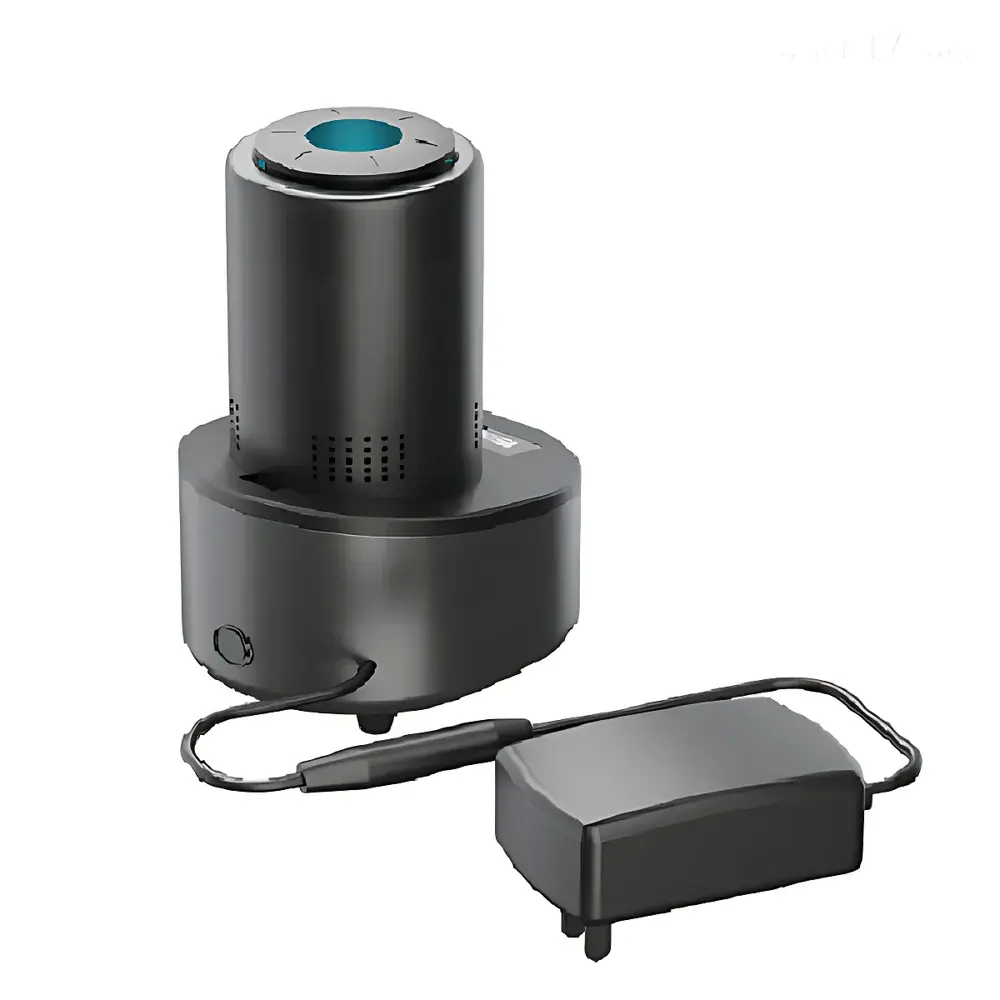
Shanghai 3S AS(8) Single-Position Full-Spectrum Photochemical Reactor
| Brand | Shanghai 3S Technology Co., Ltd |
|---|---|
| Origin | Shanghai, China |
| Manufacturer Type | OEM Manufacturer |
| Product Origin | Domestic (China) |
| Model | AS(8) |
| Pricing | Upon Request |
Overview
The Shanghai 3S AS(8) Single-Position Full-Spectrum Photochemical Reactor is an engineered platform for controlled photochemical synthesis and mechanistic investigation under precisely tunable irradiation conditions. It operates on the principle of broadband photon delivery—enabling wavelength-selective excitation across the deep ultraviolet (DUV), near-UV, visible, and near-infrared (NIR) spectral ranges (250–975 nm). Unlike multi-position parallel reactors, the AS(8) prioritizes optical fidelity and experimental reproducibility through a single, high-intensity reaction zone optimized for rigorous kinetic profiling, quantum yield determination, and photostability assessment. Its design emphasizes thermal management, optical coupling efficiency, and compatibility with standard laboratory glassware—making it suitable for both exploratory screening and protocol development in regulated research environments.
Key Features
- Precision Light Power Control: Digital power regulation with ≤10 mW resolution ensures repeatable irradiance delivery—critical for dose-dependent studies and photoreaction optimization.
- Full-Spectrum Illumination Capability: Interchangeable lamp modules cover 250–975 nm; over 60 discrete wavelength options available—including deuterium, mercury-xenon, LED, and filtered halogen sources—supporting DUV-initiated C–H activation, visible-light redox catalysis, and NIR-triggered upconversion systems.
- High Irradiance Output: Delivers up to ~700 mW/cm² (exceeding 2,000,000 lux at sample plane) with <5% annual optical decay—validated via NIST-traceable radiometric calibration protocols.
- Modular Sample Chamber Design: Accommodates standard NMR tubes (5 mm OD), 5/10/20 mL screw-cap reaction vials, and cylindrical quartz/glass tubes (25/50/100 mL); custom bore diameters and cooling jacket interfaces are available upon specification.
- Thermal Stability Architecture: Integrated air-cooling system maintains ambient-to-moderate temperature operation (<40 °C surface rise under continuous 700 mW/cm² exposure), minimizing thermal side reactions during prolonged photolysis.
Sample Compatibility & Compliance
The AS(8) supports chemically inert sample containment using borosilicate or fused quartz vessels—ensuring minimal UV absorption below 254 nm and compatibility with aggressive reagents (e.g., strong acids, organometallics, radical initiators). Reaction vessels are secured via precision-machined PTFE-lined holders to prevent vibration-induced misalignment. While not certified to IEC 61000-4 or UL 61010-1 as a standalone safety system, the reactor complies with general laboratory equipment requirements per ISO/IEC 17025:2017 for method validation support. When operated with traceable light sources and calibrated power meters, data generated meets reporting criteria for peer-reviewed photochemical studies and internal R&D documentation under GLP-aligned workflows.
Software & Data Management
The AS(8) operates in manual or semi-automated mode via front-panel digital interface (no proprietary software required). For integration into automated labs, analog 0–10 V control inputs allow external triggering from programmable logic controllers (PLCs) or lab automation platforms (e.g., Hamilton STAR, Tecan Fluent). Radiant power logs can be recorded externally using compatible USB-powered spectroradiometers (e.g., Ocean Insight HDX, StellarNet Black-Comet). All irradiation parameters—including cumulative fluence (J/cm²), peak irradiance (mW/cm²), and spectral bandwidth (FWHM)—are documented in raw log files compliant with ALCOA+ principles when paired with validated electronic lab notebooks (ELNs) supporting 21 CFR Part 11 audit trails.
Applications
- Photocatalytic C–C and C–heteroatom bond formation under UVC (254 nm) and UVA (365 nm) irradiation
- Quantum yield (Φ) determination via actinometry (e.g., potassium ferrioxalate, Aberchrome 540)
- Photoinduced polymerization kinetics and crosslinking density analysis
- Photostability testing of pharmaceutical intermediates per ICH Q1B guidelines
- Mechanistic elucidation of triplet energy transfer, electron transfer, and energy migration pathways
- Development of visible-light-mediated asymmetric catalysis protocols
FAQ
Is the AS(8) compatible with inert atmosphere glovebox integration?
Yes—the reactor features sealed feedthrough ports for gas inlet/outlet lines and optional vacuum-compatible flange adapters.
Can spectral output be verified in-house without third-party calibration?
Yes—interchangeable filter sets and reference photodiodes enable routine spectral verification using NIST-traceable reference lamps.
What cooling options are available beyond air convection?
Optional recirculating chiller interfaces (standard 6 mm quick-connect) support active temperature control down to 5 °C.
Does the system support time-resolved irradiation profiles (e.g., pulsed light)?
Yes—external TTL triggering enables microsecond-scale on/off control when paired with compatible pulsed LED modules.
Are quartz reaction tubes supplied with the base configuration?
No—quartz components are offered as configurable accessories to match wavelength range and thermal load requirements.



