
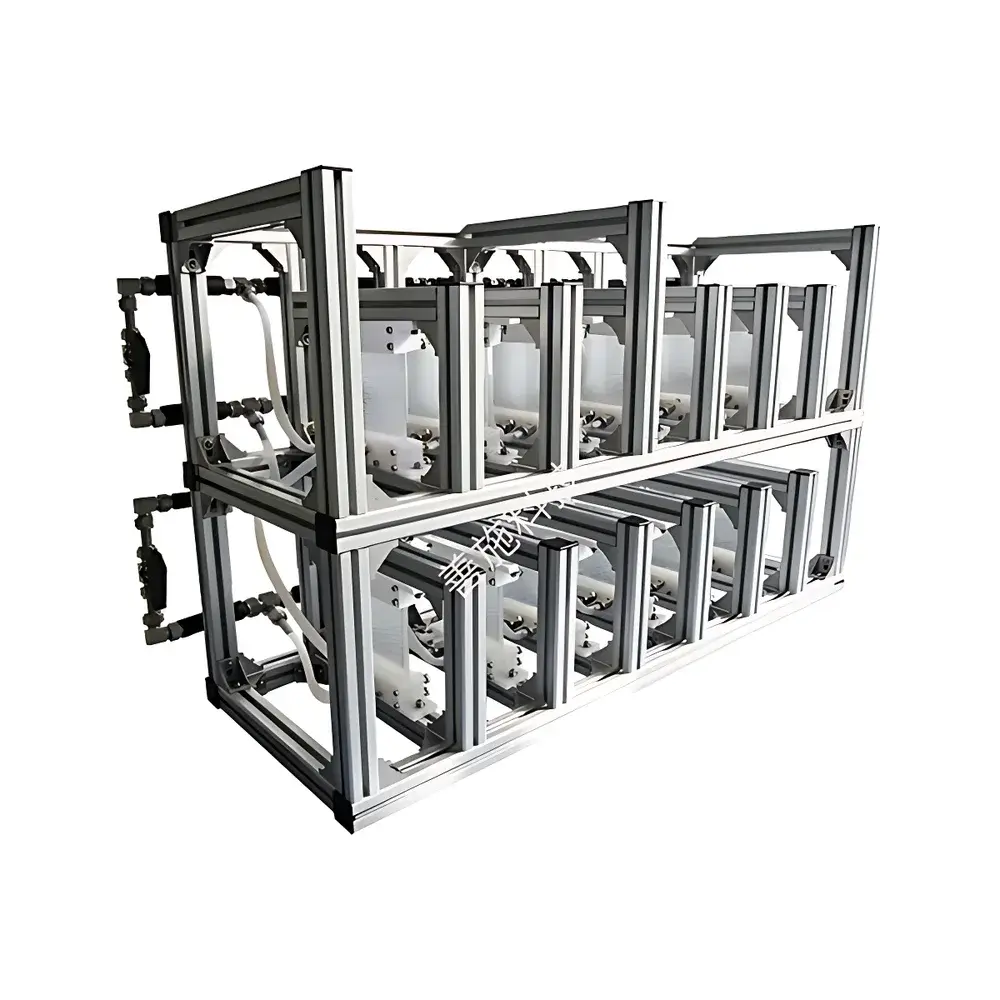
Shanghai 3S FP(2) Continuous-Flow Photochemical Reactor
| Brand | Shanghai 3S Technology Co., Ltd |
|---|---|
| Origin | Shanghai, China |
| Manufacturer Type | OEM Manufacturer |
| Product Origin | Domestic (China) |
| Model | FP(2) |
| Pricing | Available Upon Request |
Overview
The Shanghai 3S FP(2) Continuous-Flow Photochemical Reactor is an engineered platform for precise, scalable, and reproducible photochemical synthesis under controlled flow conditions. It operates on the principle of heterogeneous or homogeneous photocatalysis combined with laminar microfluidic transport—where incident photons from high-stability LED arrays activate catalytic species (e.g., TiO₂, Ru(bpy)₃²⁺, or organic dyes), initiating bond cleavage, radical generation, or energy transfer pathways in flowing substrates. Unlike batch photoreactors, the FP(2) maintains constant photon flux density across the reaction channel while ensuring uniform residence time distribution (RTD), thereby minimizing over-irradiation, thermal gradients, and side-product formation. Its design adheres to fundamental principles of photochemical engineering: quantum yield optimization, photon efficiency mapping, and mass-transfer-limited reaction control. The system is intended for laboratory-scale route scouting, kinetic profiling, and early-stage process intensification—particularly where oxygen sensitivity, exothermicity, or wavelength-selective activation presents challenges in conventional vessels.
Key Features
- Modular microchannel reactor core fabricated from UV-transparent quartz or borosilicate glass, enabling >90% optical coupling across 365–455 nm LED spectra
- Integrated multi-zone LED illumination system with independent intensity control (0–100% PWM), calibrated irradiance output (measured in mW/cm² at channel wall)
- Precision syringe or HPLC-grade peristaltic pumping with dual-channel capability (liquid + gas co-feeding supported via mass flow controllers)
- Real-time temperature regulation (±0.5 °C) via Peltier-based jacketed heat exchange; optional back-pressure regulator for pressurized operation up to 10 bar
- Robust architecture compliant with IEC 61000-6-2/6-4 EMC standards; IP54-rated enclosure for general lab use
- Interlock-enabled safety logic: automatic LED shutoff upon flow interruption, pressure excursion, or thermal fault detection
Sample Compatibility & Compliance
The FP(2) accommodates a broad range of photoactive substrates—including aryl halides, alkenes, carbonyls, and diazonium salts—in solvents such as acetonitrile, THF, DMF, and aqueous buffers. Heterogeneous catalysts (e.g., immobilized Pd/TiO₂, graphitic carbon nitride) can be packed into replaceable cartridge modules. Homogeneous systems require compatible solvent/catalyst solubility and minimal LED absorption interference. The reactor meets general requirements for GLP-compliant method development and aligns with ASTM E2973-21 (Standard Guide for Photoreactor Characterization) for irradiance uniformity reporting. While not certified for GMP manufacturing, its audit-ready parameter logging supports FDA 21 CFR Part 11–compliant data integrity when integrated with validated third-party SCADA software.
Software & Data Management
The FP(2) interfaces via RS-485 or Ethernet to optional PC-based control software (Windows/Linux), supporting synchronized acquisition of flow rate, temperature, pressure, LED current, and external sensor inputs (e.g., inline UV-Vis absorbance). All operational parameters are timestamped and stored in CSV/SQLite format with SHA-256 checksums for traceability. Software includes preconfigured methods for common transformations (e.g., [2+2] cycloadditions, C–H functionalizations, dehalogenations) and permits custom ramp profiles for irradiance or residence time sweeps. Audit trails record user login, parameter changes, and emergency stops—enabling full retrospective analysis per ALCOA+ principles.
Applications
- Kinetic studies of photocatalytic C–N bond formation under varied photon flux and stoichiometric ratios
- Scalable synthesis of pharmaceutical intermediates (e.g., oxetanes, aziridines) with improved selectivity vs. batch photochemistry
- Photoredox-mediated polymerization initiation with narrow dispersity (Đ < 1.15) control
- Gas–liquid photo-oxidation of sulfides to sulfoxides using O₂ as terminal oxidant
- High-throughput screening of photocatalyst libraries using automated fraction collection
- Teaching modules in advanced organic chemistry and chemical engineering curricula focusing on residence time distribution analysis
FAQ
What light sources are compatible with the FP(2)?
The system ships with factory-calibrated 365 nm and 455 nm high-power LEDs; additional narrowband modules (385 nm, 405 nm, 427 nm) are available as options.
Can the reactor handle solid suspensions or slurries?
Yes—when equipped with the optional packed-bed cartridge module and low-shear peristaltic drive; maximum particle size recommended ≤25 µm to avoid clogging.
Is remote monitoring supported?
Yes, via Modbus TCP or OPC UA protocols when connected to institutional lab networks; firewall configuration guidance provided in the technical manual.
Does the FP(2) comply with explosion-proof requirements for flammable solvent handling?
No—it is rated for general laboratory use only; integration with certified explosion-proof enclosures or inert atmosphere gloveboxes is required for Class I, Division 1 environments.
What maintenance intervals are recommended?
LED output calibration every 500 operating hours; quartz channel cleaning with piranha solution (with appropriate PPE) every 200 runs or when transmittance drops >15%.



