
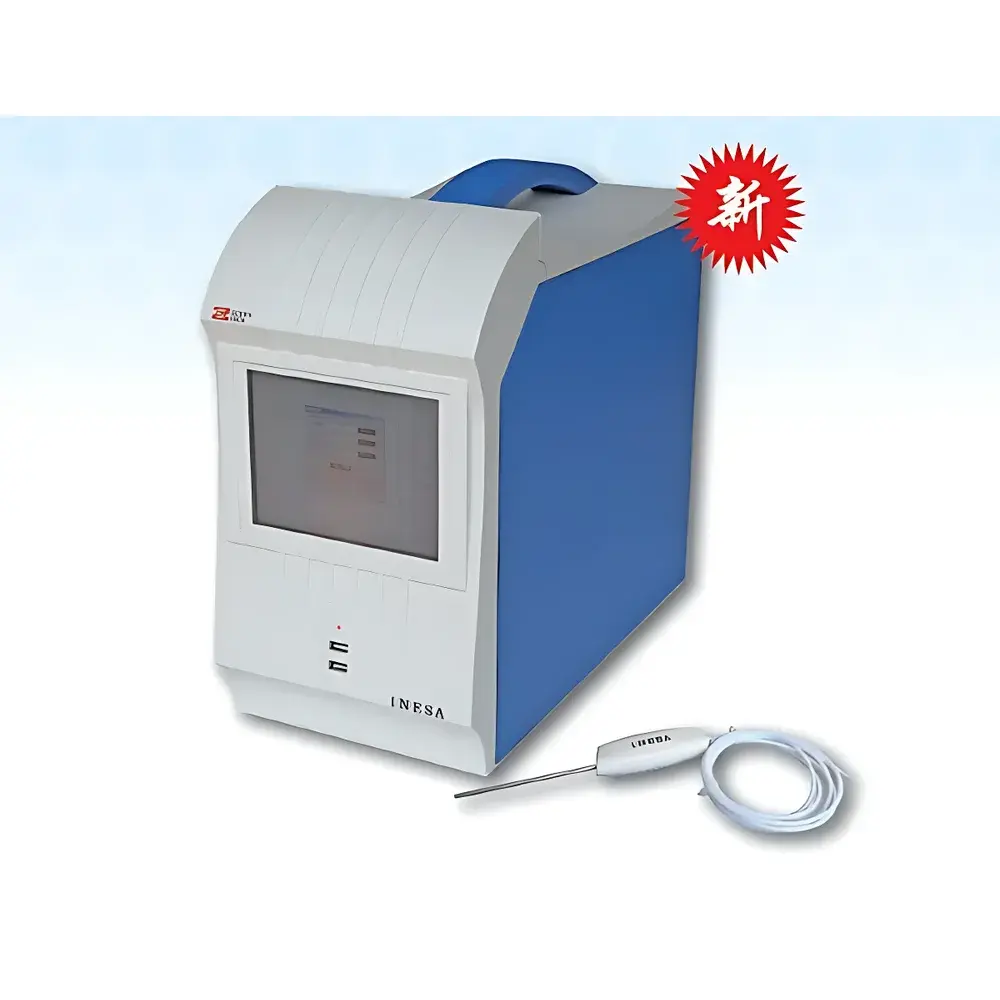
Shanghai INESA GC190A Portable Gas Chromatograph for On-Site Environmental VOC Analysis
| Brand | INESA |
|---|---|
| Origin | Shanghai, China |
| Model | GC190A |
| Column Temperature Stability | ±0.03 °C |
| UV Lamp Energy | 10.6 eV |
| Detection Limit | ≤1×10⁻¹¹ g/mL (benzene) |
| Measurement Range | 0.0–100 mg/m³ |
| Repeatability | ≤3% RSD |
| Baseline Noise | ≤20 µV |
| Baseline Drift | ≤500 µV/15 min |
| Warm-up Time | 1 h to operational stability |
| Power Supply | AC 220 V / 50 Hz |
| Dimensions | 190 mm × 385 mm × 350 mm |
| Weight | 12 kg |
| Operating System | Embedded Windows XP |
| Connectivity | Integrated Ethernet port |
| Detector Type | Photoionization Detector (PID) with 10.6 eV UV lamp |
Overview
The INESA GC190A is a purpose-engineered portable gas chromatograph designed for real-time, on-site quantification of volatile organic compounds (VOCs) in ambient air, indoor environments, and vehicle cabin atmospheres. Unlike laboratory-based GC systems requiring sample pre-concentration or cryogenic trapping, the GC190A integrates direct air sampling with high-sensitivity photoionization detection (PID) using a stable 10.6 eV ultraviolet lamp. This energy level enables selective ionization of aromatic hydrocarbons—including benzene, toluene, ethylbenzene, and xylenes (BTEX)—while minimizing interference from saturated aliphatics and common atmospheric constituents such as CO₂, N₂, and O₂. The system employs a fused-silica capillary column with optimized stationary phase chemistry to achieve baseline separation of BTEX isomers within an 8-minute chromatographic run under isothermal or low-gradient temperature programming. Its thermal management architecture maintains column oven stability at ±0.03 °C—critical for retention time reproducibility across field deployments where ambient temperature fluctuates.
Key Features
- Direct air sampling without pre-concentration: Eliminates reliance on sorbent tubes, thermal desorption units, or Tedlar bags—reducing method variability and carryover risk.
- High-sensitivity PID detection: 10.6 eV UV source delivers sub-ppb (≤1×10⁻¹¹ g/mL) detection limits for benzene; 50–100× more sensitive than conventional FID for aromatic VOCs.
- Self-contained operation: Integrated single-channel carrier gas supply (ultra-high-purity nitrogen or helium), eliminating external gas cylinders and associated logistical constraints.
- Embedded computing platform: Dedicated Windows XP-based control system with touchscreen + USB mouse interface; no external PC required for acquisition, processing, or report generation.
- Ruggedized field design: 12 kg total mass, compact footprint (190 × 385 × 350 mm), and shock-absorbing chassis engineered for transport in vehicles, on foot, or aboard mobile monitoring platforms.
- Automated workflow: Programmable sequence control for auto-sampling, peak integration, calibration curve application, and PDF report generation with timestamped metadata.
Sample Compatibility & Compliance
The GC190A is validated for gaseous matrices including ambient outdoor air (EPA TO-15/TO-17 reference frameworks), indoor air per ISO 16000-6, and confined-space cabin air per SAE J1716. It complies with core performance criteria outlined in ASTM D5466 (Standard Test Method for Determination of Volatile Organic Compounds in Atmospheres by GC/PID) and supports traceability under ISO/IEC 17025:2017 for accredited environmental testing laboratories. While not inherently 21 CFR Part 11 compliant due to its embedded OS limitations, audit-ready data files include electronic signatures, operator ID, instrument configuration logs, and raw chromatogram archives—facilitating GLP-aligned documentation practices when deployed in regulated monitoring programs.
Software & Data Management
Data acquisition and processing are handled via INESA’s proprietary GC Control Suite v3.2, running natively on the embedded OS. The software supports method storage (up to 50 user-defined methods), automatic baseline correction, library-assisted peak identification (NIST MS compatible spectral matching optional), and linear/non-linear calibration models (1–6 point). All chromatograms, integration results, and QA/QC metrics (e.g., retention time shift, peak area RSD, detector response drift) are stored in standardized .cdf format. Ethernet connectivity enables remote access through secure SSH tunneling or HTTP-based status polling; data export supports CSV, XML, and PDF formats for integration into LIMS or centralized environmental databases.
Applications
- Rapid screening of BTEX contamination at brownfield sites, industrial fencelines, and landfill perimeter zones.
- Indoor air quality (IAQ) assessment in newly renovated buildings, schools, and healthcare facilities per WHO indoor air guidelines.
- In-vehicle VOC profiling during emissions certification testing or post-manufacturing cabin off-gassing evaluation.
- Emergency response deployment for fugitive emission source identification following chemical spills or process upsets.
- Long-term unattended monitoring when paired with solar-charged power modules and cellular telemetry adapters.
FAQ
What carrier gases are compatible with the GC190A?
The system is configured for ultra-high-purity nitrogen (99.999%) or helium (99.999%) supplied from its internal pressure-regulated reservoir. Hydrogen is not supported due to safety constraints in portable PID configurations.
Can the GC190A quantify non-aromatic VOCs such as formaldehyde or acetaldehyde?
No—its 10.6 eV PID exhibits negligible ionization efficiency for compounds with ionization potentials >10.6 eV (e.g., formaldehyde = 10.88 eV); it is optimized for BTEX, styrene, chlorobenzenes, and other low-IP aromatics.
Is method validation support available from INESA?
Yes—INESA provides application notes aligned with EPA Method TO-15 Appendix B and ISO 16000-6, including documented LOD/LOQ studies, matrix spike recovery data, and inter-laboratory comparison reports upon request.
How is calibration maintained during extended field use?
The system supports multi-point external standard calibration with certified gas standards; built-in leak-check routines and column bleed diagnostics are executed automatically prior to each analytical sequence.
Does the GC190A meet CE or UKCA marking requirements?
It carries CE marking per Directive 2014/30/EU (EMC) and 2014/35/EU (LVD); UKCA compliance is pending formal third-party assessment but follows identical technical specifications.






