
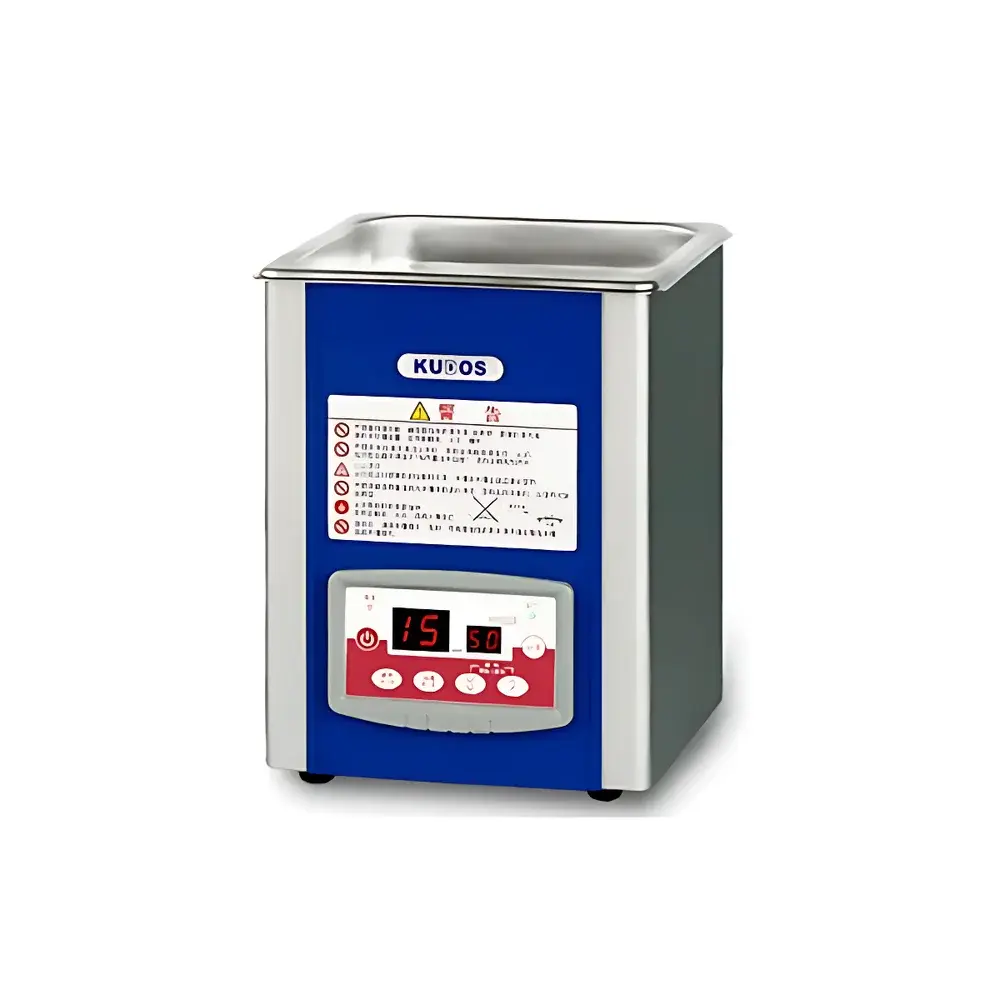
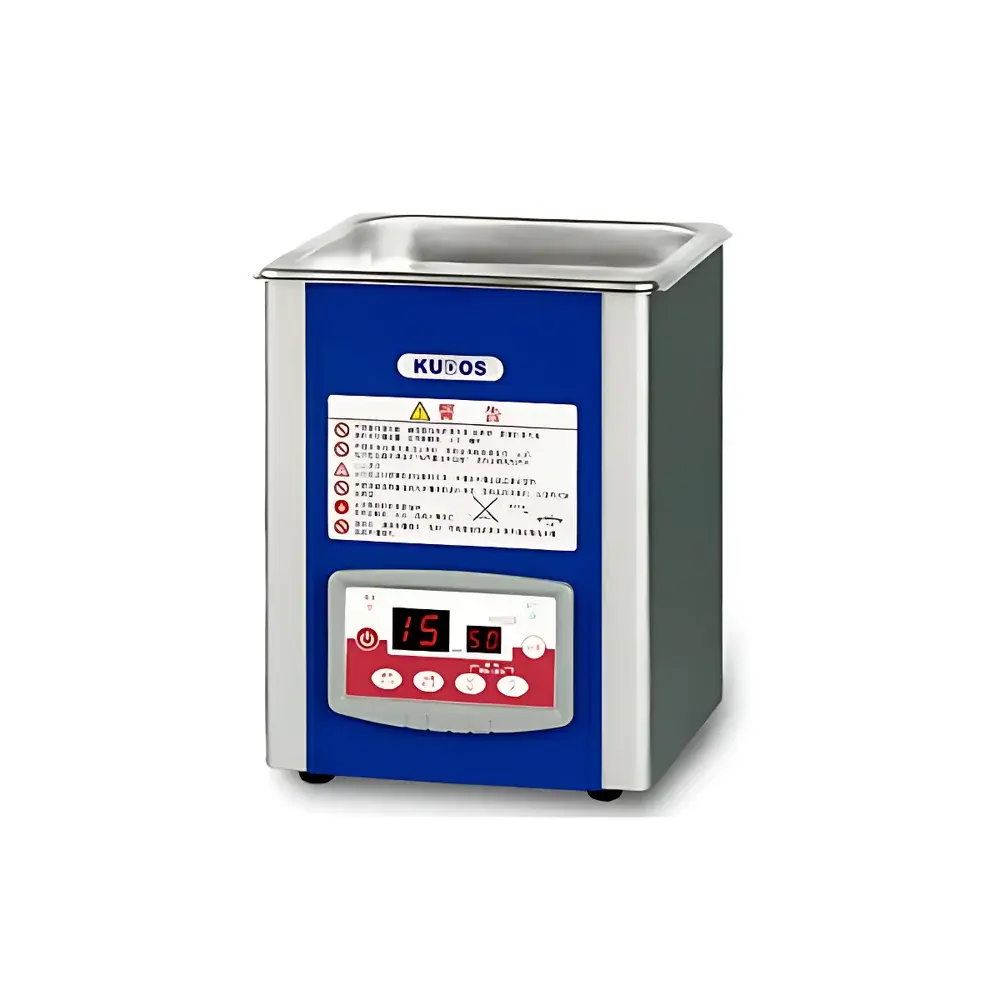
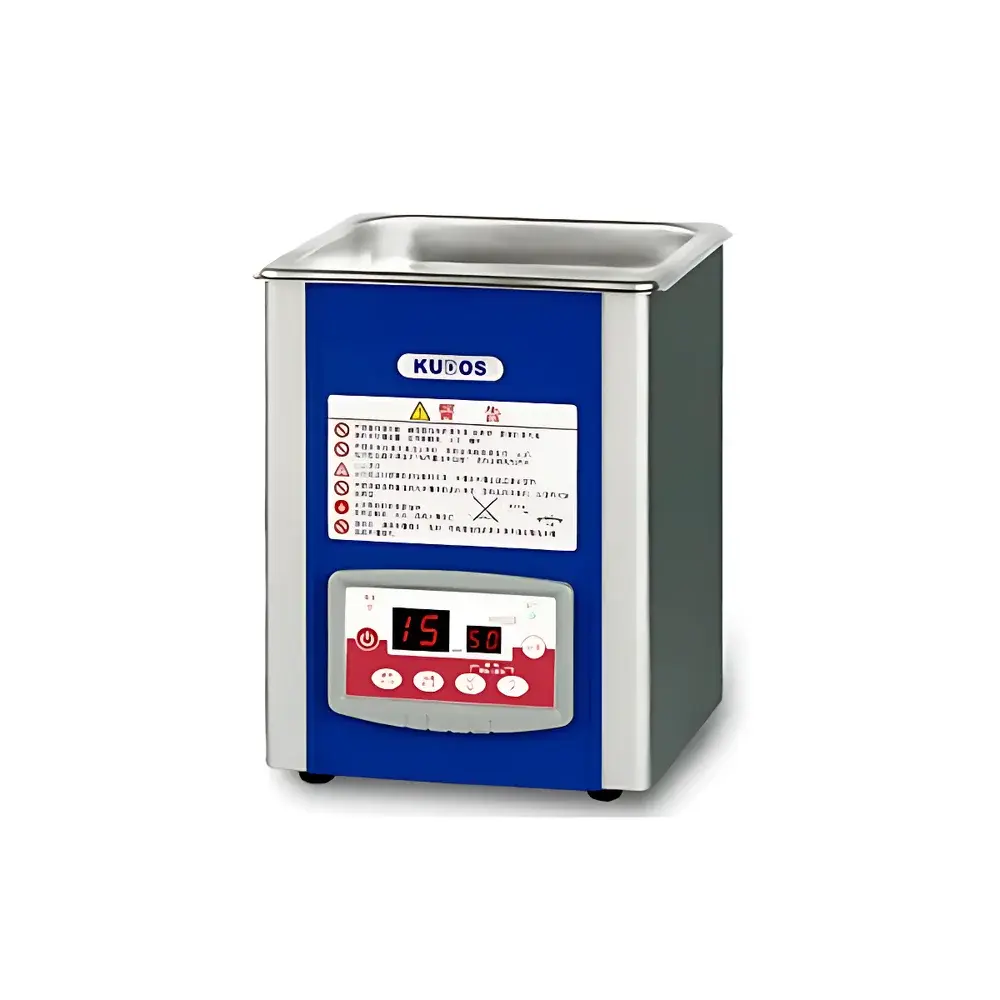
Shanghai Kedao SK1200GT Degassing & Heated Ultrasonic Cleaner
| Brand | Shanghai Kedao |
|---|---|
| Origin | Shanghai, China |
| Model | SK1200GT |
| Tank Capacity | 2 L |
| Ultrasonic Frequency | 35 kHz |
| Ultrasonic Power | 50 W |
| Heating Power | 48 W |
| Temperature Range | 20–69 °C |
| Digital Timer | 1–99 min |
| Tank Material | 304 Stainless Steel |
| Internal Dimensions (L×W×H) | 150 × 140 × 100 mm |
| External Dimensions (L×W×H) | 180 × 160 × 220 mm |
| Net Weight | 3 kg |
| Standard Accessories | Stainless Steel Rack, Sound-Dampening Lid |
Overview
The Shanghai Kedao SK1200GT is a compact, benchtop degassing and heated ultrasonic cleaner engineered for precision cleaning of delicate laboratory components—including glassware, pipette tips, microfluidic chips, optical lenses, and small metal parts—where residual air bubbles, particulate contamination, or solvent film interference must be eliminated prior to analysis or assembly. It operates on the principle of cavitation-induced acoustic energy transfer: at a fixed frequency of 35 kHz, high-frequency pressure oscillations generate transient microbubbles in the cleaning medium (e.g., deionized water, isopropyl alcohol, or aqueous detergent solutions), which collapse violently near surfaces, dislodging contaminants via microjetting and shockwave propagation. The integrated degassing function enhances this process by removing dissolved gases from the liquid prior to ultrasonication—reducing bubble shielding effects and improving energy coupling efficiency. Combined with precise digital temperature control (20–69 °C), the unit supports thermally assisted cleaning protocols critical for removing viscous residues or accelerating chemical dissolution without thermal degradation.
Key Features
- Stable 35 kHz ultrasonic transducer array delivering consistent cavitation intensity across the entire 2 L tank volume
- Degassing mode activated before ultrasonication cycle to minimize gas nucleation and maximize active cavitation density
- Programmable digital timer (1–99 minutes) with real-time countdown display and audible end-cycle alert
- Precise PID-controlled heating system (48 W) maintaining ±1.5 °C stability within the 20–69 °C operating range
- 304 stainless steel tank (150 × 140 × 100 mm internal dimensions) resistant to corrosion from common solvents and alkaline detergents
- Sound-dampening lid included as standard equipment to reduce ambient noise and prevent solvent evaporation during operation
- Compact footprint (180 × 160 × 220 mm) optimized for space-constrained lab benches or fume hood integration
Sample Compatibility & Compliance
The SK1200GT is suitable for cleaning substrates commonly used in analytical chemistry, semiconductor prototyping, biomedical device manufacturing, and materials science labs—including borosilicate glass, fused silica, silicon wafers, titanium alloys, and anodized aluminum. Its non-aggressive 35 kHz frequency minimizes surface pitting risk on soft metals and coated optics while retaining sufficient energy for particulate removal. The unit complies with IEC 61000-6-3 (EMC emission standards) and IEC 61000-6-2 (immunity requirements) for laboratory environments. While not certified to ISO 13485 or FDA 21 CFR Part 11, its operational parameters (digital logging of time/temperature settings, mechanical timer redundancy) support GLP-aligned documentation practices when paired with external audit trails.
Software & Data Management
The SK1200GT operates via a dedicated front-panel interface with push-button controls and an LED display; no external software or driver installation is required. All operational parameters—including elapsed time, set temperature, and active mode (clean/degas)—are retained in volatile memory during power cycling but are not stored long-term. For laboratories requiring traceability, manual logbook entry or integration with external environmental monitoring systems (e.g., via RS-232 or analog output modules, available as optional accessories) is recommended. The absence of network connectivity or cloud-based firmware ensures electromagnetic isolation in sensitive measurement environments such as electron microscopy suites or low-noise electrical testing labs.
Applications
- Pre-analytical sample preparation: degassing mobile phase solvents prior to HPLC or UHPLC injection
- Cleaning quartz cuvettes and optical filters to eliminate Rayleigh scattering artifacts in UV-Vis spectroscopy
- Removing photoresist residue from mask blanks and reticles in microfabrication cleanrooms
- Decontaminating reusable surgical instruments in research animal facilities (when validated with appropriate biocidal solutions)
- Preparing TEM grids and AFM cantilevers by eliminating hydrocarbon adsorption layers via heated ethanol sonication
- Supporting ASTM D2621 and ISO 10523-compliant cleaning validation for pH electrode calibration standards
FAQ
What cleaning solutions are compatible with the SK1200GT?
Aqueous alkaline detergents, isopropyl alcohol (IPA), ethanol, acetone, and deionized water are routinely used. Avoid halogenated solvents (e.g., chloroform, carbon tetrachloride) due to potential stress corrosion cracking of 304 stainless steel.
Can the unit operate continuously beyond 99 minutes?
No—the maximum timer setting is 99 minutes. For extended cycles, users must manually restart the unit after completion; automatic repeat functionality is not implemented.
Is the heater thermostatically regulated during ultrasonication?
Yes. Temperature control remains active and independent of ultrasonic output; the system maintains setpoint accuracy throughout both degas and clean phases.
Does the sound-dampening lid affect cavitation efficiency?
Minimal impact is observed: the lid reduces airborne noise by ~12 dB(A) without significantly attenuating acoustic energy transmission into the bath, as confirmed by calibrated hydrophone measurements at 35 kHz.
What maintenance is required for long-term reliability?
Monthly inspection of tank integrity, quarterly cleaning of transducer mounting surfaces with non-abrasive cloth, and annual verification of temperature sensor calibration using a NIST-traceable RTD probe are recommended best practices.



