
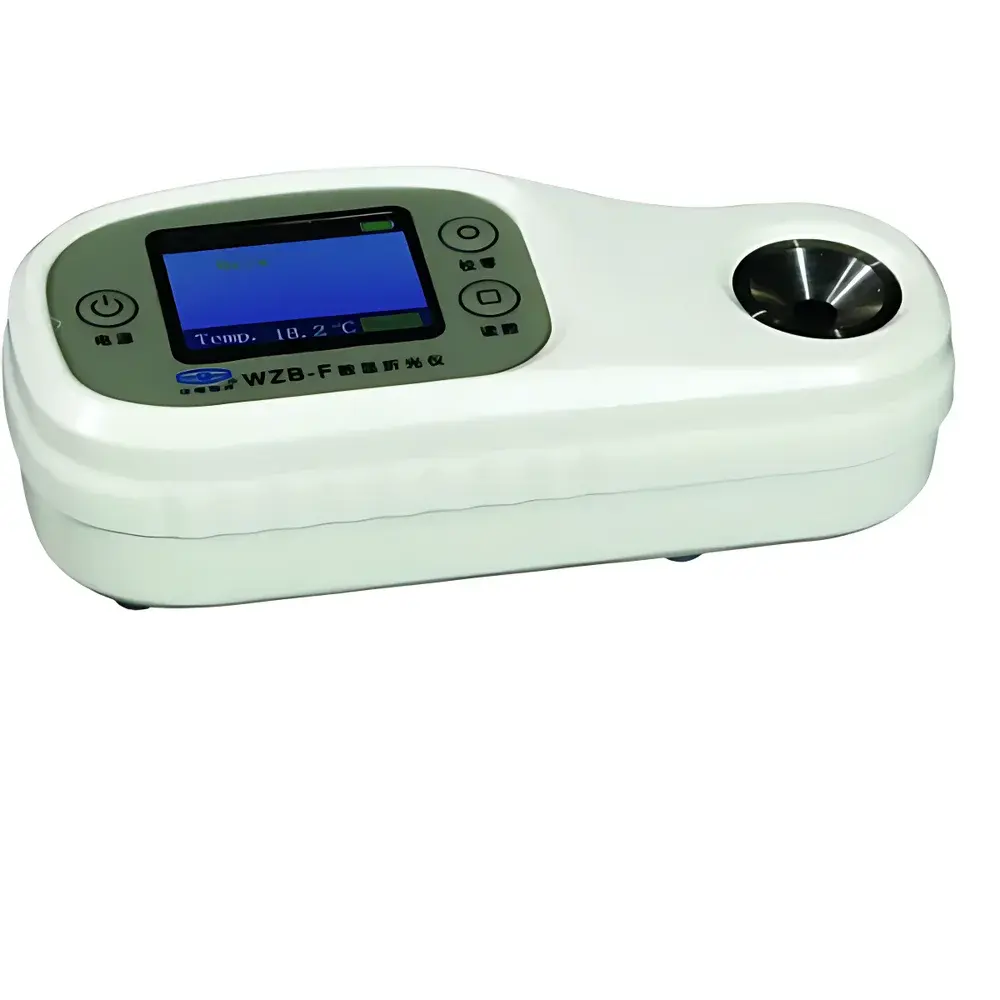
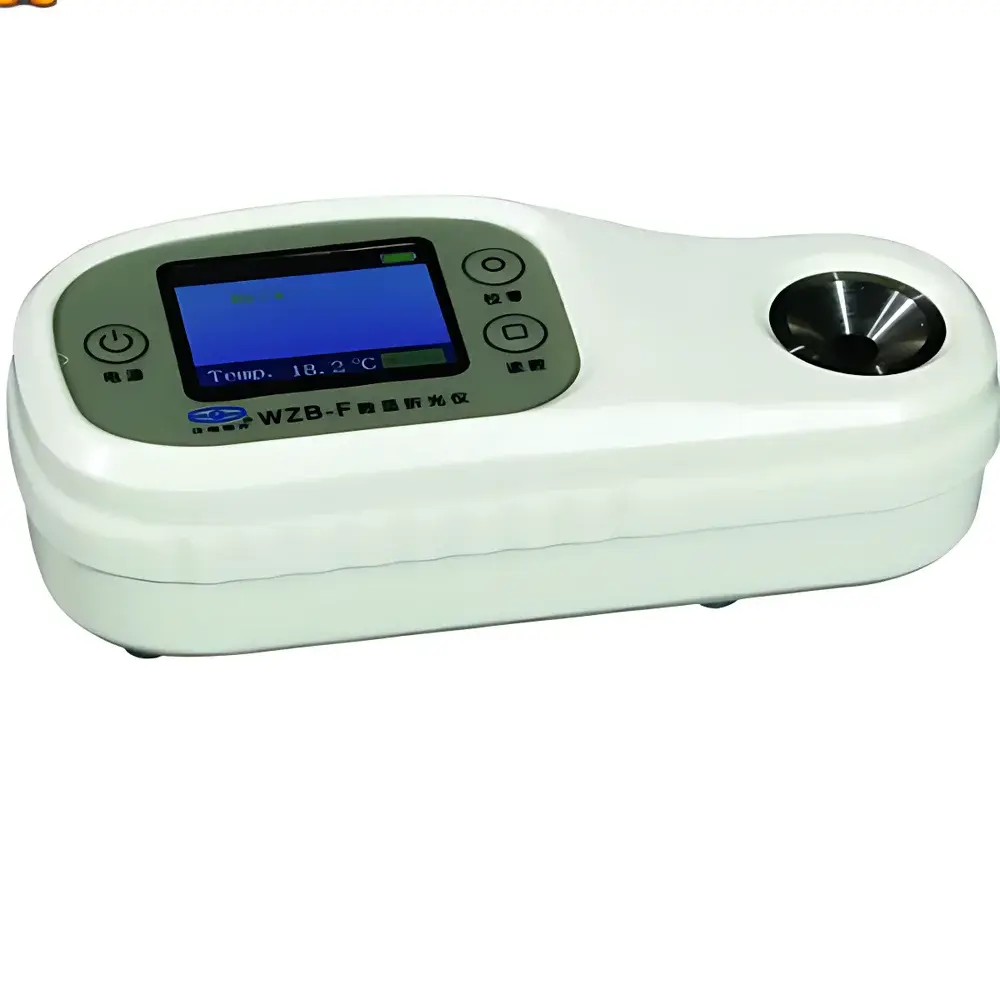
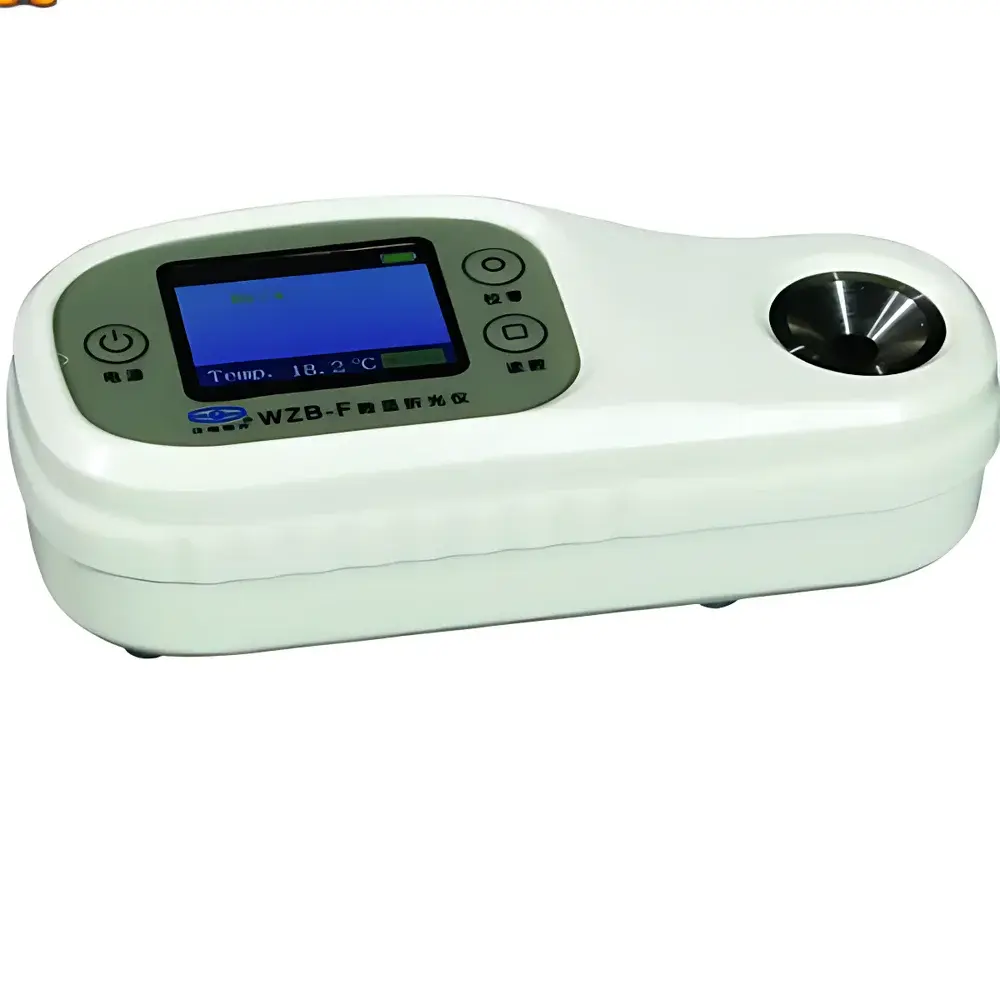
Shanghai Physical Optics WZB-F(A1) Portable Digital Refractometer
| Brand | YDWG (Yi Dian Wu Guang) |
|---|---|
| Origin | Shanghai, China |
| Manufacturer Type | Authorized Distributor |
| Product Category | Domestic |
| Model | WZB-F(A1) |
| Price | USD 250 (est.) |
| Type | Handheld Refractometer |
| Temperature Control | Yes (Built-in Peltier-assisted thermal stabilization) |
| Digital Display | Yes (Full-color LCD with menu-driven interface) |
| Operating Temperature Range | 0–40 °C (32–104 °F) |
| Temperature Measurement Accuracy | ±0.5 °C (±1 °F) |
Overview
The Shanghai Physical Optics WZB-F(A1) Portable Digital Refractometer is an entry-level handheld optical instrument engineered for rapid, field-deployable measurement of refractive index (nD) and derived concentration values—including Brix (% w/w), salinity (ppt), and specific gravity—across diverse industrial and agricultural applications. Based on the principle of total internal reflection at the prism–sample interface, the device employs a high-precision Abbe-type optical path with temperature-compensated LED illumination and a calibrated sapphire-coated measuring prism. Unlike analog refractometers, the WZB-F(A1) integrates real-time digital signal processing and automatic temperature correction (ATC) using an embedded thermistor array adjacent to the sample chamber, enabling direct nD readout at 20 °C regardless of ambient conditions within its operational range. Its compact, IP65-rated housing ensures resistance to dust and incidental water exposure—critical for use in food processing lines, aquaculture sites, orchards, and mobile QC labs.
Key Features
- Full-color graphical LCD display with intuitive icon-based menu navigation and multilingual UI support (English, Chinese, Spanish)
- Integrated Peltier-assisted thermal stabilization system for consistent measurement at reference temperature (20 °C)
- Automatic zero calibration function with visual confirmation and 60-second retention of calibration status
- Sapphire-coated borosilicate glass measuring prism for enhanced scratch resistance and long-term optical stability
- Battery-powered operation (4 × AAA, ~10,000 measurements per set) with low-voltage warning and auto-sleep mode after 3 minutes of inactivity
- Non-destructive, single-drop sampling (≥0.5 mL required); no solvent or consumables needed
Sample Compatibility & Compliance
The WZB-F(A1) is validated for aqueous solutions with viscosity ≤500 mPa·s and particulate content <5 µm. Compatible samples include fruit juices, soft drinks, brine solutions, honey, antifreeze coolants, and plant sap extracts. It complies with ISO 21748:2017 (Guidance for the evaluation of measurement uncertainty in refractometry) and supports traceable calibration per ASTM D1218–19 (Standard Test Method for Refractive Index of Hydrocarbon Liquids). While not certified for GMP/GLP environments, its audit-ready calibration log (timestamped, non-editable) and ATC functionality align with foundational requirements for routine QC in FDA-regulated food manufacturing (21 CFR Part 11 readiness via optional PC software export).
Software & Data Management
The instrument operates autonomously but supports data export via optional USB-C adapter and proprietary Windows-compatible software (WZB-Link v2.1). Exported CSV files contain timestamp, measured nD, temperature-corrected Brix/salinity values, and calibration event logs. The software enables batch reporting, statistical process control (SPC) charting (X̄ & R charts), and compliance with basic ALCOA+ principles (Attributable, Legible, Contemporaneous, Original, Accurate) when used with enabled audit trail settings. No cloud connectivity or remote firmware updates are supported—consistent with ISO/IEC 17025:2017 recommendations for instrument integrity in accredited testing labs.
Applications
- Food & Beverage: Rapid Brix verification in juice concentrate, syrup, and dairy processing; quality sorting of harvested fruits based on sugar maturity indices
- Aquaculture & Marine Science: Real-time salinity monitoring in hatcheries and recirculating aquaculture systems (RAS)
- Agriculture: Field assessment of crop sap osmolality as proxy for nutrient status and drought stress
- Automotive & Industrial Fluids: Glycol concentration checks in engine coolants and hydraulic fluids
- Education & Training: Undergraduate optics laboratories demonstrating Snell’s law, dispersion, and temperature dependence of refractive index
FAQ
Does the WZB-F(A1) require daily recalibration?
No—zero calibration is required only after battery replacement, significant ambient temperature shifts (>10 °C), or if displayed nD deviates from 1.3330 at 20 °C using distilled water.
Can it measure viscous or turbid samples?
It is not recommended for samples with suspended solids >5 µm or viscosity exceeding 500 mPa·s, as these impair optical interface homogeneity and induce measurement hysteresis.
Is the prism surface cleanable with organic solvents?
Only deionized water or 70% isopropyl alcohol may be used; acetone, chlorinated solvents, or abrasive cleaners will degrade the sapphire coating and invalidate calibration.
What is the measurement repeatability under controlled conditions?
At 20 °C with distilled water, standard deviation across 10 consecutive readings is ≤±0.0002 in nD, corresponding to ≤±0.02% Brix.
How does the built-in temperature sensor ensure accuracy?
A dual-point thermistor array measures both prism surface temperature and ambient air temperature, applying a polynomial correction algorithm per ISO 1042:2020 Annex C to compensate for thermal lag and gradient effects.





