
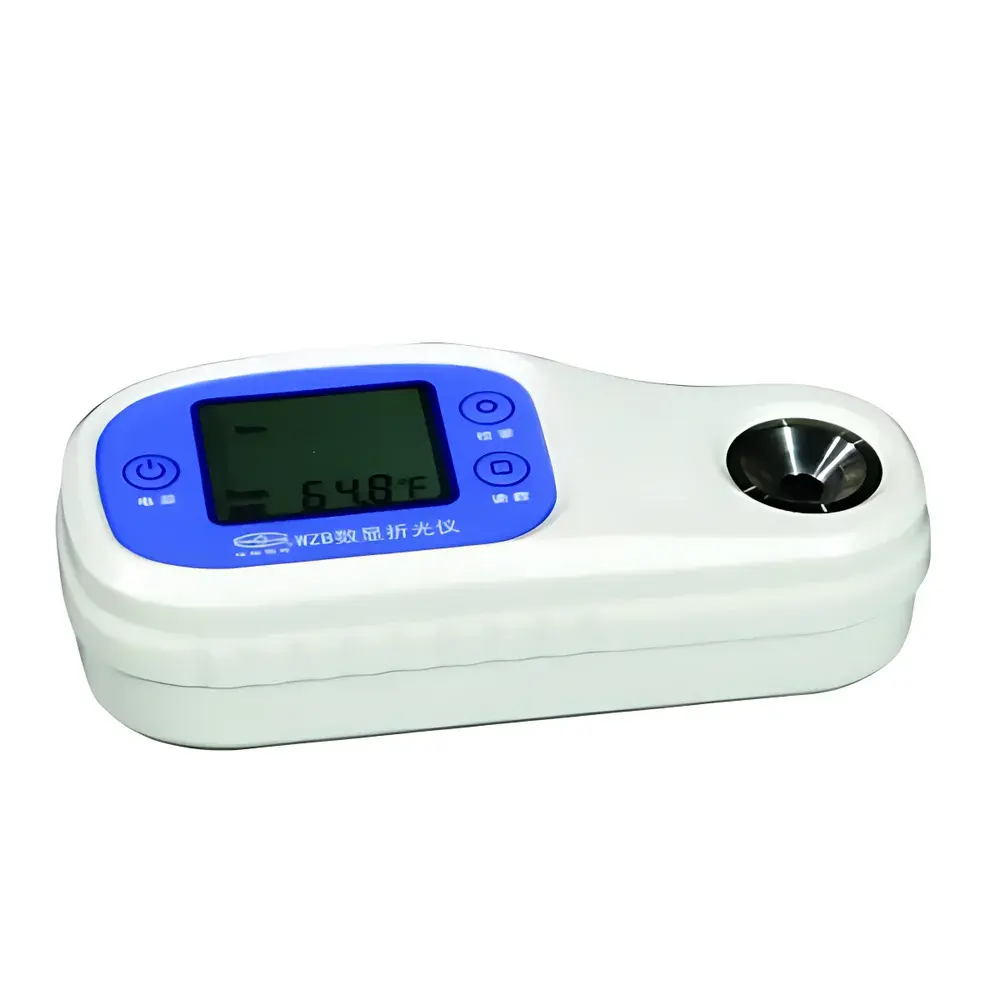
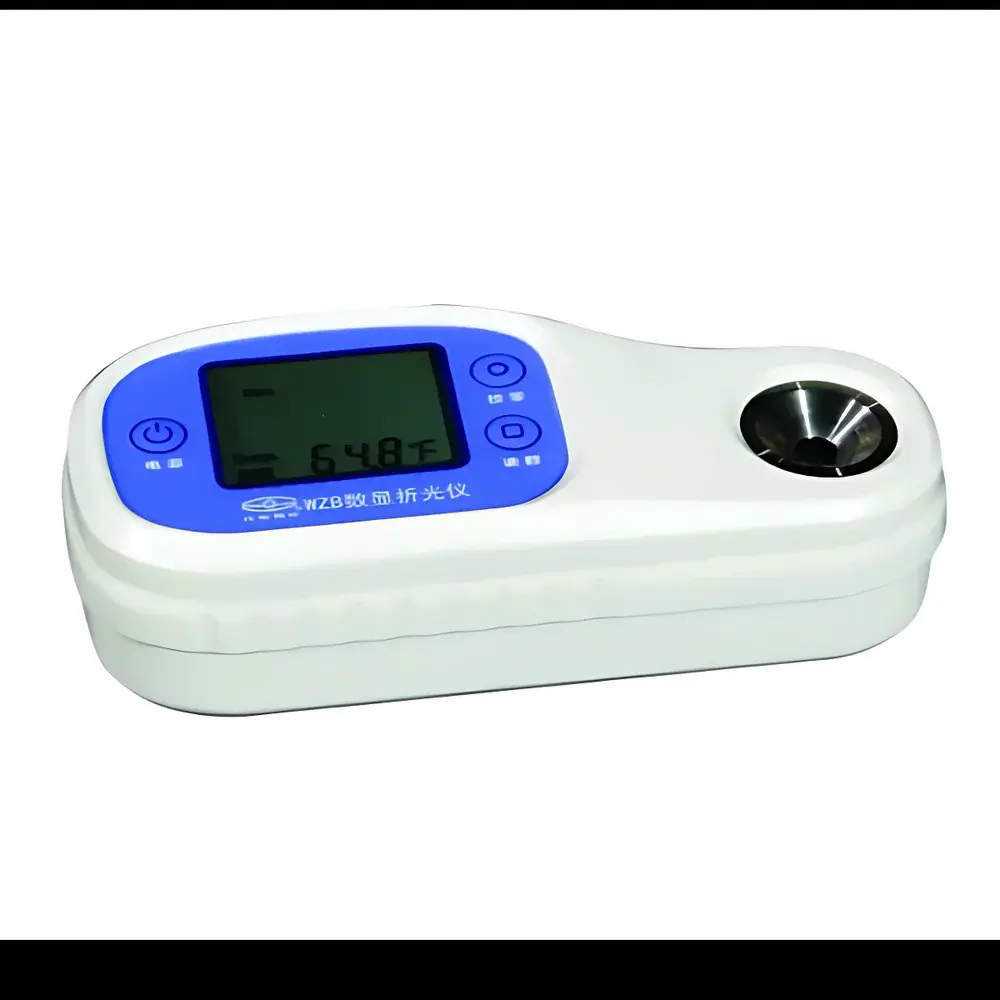
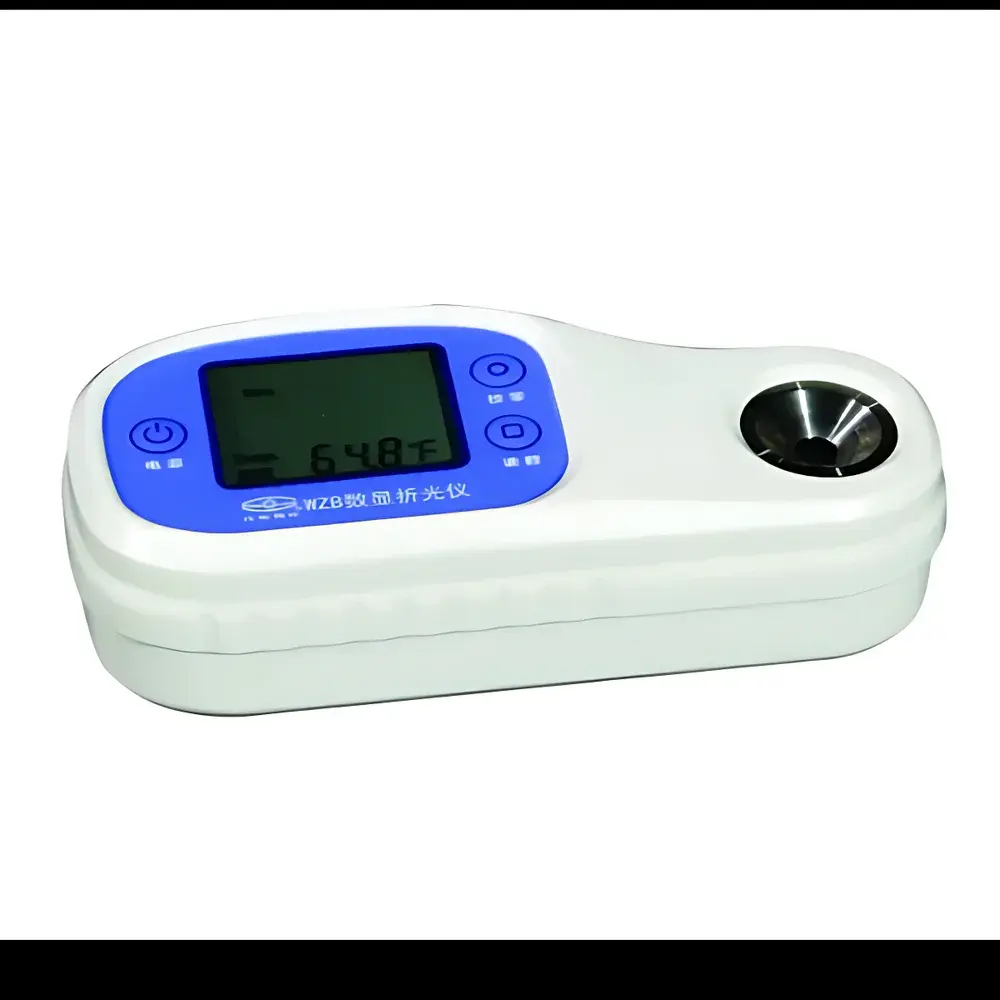
Shanghai Physical Optics WZB35 Portable Digital Refractometer
| Brand | YDWG (Shanghai Physical Optics) |
|---|---|
| Origin | Shanghai, China |
| Product Type | Handheld Refractometer |
| Temperature Compensation | Yes |
| Digital Display | Yes |
| Measurement Range | 0–35% Brix / RI 1.3330–1.3900 |
| Accuracy | ±0.2% Brix / ±0.0003 RI |
| Power Supply | 2 × AAA batteries |
| Dimensions | 140 mm × 65 mm × 40 mm |
| Net Weight | 172 g |
| Auto-Off Function | Yes |
| Battery Low Indicator | Yes |
| Temperature Unit Toggle | °C / °F |
| Rated Cycles | >10,000 measurements |
Overview
The Shanghai Physical Optics WZB35 Portable Digital Refractometer is a precision optical instrument engineered for rapid, field-deployable refractive index and concentration measurements based on the fundamental principle of total internal reflection at the prism-sample interface. It employs a high-stability Abbe-type optical path with a sapphire-coated measuring prism and integrated LED illumination to ensure consistent light coupling and minimal thermal drift. Designed for routine quality control in decentralized environments—such as production lines, cold storage facilities, orchards, breweries, and food processing trucks—the WZB35 delivers laboratory-grade repeatability without requiring external power sources or calibration infrastructure. Its compact form factor (140 × 65 × 40 mm, 172 g) enables single-handed operation and pocket-level portability, while the real-time digital readout eliminates parallax error and subjective interpretation inherent in analog scale refractometers.
Key Features
- High-resolution LCD display with backlight for low-light conditions and dual-unit temperature readout (°C/°F)
- Integrated automatic temperature compensation (ATC) across 10–40 °C using a high-precision NTC thermistor embedded directly in the prism block
- Measurement completion in ≤3 seconds after sample application—optimized optical path geometry minimizes settling time
- Dual-mode output: simultaneous display of refractive index (RI) and user-selectable concentration units including Brix (%), NaCl (%), specific gravity, battery electrolyte density (g/cm³), glycol concentration (ethylene/propylene), serum protein (g/dL), and urine specific gravity
- Robust mechanical architecture: anodized aluminum housing with IP65-rated sealing against dust and incidental water splashes
- Energy-efficient operation: auto-power-off after 3 minutes of inactivity; low-battery indicator alerts prior to measurement degradation
- Calibration traceability: factory-calibrated with NIST-traceable sucrose standards; optional user calibration via distilled water or certified Brix reference solutions
Sample Compatibility & Compliance
The WZB35 accepts aqueous and semi-viscous liquid samples with surface tension compatible with standard prism wetting (e.g., fruit juices, soft drinks, dairy whey, brines, antifreeze solutions, fermentation broths, and clinical urine specimens). Sample volume requirement is ≤0.1 mL. The sapphire-coated prism resists scratching and chemical etching from mildly acidic or alkaline matrices (pH 4–9), supporting long-term stability under repeated cleaning with ethanol or mild detergent. While not certified for GMP or ISO 17025 accreditation out-of-the-box, the instrument’s measurement repeatability (≤±0.0002 RI over 24 h at constant ambient temperature) and documented calibration protocol enable compliance with internal QC procedures aligned with ASTM D1218, ISO 21745, and USP for non-sterile liquid preparations. Full audit trail functionality requires integration with external data logging software.
Software & Data Management
The WZB35 operates as a standalone instrument with no onboard memory or USB/Bluetooth connectivity. All measurements are displayed in real time and intended for immediate transcription or visual verification. For regulated environments requiring electronic records, users may pair the device with third-party documentation systems (e.g., LabWare LIMS, Veeva Vault QMS) via manual entry or barcode-assisted logging. The unit supports GLP-aligned workflows through its ATC validation log (recorded per ASTM E2912), battery status tracking, and defined calibration interval guidance (recommended every 500 uses or quarterly, whichever occurs first). Firmware updates are not supported; hardware consistency ensures long-term method equivalence across instrument fleets.
Applications
- Fruit juice and nectar production: Brix verification pre- and post-pasteurization to ensure batch consistency and label claim compliance
- Brewing and distillation: Monitoring wort gravity, mash efficiency, and alcohol potential via calibrated Brix-to-ABV conversion tables
- Food service and catering: Rapid salt concentration checks in brines, soy sauce, and pickling solutions
- Veterinary and clinical point-of-care: Urine specific gravity screening and serum total protein estimation in mobile clinics
- Automotive maintenance: Glycol-based coolant concentration assessment for freeze/boil protection verification
- Education and vocational training: Hands-on instruction in optical metrology principles, solution thermodynamics, and QC sampling protocols
FAQ
What is the recommended calibration frequency for the WZB35?
Calibration should be performed before each shift when used in production environments, or at minimum every 500 measurements—or daily if operating outside controlled lab conditions.
Can the WZB35 measure non-aqueous solvents such as ethanol or acetone?
No. The ATC algorithm and factory calibration are optimized for aqueous solutions only. Non-aqueous media induce significant RI deviation due to differential thermal expansion and dispersion characteristics.
Is the prism surface resistant to citric acid or vinegar-based samples?
Yes—the sapphire coating provides excellent resistance to organic acids at concentrations typical in food matrices (10%) is not advised.
Does the WZB35 comply with FDA 21 CFR Part 11 requirements?
No. As a stand-alone, non-networked instrument without electronic record generation or user authentication, it does not meet Part 11 criteria—but it supports compliant data handling when integrated into validated procedural workflows.
How is temperature compensation verified during qualification?
ATC performance is validated using certified reference liquids (e.g., 10%, 20%, and 30% sucrose standards) measured across 15–35 °C; deviation from certified values must remain within ±0.1% Brix per 1 °C change.






