
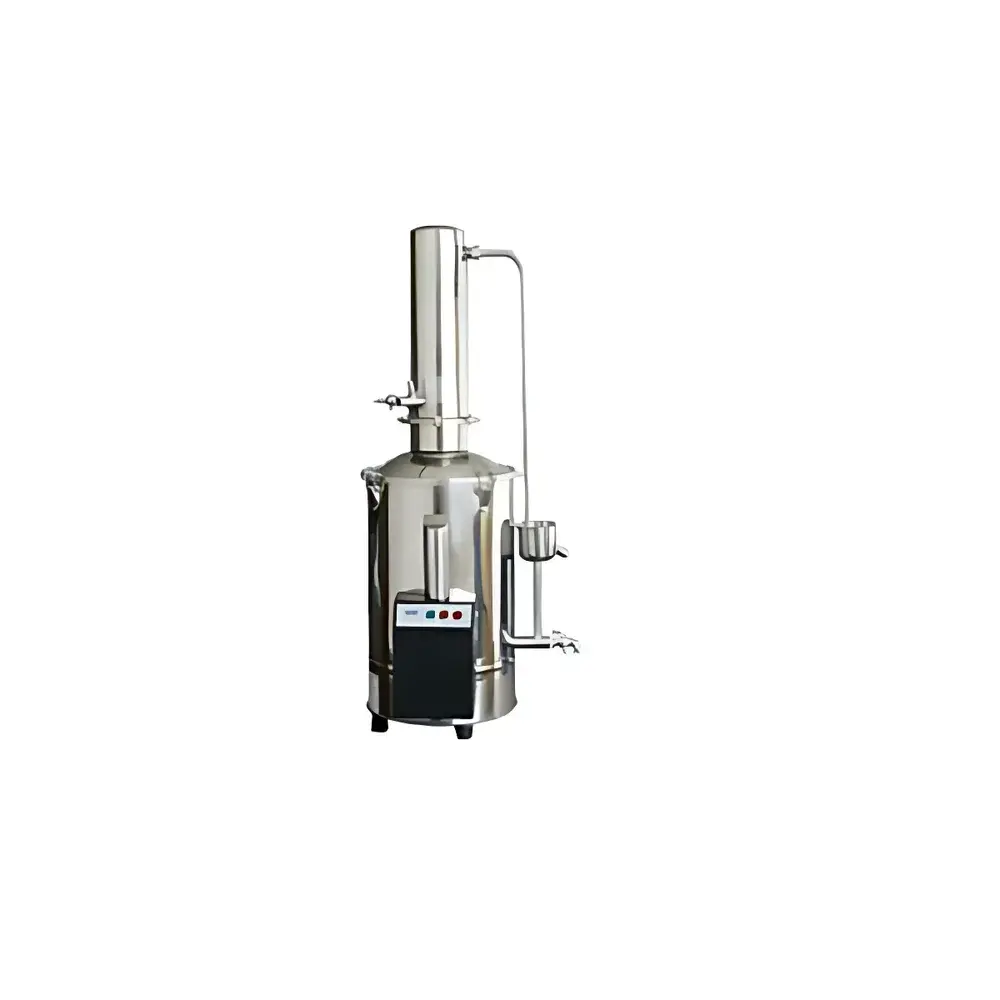
Shanghai Shen DZ10Z Stainless Steel Electrically Heated Autoclavable Distillation Apparatus
| Brand | Shanghai Shen |
|---|---|
| Origin | Shanghai, China |
| Model | DZ10Z |
| Instrument Type | Sub-boiling Distiller |
| Heating Method | Copper Immersion Heating Element |
| Cooling Method | Helical Coil Condenser |
| Distillation Rate | ≥10 L/h |
| Power Supply | 3-phase 380 V / 50 Hz |
| Rated Power | 7.5 kW |
| Construction Material | AISI 304 Stainless Steel |
| Safety Features | Automatic Low-Water Cut-off, Recirculating Cooling Water System, Drain Valve for Concentrate Removal |
Overview
The Shanghai Shen DZ10Z Stainless Steel Electrically Heated Autoclavable Distillation Apparatus is a laboratory-grade sub-boiling distiller engineered for continuous, reliable production of high-purity distilled water in research, quality control, and regulated manufacturing environments. Operating on the principle of controlled thermal vaporization followed by efficient condensation, the DZ10Z utilizes a copper immersion heating element to generate steam at near-atmospheric pressure while minimizing splashing and carryover of non-volatile contaminants. Its sub-boiling design ensures that feed water remains below full nucleate boiling—reducing aerosol formation and enhancing purity consistency. The apparatus is constructed entirely from AISI 304 stainless steel, providing inherent resistance to corrosion from chlorides, organic acids, and trace metal ions commonly present in municipal or pretreated feed water. This material selection aligns with long-term compliance requirements for cleanroom-adjacent installations and GLP-compliant water preparation workflows.
Key Features
- Robust All-Stainless Construction: Full AISI 304 stainless steel housing, evaporator chamber, and condenser assembly ensure chemical inertness, mechanical durability, and compatibility with routine cleaning protocols including citric acid descaling.
- Copper Immersion Heating System: High-efficiency copper-sheathed heating elements provide rapid thermal response, uniform heat distribution across the evaporation surface, and extended service life under continuous operation.
- Helical Coil Condenser: Optimized copper-alloy helical condensing coil maximizes surface area-to-volume ratio, enabling rapid phase transition of steam to liquid with minimal temperature gradient loss—supporting stable output at ≥10 L/h under nominal load.
- Recirculating Cooling Water Design: Condenser cooling water is gravity-fed back into the evaporator reservoir, significantly reducing net freshwater consumption and eliminating external chiller dependency.
- Automated Low-Water Protection: Integrated float-level sensor interrupts power to the heating circuit when water level falls below operational threshold, preventing dry-firing and thermal degradation of the heating element.
- Concentrate Drain Valve: Strategically located drain port allows periodic removal of concentrated mineral residue from the evaporator sump—mitigating scale accumulation and extending maintenance intervals between descaling cycles.
Sample Compatibility & Compliance
The DZ10Z is designed for use with deionized, softened, or municipally treated feed water (conductivity ≤ 500 µS/cm recommended). It is not intended for direct use with seawater, brackish water, or heavily contaminated industrial effluents. While the unit itself does not carry CE, UL, or FDA certification, its construction materials and functional safety mechanisms—including automatic thermal cutoff and sealed electrical compartments—align with general-purpose laboratory equipment requirements under ISO/IEC 17025 Annex A.3 (equipment verification) and support adherence to USP “Water for Pharmaceutical Purposes” when integrated into validated water purification trains. Routine performance qualification may include conductivity monitoring (<1.3 µS/cm at 25°C), total organic carbon (TOC) testing (<500 ppb), and bacterial endotoxin assessment per pharmacopeial guidelines.
Software & Data Management
The DZ10Z operates as a standalone analog-controlled system without embedded microprocessor logic or digital interface. All operational parameters—including power input, heating status, and water level—are monitored via front-panel indicators (LEDs, mechanical float gauge). No data logging, remote control, or audit trail functionality is provided. For laboratories requiring 21 CFR Part 11–compliant documentation, integration with external PLC-based supervisory systems or standalone data loggers (e.g., calibrated temperature and flow transducers) is recommended during IQ/OQ validation. Maintenance records—including descaling frequency, drain valve actuation logs, and heating element resistance checks—should be retained per internal SOPs aligned with ISO 9001 clause 7.5.3.
Applications
- Preparation of analytical reagent-grade water for HPLC mobile phase preparation, spectrophotometric blanking, and titrant standardization.
- Feed water supply for ultrapure water systems (Type I) where primary purification relies on reverse osmosis and ion exchange, and secondary polishing requires thermally generated distillate.
- Steam generation for autoclave pre-vacuum cycles in microbiology labs where distilled steam minimizes chamber scaling.
- Manufacturing support in pharmaceutical excipient blending, medical device rinsing, and diagnostic reagent formulation where USP Purified Water specifications apply.
- Educational laboratories requiring robust, low-maintenance distillation platforms for undergraduate chemistry and engineering curricula.
FAQ
What feed water quality is recommended for optimal performance?
Deionized or softened water with conductivity ≤ 500 µS/cm and hardness < 10 ppm CaCO₃ equivalent is strongly advised to minimize scale formation and extend maintenance cycles.
Can the DZ10Z be operated continuously for 24/7 applications?
Yes—its industrial-grade copper heating elements and stainless steel structural integrity support uninterrupted operation; however, scheduled concentrate drainage and periodic descaling remain essential for long-term reliability.
Is external cooling water required?
No—the unit employs a closed-loop recirculation system where condenser coolant returns to the evaporator reservoir; only initial fill volume is needed.
Does the DZ10Z meet ISO 3696 or ASTM D1193 specifications for Type II water?
When operated with appropriate feed water and maintained per manufacturer guidelines, typical output meets or exceeds conductivity and silica limits for ISO 3696 Grade 2 and ASTM D1193 Type II, though final verification must be performed in situ.
How often should the drain valve be used?
For continuous operation at rated capacity, manual draining of the evaporator sump is recommended every 8–12 hours—or whenever visible mineral sediment accumulates—to prevent localized overheating and premature scaling.



