
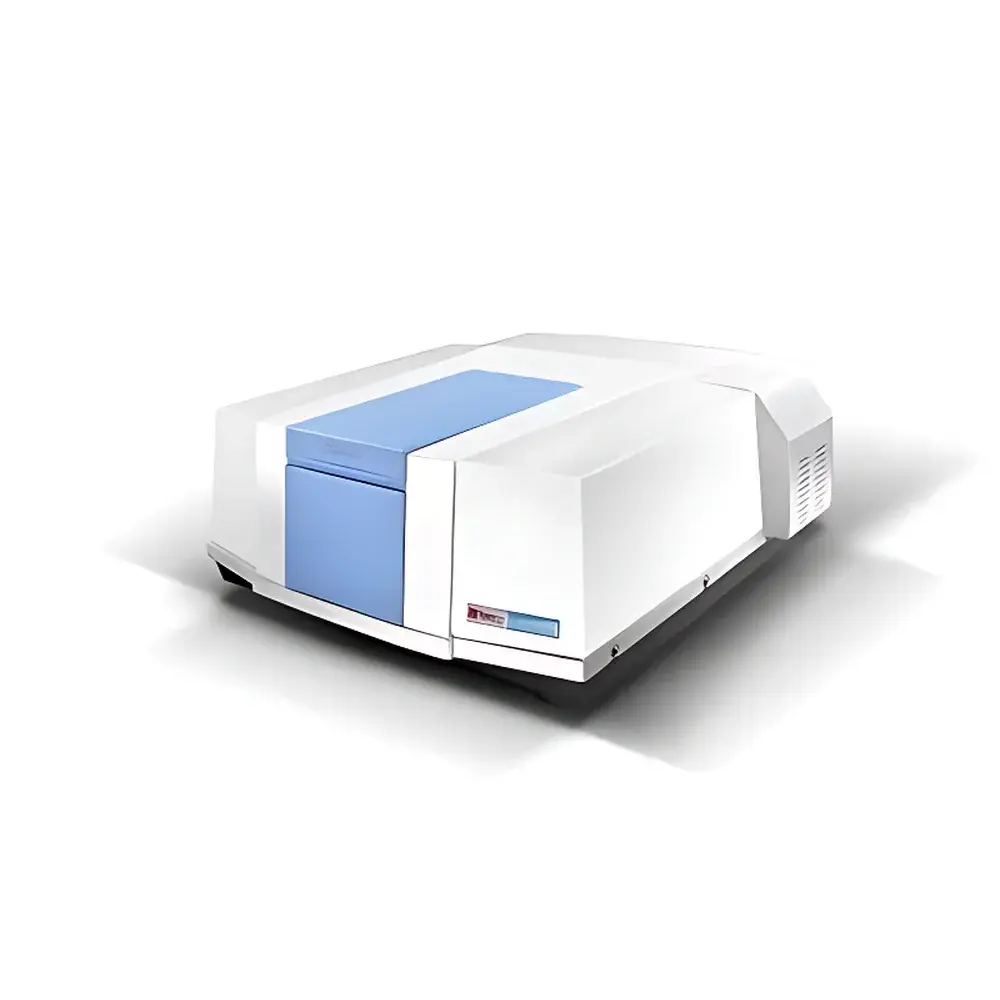
Shanghai Spectrum SP-2500 Dual-Beam Ultraviolet-Visible Spectrophotometer
| Brand | Shanghai Spectrum |
|---|---|
| Origin | Shanghai, China |
| Model | SP-2500 |
| Optical Design | Dual-beam with dual detectors |
| Detector Type | Photomultiplier Tube (PMT) |
| Wavelength Range | 190–900 nm |
| Spectral Bandwidth | 0.1, 0.2, 0.5, 1, 2, and 4 nm (selectable) |
| Wavelength Accuracy | ±0.3 nm |
| Stray Light | ≤0.01% T |
| Automation | Automatic wavelength scanning and energy calibration |
| Light Source | Imported deuterium and tungsten-halogen lamps |
| Software | Integrated PC-based acquisition and analysis platform with GLP-compliant data handling |
Overview
The Shanghai Spectrum SP-2500 is a precision-engineered dual-beam ultraviolet-visible (UV-Vis) spectrophotometer designed for routine and research-grade quantitative and qualitative spectral analysis in regulated and academic laboratories. It operates on the fundamental principle of Beer–Lambert law-based absorbance measurement, utilizing a balanced dual-beam optical architecture with independent reference and sample paths to compensate for source drift, lamp aging, and environmental fluctuations in real time. The instrument integrates two high-sensitivity photomultiplier tube (PMT) detectors—one for the sample beam and one for the reference beam—enabling rapid, high-fidelity signal comparison without mechanical chopper-induced noise or timing artifacts. Its vertical optical layout minimizes optical path length, reducing photon loss and enhancing photometric throughput across the full 190–900 nm range. This design contributes directly to improved signal-to-noise ratio (SNR), particularly in the critical far-UV region (190–220 nm), where many biomolecules and organic compounds exhibit characteristic absorption.
Key Features
- Dual-beam, dual-detector optical system for real-time baseline correction and enhanced photometric stability
- High-efficiency imported deuterium and tungsten-halogen light sources with extended operational lifetime and low thermal drift
- Seven-step adjustable spectral bandwidth (0.1–4 nm) to optimize resolution versus sensitivity for diverse sample types
- Wavelength accuracy of ±0.3 nm certified via traceable holmium oxide and didymium glass filters
- Stray light performance ≤0.01% T at 220 nm and 340 nm, meeting ISO 9001 and ASTM E275 validation requirements
- Automated self-diagnostic routines including wavelength calibration, photometric zero adjustment, and energy output verification at startup
- Robust mechanical construction with temperature-stabilized optics housing to minimize thermal-induced wavelength shift
Sample Compatibility & Compliance
The SP-2500 supports standard 10 mm rectangular quartz, glass, or plastic cuvettes and accommodates optional accessories including micro-volume adapters, temperature-controlled cells, and fiber-optic probes. It complies with core international standards for UV-Vis instrumentation, including ISO 6223 (spectrophotometer performance testing), ASTM E169 (general practices for UV-Vis spectroscopy), and USP (spectrophotometric analysis in pharmaceutical applications). Data integrity features—including user access levels, electronic signatures, audit trail logging, and exportable metadata—support alignment with FDA 21 CFR Part 11 and EU Annex 11 expectations when deployed in GxP environments. All calibration records, method files, and raw spectral data are timestamped and stored in non-editable binary format prior to export.
Software & Data Management
The proprietary SP-2500 Control and Analysis Suite provides a unified Windows-based interface for instrument control, spectral acquisition, and post-processing. It includes preconfigured analytical templates for photometric mode, quantitative analysis (single/multi-point calibration), kinetic assays, spectral scanning, multi-wavelength quantitation, and first-derivative spectral evaluation. All acquired spectra are stored with embedded instrument parameters (wavelength, bandwidth, slit width, scan speed, detector gain), enabling full method reproducibility. Data export options include CSV (for Excel-compatible tabular analysis), BMP (for publication-ready figures), and XML (for LIMS integration). The software maintains an immutable audit trail recording operator ID, session start/end times, parameter modifications, and calibration events—essential for GLP/GMP documentation and internal quality audits.
Applications
The SP-2500 delivers reliable performance across multiple analytical domains: quantification of nucleic acids and proteins (A260/A280 ratios), enzymatic kinetics monitoring (e.g., NADH/NADPH oxidation), colorimetric assay validation (e.g., Bradford, Lowry, BCA), dissolution testing in pharmaceutical development, water quality assessment (nitrate, phosphate, COD), and pigment characterization in food and cosmetic R&D. Its broad spectral coverage and selectable bandwidths make it suitable for both narrow-band transition metal complex analysis and broad-band polymer film transmission profiling. Routine QC labs benefit from its automated calibration protocols and batch-reporting functions; academic users leverage its derivative analysis capability for peak deconvolution in overlapping absorption bands.
FAQ
Does the SP-2500 support compliance with 21 CFR Part 11?
Yes—the software includes role-based user authentication, electronic signature capture, and a tamper-evident audit trail for all critical actions.
What cuvette materials are compatible with the full 190–900 nm range?
Quartz cuvettes are required for measurements below 340 nm; fused silica or UV-grade quartz is recommended for optimal transmission down to 190 nm.
Can spectral data be exported directly into LIMS or ELN systems?
Yes—CSV and XML exports preserve metadata and structured results, enabling seamless ingestion into most modern laboratory informatics platforms.
Is wavelength calibration traceable to NIST standards?
Calibration verification uses certified reference materials (holmium oxide, didymium glass) traceable to NIST SRM 2034 and SRM 2035.
What maintenance is required for the PMT detectors?
No routine user maintenance is required; PMTs are sealed, thermally stabilized components with no consumable parts or alignment procedures.




