
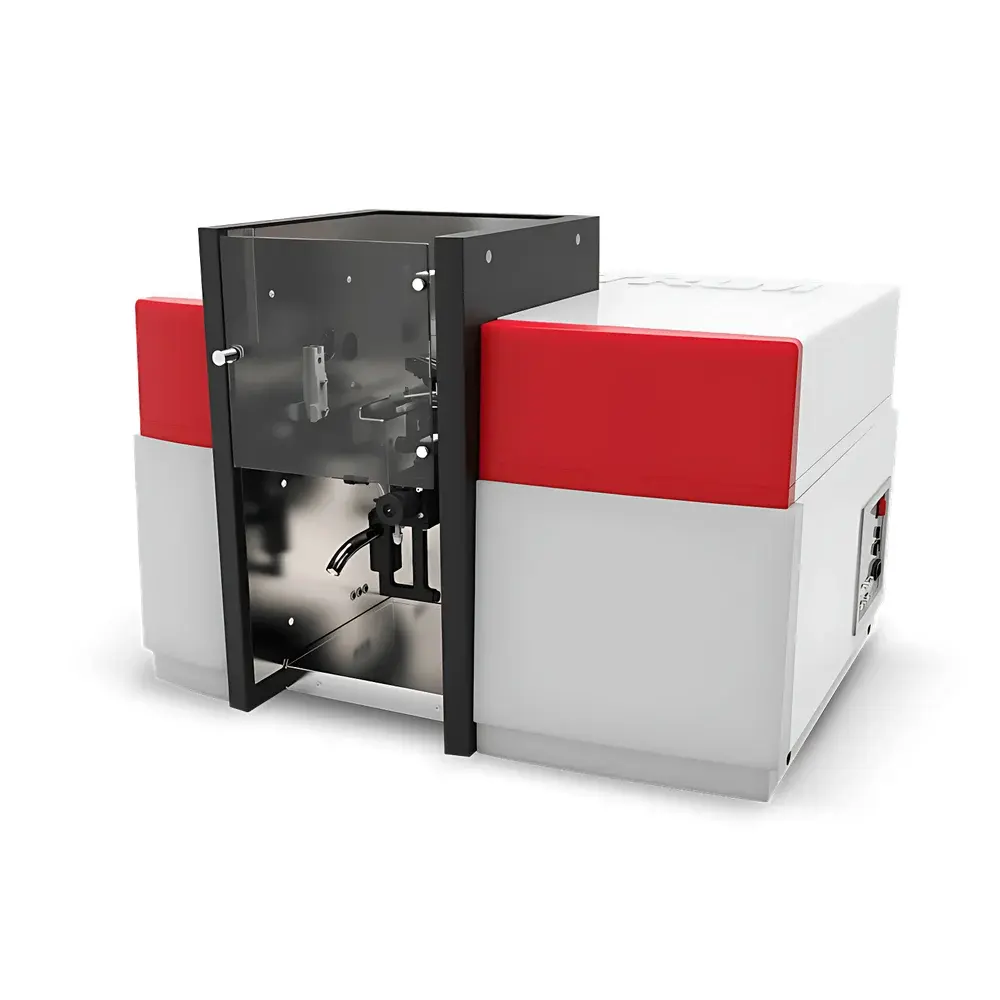
Shanghai Spectrum SP-3520AA Flame and Graphite Furnace Atomic Absorption Spectrometer
| Brand | Shanghai Spectrum |
|---|---|
| Origin | Shanghai, China |
| Model | SP-3520AA |
| Instrument Type | Flame and Graphite Furnace AAS |
| Monochromator | Concave Grating |
| Optical System | Single-Beam |
| Detector | Photomultiplier Tube (PMT) |
| Background Correction | D₂ Lamp + Self-Reversal Method |
| Compliance | Meets GB/T 21187–2007 (Chinese National Standard for AAS), ASTM E1941, ISO 8288 |
Overview
The Shanghai Spectrum SP-3520AA is a dual-mode atomic absorption spectrometer engineered for precise elemental quantification in routine and research-grade laboratories. It operates on the fundamental principle of atomic absorption spectroscopy—measuring the attenuation of characteristic hollow cathode lamp radiation as ground-state atoms in a flame or graphite furnace vaporization zone absorb specific wavelengths. The instrument integrates flame atomization for higher-concentration analysis (e.g., Ca, Mg, Na in water or biological matrices) and electrothermal graphite furnace atomization for sub-ppt detection capability across over 60 elements—including Cd, Pb, As, and Se—without matrix interference compromise. Its single-beam optical architecture employs a high-efficiency concave grating monochromator to deliver stable spectral resolution and wavelength reproducibility, while the photomultiplier tube detector ensures high signal-to-noise ratio across the 190–900 nm spectral range.
Key Features
- Dual-atomization platform: Fully switchable between air-acetylene flame and temperature-programmable graphite furnace modes—enabling method-specific optimization without hardware reconfiguration.
- Hybrid background correction system: Simultaneous D₂ lamp continuum source and self-reversal (SR) technique for accurate correction of structured and non-structured molecular absorption, especially critical for complex matrices such as soil digests, clinical sera, and industrial effluents.
- Win-AAS workstation software: A Windows-based control and data acquisition platform compliant with GLP documentation requirements; supports audit trail logging, user access levels, and electronic signature functionality per FDA 21 CFR Part 11 guidelines.
- Full-information acquisition mode: Captures raw time-resolved absorbance signals during furnace atomization—automatically computing peak height, peak area, time-averaged absorbance, and statistical descriptors (e.g., RSD, confidence intervals) from a single run.
- Expert method database: Embedded library of validated analytical protocols aligned with ISO 11047 (soil analysis), EPA Method 7000B (wastewater metals), and GB 5009.12–2023 (food safety)—reducing method development time and operator dependency.
Sample Compatibility & Compliance
The SP-3520AA accommodates liquid samples ranging from aqueous standards and acid-digested environmental specimens to organic extracts and diluted biological fluids. With optional autosampler integration (model AS-3500), it supports unattended sequential analysis of up to 120 samples per batch. All measurement protocols adhere to internationally recognized validation frameworks: calibration linearity verified per ICH Q2(R2), limit of detection (LOD) calculated using 3σ/slope methodology, and precision assessed via repeated standard solution injections (n ≥ 10). The system meets Chinese national standard GB/T 21187–2007 for AAS performance verification and demonstrates conformance with ASTM E1941 (standard test method for determination of metals by AAS) and ISO 8288 (determination of nickel, cobalt, cadmium, zinc, and lead in water).
Software & Data Management
Win-AAS provides traceable, secure, and scalable data handling. Each analytical session generates a timestamped, digitally signed result file containing raw spectra, furnace temperature ramp profiles, integration parameters, and QC metrics (e.g., bracketing standard recovery, drift correction values). Data export supports CSV, XML, and PDF formats compatible with LIMS environments. Audit trail records include user ID, parameter changes, calibration events, and report generation actions—fully retrievable for regulatory inspections. Software updates are delivered via encrypted firmware packages with version-controlled release notes and backward-compatible data migration tools.
Applications
The SP-3520AA serves core analytical functions across multiple regulated sectors: environmental monitoring (heavy metal profiling in drinking water per WHO guidelines), food safety testing (Pb and Cd screening in cereals per EU Commission Regulation (EC) No 1881/2006), clinical toxicology (blood lead level quantification per CLIA requirements), and geochemical research (trace element mapping in sediment cores). Its dual-atomization design also supports method transfer validation studies where flame-based screening precedes furnace-based confirmation—ensuring full compliance with ISO/IEC 17025:2017 clause 7.2.2 on method selection and verification.
FAQ
Does the SP-3520AA support hydride generation or cold vapor techniques?
No—the instrument is configured exclusively for flame and graphite furnace atomization. Hydride generation or cold vapor modules are not integrated and require external accessories not supplied by Shanghai Spectrum.
Is the Win-AAS software compatible with Windows 11 and 64-bit systems?
Yes—Win-AAS v4.2.1 and later versions are certified for Windows 10 and Windows 11 (64-bit), with driver-level compatibility for USB-connected peripherals and networked printer support.
What maintenance protocols are recommended for long-term PMT stability?
Daily quartz window cleaning with spectroscopic-grade methanol, quarterly alignment verification using Hg/Ne lamp reference lines, and annual gain calibration using certified hollow cathode lamps per manufacturer’s service manual.
Can measurement data be exported directly to Excel or LIMS without third-party middleware?
Yes—native CSV and XML exports include all metadata fields required for direct ingestion into most LIMS platforms, including Thermo Fisher SampleManager, LabWare LIMS, and Agilent OpenLab.
Is the graphite furnace temperature program user-definable?
Yes—up to 30-step heating programs (drying, ashing, atomization, cleaning) can be defined with independent ramp rates, hold times, and gas flow control for Ar or N₂ purge sequences.






