
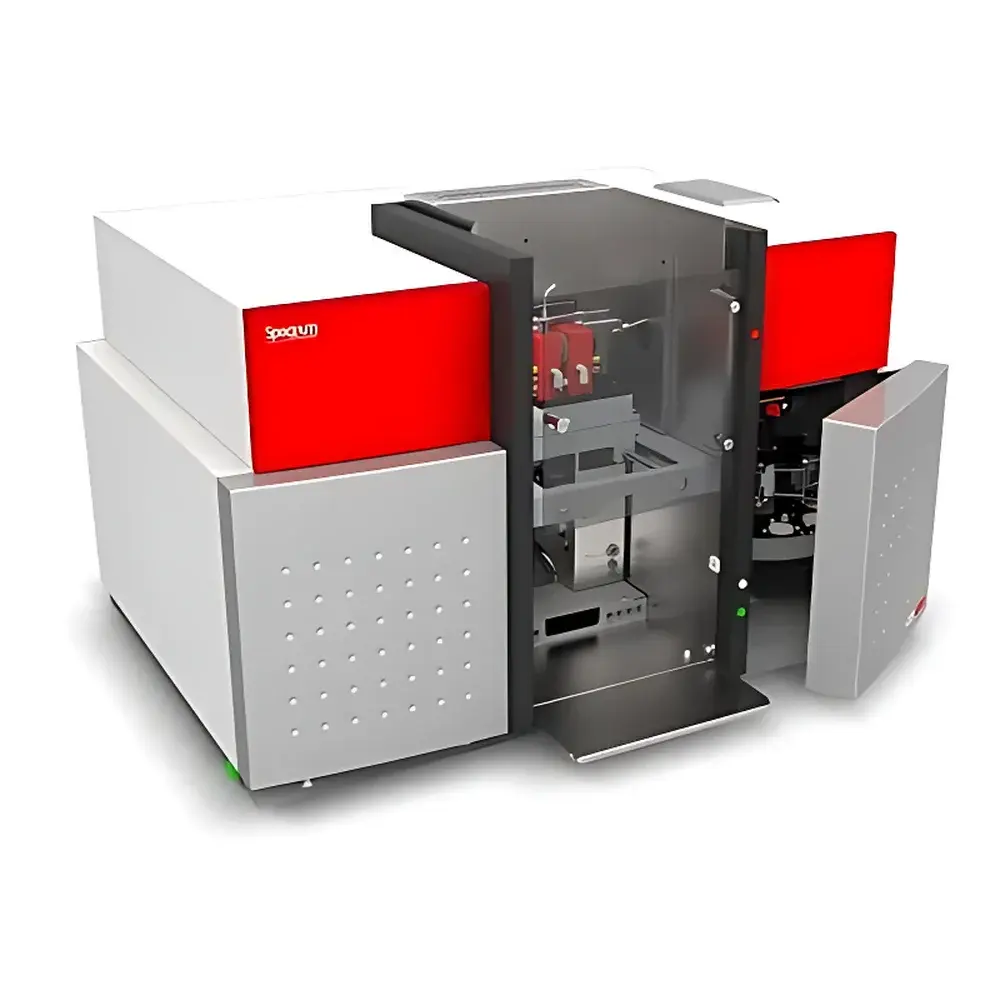
Shanghai Spectrum SP-3590AA Flame and Graphite Furnace Atomic Absorption Spectrophotometer
| Brand | Shanghai Spectrum |
|---|---|
| Origin | Shanghai, China |
| Model | SP-3590AA |
| Instrument Type | Flame and Graphite Furnace AAS |
| Optical System | Single-beam, All-reflective Achromatic Optics |
| Detector | Photomultiplier Tube (PMT) |
| Background Correction | Deuterium Lamp + Self-reversal (Self-absorption) Method |
| Safety Features | Automatic Lamp Switching, Graphite Tube Auto-diagnosis, Multi-point Radiation Shielding |
| Compliance | Designed for GLP-compliant laboratories |
Overview
The Shanghai Spectrum SP-3590AA is a dual-mode atomic absorption spectrophotometer engineered for quantitative trace metal analysis in complex matrices. It operates on the fundamental principle of atomic absorption spectroscopy (AAS), where ground-state free atoms in a gaseous state absorb light at element-specific wavelengths—typically in the ultraviolet and visible range (190–900 nm). The instrument integrates both flame atomization (for higher concentration samples, e.g., ppm-level Cu, Fe, Zn) and electrothermal graphite furnace atomization (for sub-ppt detection of Cd, Pb, As, Se), enabling broad dynamic range coverage across environmental, clinical, pharmaceutical, geological, and industrial QC applications. Its single-beam optical architecture employs an all-reflective achromatic design—eliminating chromatic aberration across the full spectral range—and ensures consistent beam alignment between sample and reference paths without mechanical realignment after lamp changes. This optical stability directly contributes to measurement reproducibility and long-term baseline integrity.
Key Features
- Integrated flame/graphite furnace atomization platform with automated switching and safety interlocks
- All-reflective achromatic optical system: maintains uniform focal geometry and beam collimation across wavelengths, minimizing wavelength-dependent signal drift
- Dual background correction: deuterium arc lamp for broadband correction and self-reversal (SR) mode using standard hollow cathode lamps—enabling high-fidelity correction of structured molecular absorption and scattering
- Gap-controlled lamp current modulation: extends standard HCL lifetime by >10× while maintaining optimal self-reversal line profile; eliminates need for costly dedicated SR lamps
- Graphite tube auto-diagnostic function: verifies electrical continuity, geometry integrity, and thermal contact prior to each furnace cycle—reducing downtime and false failure events
- Enhanced UV optical performance: fused silica-coated mirrors and UV-optimized PMT deliver improved quantum efficiency below 220 nm (critical for As, Se, Sb analysis)
- Optical stray-light measurement and real-time correction algorithm: quantifies and compensates for off-axis scatter, improving linearity and expanding usable calibration range
- Multi-layer radiation shielding: actively suppresses broadband emission from flame plasma and graphite furnace blackbody radiation—minimizing spectral interference in high-temperature atomization
Sample Compatibility & Compliance
The SP-3590AA accommodates aqueous solutions, acid-digested biological tissues, filtered environmental extracts, and diluted metallurgical leachates. Sample introduction is compatible with standard nebulizers (e.g., concentric glass, cross-flow) and autosamplers supporting up to 120-position racks. For graphite furnace operation, it accepts standard pyrolytic-coated or platform-type graphite tubes (L’vov type). The system meets essential functional requirements of ISO 8288:2017 (determination of nickel, cobalt, copper, zinc, cadmium, lead in water), ASTM E1948-22 (trace metals in soils), and USP (elemental impurities in pharmaceuticals). Data acquisition and method storage comply with ALCOA+ principles; audit trail functionality (via optional software module) supports 21 CFR Part 11 readiness when deployed in regulated GMP environments.
Software & Data Management
The instrument is controlled via Windows-based SpectrumAAS software, providing method development wizards, multi-element sequential analysis scheduling, and real-time signal visualization (absorbance vs. time, peak area/integration). Raw data files (.spc) are stored with embedded metadata—including lamp ID, slit width, integration time, gas flow rates, and furnace temperature ramp profiles. Export formats include CSV, TXT, and XML for LIMS integration. Optional compliance packages enable electronic signatures, user access levels (admin/operator/analyst), and immutable audit trails for method changes, calibration updates, and result modifications—fully traceable to individual users and timestamps.
Applications
- Environmental monitoring: Pb, Cd, Cr quantification in drinking water per EPA Method 7000B
- Pharmaceutical QA/QC: residual catalyst metals (Pd, Pt, Ni) in active pharmaceutical ingredients (APIs)
- Clinical toxicology: blood/urine As, Hg, Tl analysis following sample microwave digestion
- Food safety: Cd and Pb screening in rice, spices, and infant formula per EU Commission Regulation (EU) No 2023/915
- Geochemical exploration: multi-element profiling of rock digests using GF-AAS for ultra-trace REEs and transition metals
- Materials science: coating homogeneity assessment via surface leaching and AAS quantification of Ni/Cr/Co release
FAQ
Does the SP-3590AA support simultaneous multi-element analysis?
No—it is a sequential AAS system. Elements are measured one at a time using discrete hollow cathode lamps; however, automated lamp turret rotation and parameter recall minimize cycle time between elements.
What graphite furnace temperature programs are supported?
The system provides fully programmable 12-step heating cycles (drying, ashing, atomization, cleaning), with ramp rate control, hold time precision ±0.5 s, and maximum furnace temperature up to 3000 °C.
Is the deuterium background correction validated per ISO 11171?
While ISO 11171 applies to particle counting, the D₂ lamp’s spectral bandwidth and intensity stability conform to ISO 8288 Annex C specifications for background correction verification using certified reference materials (CRMs) such as NIST SRM 1643e.
Can third-party autosamplers be integrated?
Yes—the instrument features RS-232 and USB device interfaces compatible with major OEM autosamplers (e.g., CETAC ASX-520, PerkinElmer AS-90) via standardized command protocols.
How is optical alignment verified during routine maintenance?
The system includes built-in alignment diagnostics: automatic slit centering verification, lamp beam position mapping, and PMT gain stabilization routines—all accessible through service mode without external alignment tools.
Related Products




