
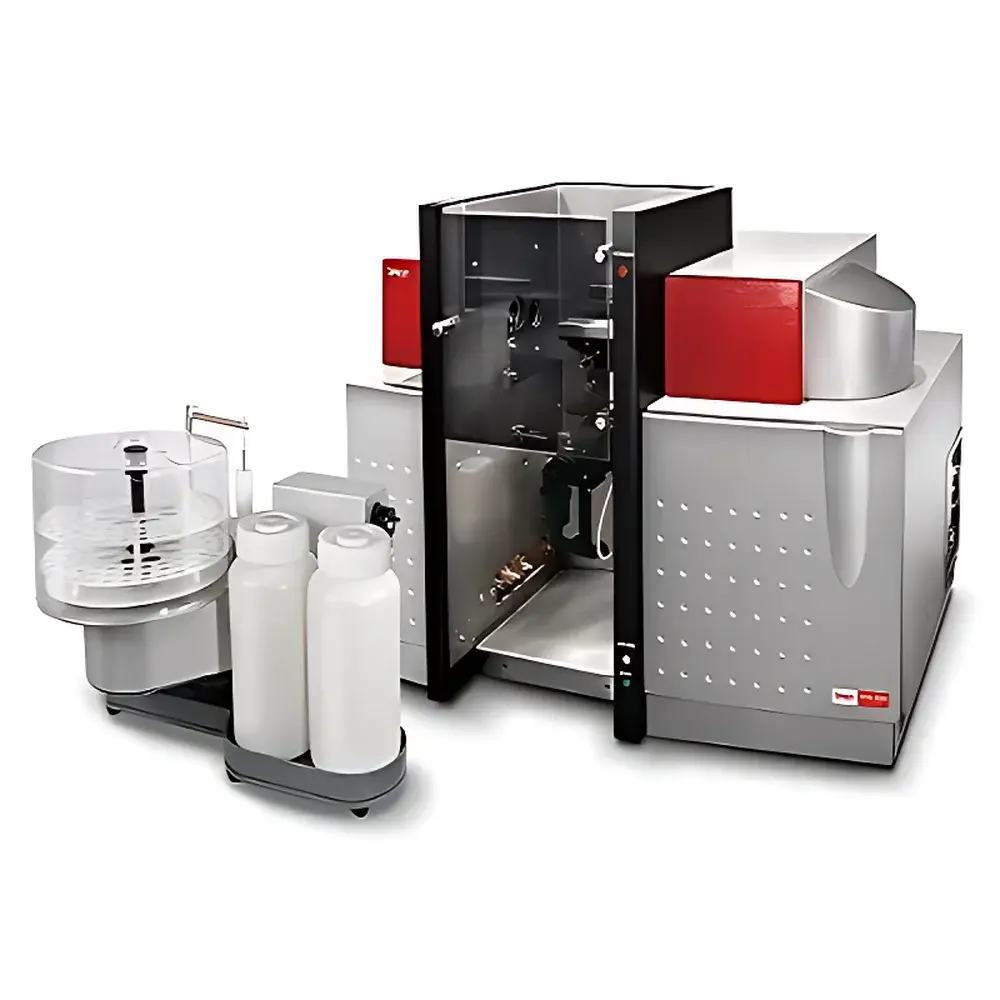
Shanghai Spectrum SP-3801 Flame and Graphite Furnace Atomic Absorption Spectrophotometer
| Brand | Shanghai Spectrum |
|---|---|
| Origin | Shanghai, China |
| Model | SP-3801 |
| Instrument Type | Flame and Graphite Furnace AAS |
| Monochromator | Plane Grating |
| Optical System | Dual-Beam |
| Detector | Photomultiplier Tube (PMT) |
| Background Correction | Deuterium Lamp + Self-Absorption Method |
| Background Correction Efficiency | >50× (D₂), >100× (Self-Absorption) |
Overview
The Shanghai Spectrum SP-3801 is a dual-mode atomic absorption spectrophotometer engineered for routine and research-grade elemental quantification in environmental, pharmaceutical, clinical, and industrial laboratories. It operates on the fundamental principle of atomic absorption spectroscopy (AAS), where ground-state free atoms in a gaseous state absorb characteristic radiation emitted by hollow cathode lamps (HCLs) or electrodeless discharge lamps (EDLs). The SP-3801 integrates both flame atomization (for higher concentration samples, typically µg/mL range) and electrothermal graphite furnace atomization (for trace-level analysis down to pg/mL), enabling method flexibility without hardware reconfiguration. Its dual-beam optical architecture compensates for source intensity drift and lamp aging, ensuring long-term photometric stability. The system employs a plane grating monochromator with fixed slit geometry, delivering consistent spectral resolution across the 190–900 nm working range—covering all common elemental lines from sodium (Na, 330.2 nm) to arsenic (As, 193.7 nm).
Key Features
- Intelligent atomizer recognition and automatic switching between flame and graphite furnace modes, including real-time parameter validation against stored method templates
- Dual-background correction capability: deuterium arc lamp (D₂) for broadband correction and self-absorption (SA) mode for high-precision correction at narrow spectral profiles—validated per ASTM E1941 and ISO 11170 protocols
- Auto-balanced optical energy control across full wavelength range, minimizing photomultiplier tube saturation and dark-current drift
- Dual-balanced signal amplification circuitry, providing dynamic range extension and improved signal-to-noise ratio during transient furnace signals
- Integrated sample handling module supporting programmable dilution, matrix-matched standard addition, and online preconcentration via chelation or co-precipitation workflows
- Hollow cathode lamp auto-recognition via embedded EEPROM tags, triggering instrument-specific wavelength, current, and slit width presets per element
- Flame atomizer with automated carbon deposit detection and thermal cleaning cycle—reducing manual maintenance intervals and improving inter-run reproducibility
Sample Compatibility & Compliance
The SP-3801 accommodates aqueous solutions, acid-digested environmental solids (e.g., soils, sediments per EPA Method 200.7), biological digests (tissues, blood per CLIA guidelines), and food extracts (AOAC 984.27). Graphite furnace operation supports direct analysis of viscous or particulate-laden matrices when coupled with platform-stabilized temperature programming and integrated Zeeman-effect-free graphite tubes. The instrument’s firmware and data acquisition logic comply with GLP/GMP documentation requirements, including electronic signature support, audit trail logging (per FDA 21 CFR Part 11 principles), and user-access-level permissions. All calibration and QC records—including bracketing standards, continuing calibration verification (CCV), and duplicate sample analysis—are timestamped and exportable in CSV or XML formats compatible with LIMS integration.
Software & Data Management
The proprietary SP-Control Suite provides method development, sequence scheduling, real-time signal visualization, and compliance-ready reporting. It features built-in uncertainty propagation algorithms aligned with ISO/IEC 17025:2017 Annex A.3, automatically calculating combined standard uncertainty from repeatability, calibration curve fit, pipetting error, and background correction residuals. Data files include metadata headers compliant with ASTM E1461-22 (Standard Practice for Digital Data Exchange in Analytical Chemistry). Raw absorbance-time curves, peak area integrations, and background-subtracted spectra are archived with lossless compression. Export options include PDF analytical reports with embedded chromatogram-style furnace heat cycles, as well as ASCII-compatible .txt outputs for third-party statistical packages (e.g., R, JMP, Minitab).
Applications
- Environmental monitoring: Pb, Cd, Cr, Ni, and As in drinking water (EPA 7000B), wastewater (ISO 11885), and airborne particulates (NIOSH 7300)
- Pharmaceutical quality control: catalyst residue testing (Pd, Pt, Rh) in active pharmaceutical ingredients per ICH Q2(R2)
- Clinical toxicology: blood lead level (BLL) screening per CDC CLIA-waived thresholds
- Food safety: total mercury in fish tissue (FDA CPG 7104.02), zinc and copper in infant formula (Codex Stan 72-1981)
- Geological exploration: base metal assays in rock leachates (ASTM D5686)
FAQ
Does the SP-3801 support simultaneous multi-element analysis?
No—it performs sequential elemental analysis using time-multiplexed lamp illumination and wavelength scanning; true simultaneous AAS requires echelle-based or CCD-array detection systems.
Is graphite furnace autosampler included as standard equipment?
Yes—the SP-3801 ships with a 60-position programmable autosampler capable of integrated ashing, drying, and atomization temperature ramping per EN 13332-1.
Can the software generate 21 CFR Part 11-compliant audit trails?
The system logs all method edits, calibration events, and result modifications with user ID, timestamp, and reason-for-change fields—meeting core technical requirements of Part 11, though formal validation remains site-specific.
What maintenance intervals are recommended for the PMT detector?
Photomultiplier tube gain calibration is advised every 12 months or after 2,000 operating hours; no physical replacement is required under normal laboratory conditions.
Is the deuterium lamp alignment adjustable by the end user?
No—optical alignment is factory-set and sealed; field service requires certified technician recalibration using NIST-traceable spectral line sources.




