
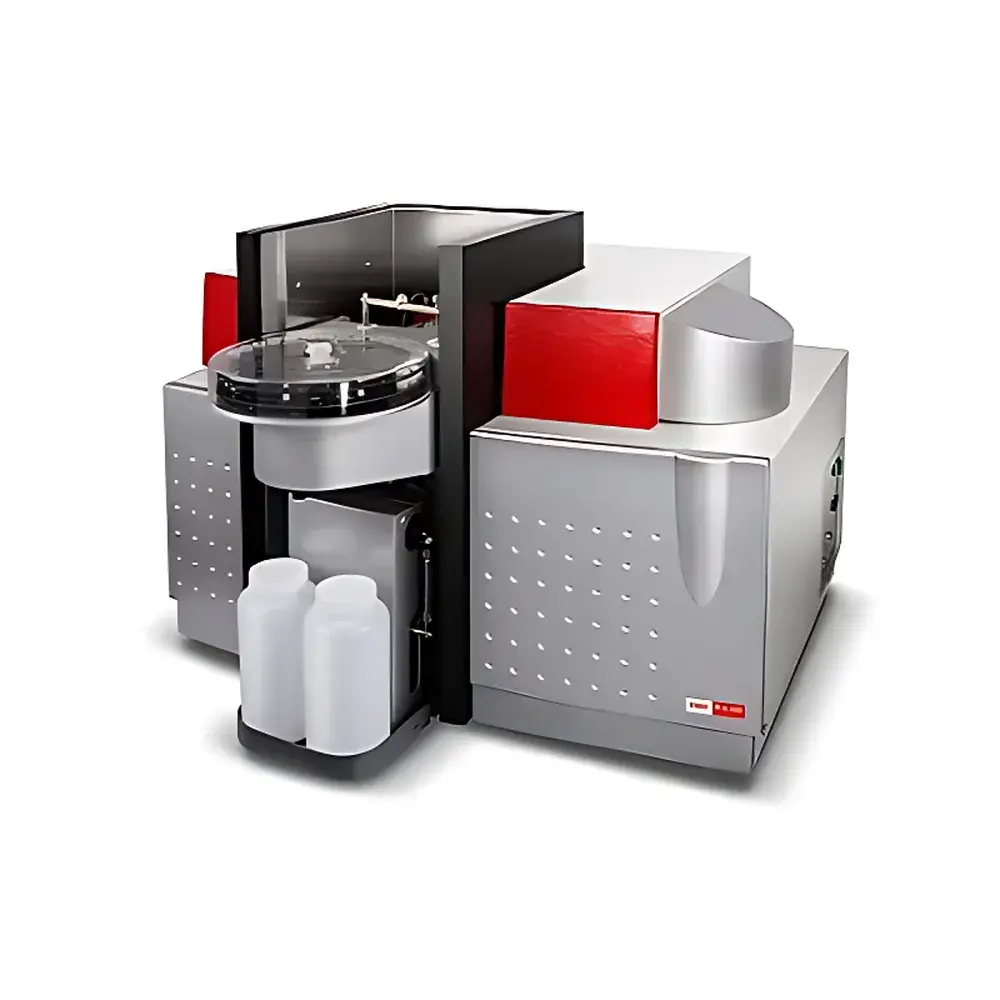
Shanghai Spectrum SP-3802 Graphite Furnace Atomic Absorption Spectrometer
| Brand | Shanghai Spectrum |
|---|---|
| Origin | Shanghai, China |
| Model | SP-3802 |
| Instrument Type | Graphite Furnace AAS |
| Optical System | Dual-beam |
| Monochromator | Plane Grating |
| Detector | Photomultiplier Tube (PMT) |
| Background Correction | Deuterium Lamp + Self-absorption Method |
| Compliance | Designed for GLP/GMP-aligned laboratory workflows |
| Software | SPWin-AAS v3.x (Windows-based, 21 CFR Part 11-ready audit trail option) |
Overview
The Shanghai Spectrum SP-3802 is a dual-beam graphite furnace atomic absorption spectrometer engineered for trace elemental analysis in demanding environmental, pharmaceutical, clinical, and materials testing laboratories. It operates on the fundamental principle of atomic absorption spectroscopy (AAS), where ground-state free atoms in a graphite tube absorb characteristic radiation from hollow cathode lamps (HCLs) at element-specific wavelengths. The SP-3802 integrates flame and graphite furnace atomization into a single platform with independent optical pathways, enabling high-sensitivity quantification down to sub-picogram levels for over 70 elements—including Cd, Pb, As, Cr, Ni, and Hg—without cross-contamination or system reconfiguration.
Key Features
- Intelligent Stray Light Measurement & Dynamic Correction: Utilizes real-time spectral scanning algorithms to quantify stray light intensity across the full wavelength range (190–900 nm) without reference standards or hardware modifications. Corrections are applied pixel-by-pixel during data acquisition, enhancing photometric linearity and extending dynamic range beyond 3 orders of magnitude.
- Dual-Mode Background Correction: Combines deuterium arc lamp continuum correction with self-absorption (SA) background correction in a single measurement cycle. The SA mode leverages pulsed HCL operation and synchronized timing control to isolate structured background from molecular absorption bands—critical for complex matrices such as biological digests and soil extracts.
- Gap-Controlled Lamp Technology: Enables standard HCLs—not dedicated SA lamps—to perform self-absorption background correction via precise current modulation and anode-cathode gap optimization. This extends lamp lifetime by ≥10× while reducing consumable costs by >90% versus proprietary SA lamps.
- Hg-Lamp–Reagent Gradient Calibration: Implements a validated mathematical model correlating mercury lamp emission stability with reagent blank response drift. This provides rapid, non-standardized assessment of dual-channel signal balance and linearity—serving as an internal performance verification protocol compliant with ISO/IEC 17025 clause 7.7.
- Achromatic Full-Spectrum Optical System: Features a plane grating monochromator with thermally stabilized mounts and UV-enhanced aluminized optics, delivering consistent spectral resolution and throughput from 190 nm (As I) to 852 nm (Rb I) without manual alignment or recalibration.
Sample Compatibility & Compliance
The SP-3802 supports aqueous, acidic-digested, and organic-solvent-based samples (with appropriate modifiers) for graphite furnace analysis. Its programmable temperature-controlled furnace accommodates standard 10–30 µL sample volumes and enables multi-step thermal protocols (drying, pyrolysis, atomization, cleaning) per ASTM D4691 and ISO 11170. The instrument architecture conforms to key regulatory expectations: software audit trails (optional 21 CFR Part 11 compliance module), electronic signature support, and GLP-compliant method validation templates embedded in SPWin-AAS. All optical and electronic subsystems meet IEC 61326-1 electromagnetic compatibility requirements.
Software & Data Management
SPWin-AAS v3.x is a native Windows application designed for intuitive method development, sequence management, and report generation. It includes automated wavelength selection, lamp alignment assistance, peak area/intensity integration with baseline subtraction options, and customizable calibration curve fitting (linear, quadratic, weighted least squares). Raw spectral data and furnace temperature logs are stored in vendor-neutral CSV and XML formats. Audit trail logging records all user actions—including parameter changes, calibration events, and result overrides—with timestamps, operator IDs, and IP addresses (when networked). Data export supports LIMS integration via ODBC and HL7-compatible metadata tagging.
Applications
The SP-3802 is routinely deployed in accredited laboratories for regulatory testing under US EPA Method 7000B (metals in wastewater), ISO 17294-2 (water quality), and pharmacopeial monographs (USP , EP 2.4.3). Typical use cases include: quantification of lead in pediatric blood specimens (LOD ≤ 0.05 µg/L), cadmium in rice flour (certified reference material NIST SRM 1568b), arsenic speciation after hydride generation coupling, and nickel release testing from medical devices per ISO 10993-15. Its dual-beam stability and background correction fidelity ensure reproducibility (RSD < 2.5% at 10× LOD) across multi-day batch analyses.
FAQ
Does the SP-3802 support both flame and graphite furnace analysis in one configuration?
Yes—the instrument features physically separate atomization modules with independent optical paths, allowing seamless switching between flame and furnace modes without realignment.
Is the deuterium lamp background correction fully automatic?
Yes; the system dynamically balances deuterium and HCL intensities before each readout using real-time photodiode feedback, eliminating manual energy adjustment.
Can SPWin-AAS generate reports compliant with ISO/IEC 17025 documentation requirements?
Yes; built-in report templates include uncertainty estimation (GUM-compliant), calibration history, system suitability test results, and analyst sign-off fields.
What maintenance is required for the graphite furnace system?
Routine maintenance includes periodic replacement of graphite tubes and platform inserts, cleaning of the autosampler probe, and annual verification of furnace temperature calibration using NIST-traceable standards.
Is remote monitoring or troubleshooting supported?
The instrument supports TCP/IP connectivity and optional VNC-enabled remote desktop access for technical support—subject to customer network security policies.
Related Products






