
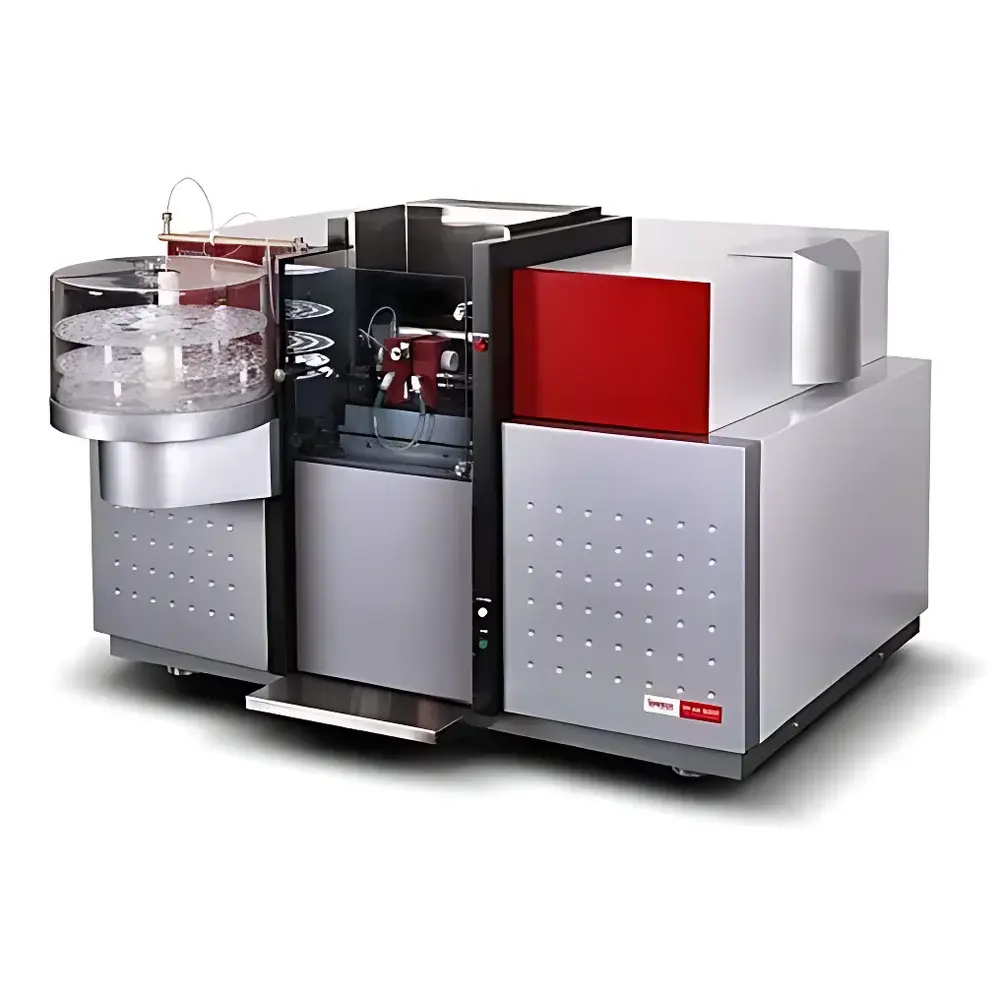
Shanghai Spectrum SP-3803AA Parallel-Configuration Flame and Graphite Furnace Atomic Absorption Spectrometer
| Brand | Shanghai Spectrum |
|---|---|
| Origin | Shanghai, China |
| Model | SP-3803AA (Parallel Configuration) |
| Instrument Type | Flame and Graphite Furnace AAS |
| Monochromator | Echelle Grating |
| Optical System | Double-Beam |
| Detector | Photomultiplier Tube (PMT) |
| Background Correction | Deuterium Lamp + Self-Reversal (Self-Absorption) Method |
| Compliance | Designed for ISO/IEC 17025-compliant laboratories |
| Software | Integrated PC-based workstation with audit trail capability |
| Regulatory Alignment | Supports GLP/GMP data integrity requirements per FDA 21 CFR Part 11 principles |
Overview
The Shanghai Spectrum SP-3803AA is a parallel-configuration, fully automated atomic absorption spectrometer integrating both flame and graphite furnace atomization systems within a single instrument platform. It operates on the fundamental principle of atomic absorption spectroscopy—measuring the attenuation of narrow-line radiation from a hollow cathode lamp as it passes through a cloud of free atoms generated in a high-temperature atomizer. The SP-3803AA employs a double-beam optical architecture to compensate for source intensity drift and lamp aging, ensuring stable baseline performance during extended analytical sequences. Its echelle grating monochromator delivers high spectral resolution and efficient wavelength dispersion across the UV–visible range (190–900 nm), enabling precise isolation of elemental absorption lines while minimizing spectral interference. The instrument’s parallel design allows independent, concurrent operation of flame and graphite furnace modules—eliminating mechanical switching delays and enhancing throughput in multi-element or multi-matrix sample workflows.
Key Features
- Parallel flame/graphite furnace configuration enables uninterrupted transition between air-acetylene flame analysis and electrothermal atomization—no manual reconfiguration or alignment required.
- Dual background correction methodology: integrated deuterium arc lamp for broad-band correction and self-reversal (self-absorption) technique for high-precision, line-specific background subtraction—validated for background absorbances up to 2.0 AU with >80× correction factor.
- Double-beam optical path with real-time reference beam monitoring minimizes drift-related uncertainty and improves long-term photometric stability.
- Modular hardware architecture facilitates field serviceability, standardized component replacement, and scalable upgrades—supporting laboratory lifecycle management and regulatory maintenance records.
- High-sensitivity photomultiplier tube detector with low-noise signal processing electronics ensures optimal signal-to-noise ratio for trace metal quantification.
- Automated gas control, autosampler integration, and programmable temperature ramping for graphite furnace cycles reduce operator dependency and enhance inter-day reproducibility.
Sample Compatibility & Compliance
The SP-3803AA accommodates liquid samples across diverse matrices—including environmental water, biological digests, food extracts, pharmaceutical excipients, and geological leachates. Flame mode supports routine analysis of elements at µg/L levels (e.g., Ca, Mg, Fe, Cu, Zn); graphite furnace mode extends detection capability to sub-pg absolute mass sensitivity (e.g., Pb, Cd, As, Se). The system meets essential functional requirements outlined in ASTM D1688 (copper in water), ISO 11171 (trace metals in fuels), and USP for elemental impurities in drug substances. While not pre-certified to IEC 61000-4 electromagnetic compatibility standards, its robust shielding and grounded chassis design align with good laboratory practice (GLP) infrastructure expectations. All firmware and software operations are structured to support audit-ready documentation per ISO/IEC 17025 clause 7.7 and FDA 21 CFR Part 11 principles—including user authentication, electronic signatures, and immutable method/data logs.
Software & Data Management
The embedded Windows-based workstation software provides comprehensive instrument control, method development, calibration curve generation (linear, quadratic, weighted least-squares), and QC reporting. It includes built-in validation tools for peak area integration, background subtraction verification, and drift compensation diagnostics. Raw spectral data, acquisition parameters, and processing metadata are stored in vendor-neutral formats (CSV, XML) alongside proprietary binary archives. Audit trail functionality logs all user actions—including method edits, calibration updates, and result overrides—with timestamps and operator IDs. Data export complies with LIMS interface protocols (ODBC, ASCII, ASTM E1384) and supports direct integration into enterprise-quality management systems.
Applications
- Environmental monitoring: Quantification of heavy metals (Cd, Cr, Ni, Pb) in wastewater, soil extracts, and airborne particulate matter per EPA Methods 200.7 and 7000B.
- Clinical and toxicology labs: Trace element profiling (Zn, Cu, Mn, Se) in serum, whole blood, and urine—aligned with CLIA and CAP proficiency testing guidelines.
- Pharmaceutical quality control: Elemental impurity screening in active pharmaceutical ingredients (APIs) and excipients per ICH Q3D thresholds.
- Food safety compliance: Detection of toxic elements (As, Hg, Pb) in infant formula, seafood, and fortified cereals per EU Commission Regulation (EU) No 1881/2006.
- Materials science R&D: Alloy composition verification, catalyst residue analysis, and semiconductor-grade chemical purity assessment.
FAQ
What atomization techniques does the SP-3803AA support?
It integrates both flame (air-acetylene) and electrothermal (graphite furnace) atomization in a parallel architecture—enabling method-specific selection without hardware reconfiguration.
How does the dual background correction improve accuracy?
Deuterium lamp correction addresses broadband molecular absorption, while self-reversal correction targets structured, line-overlapping backgrounds—providing orthogonal compensation validated up to 2.0 AU background absorbance.
Is the software compliant with FDA 21 CFR Part 11?
The system implements core Part 11 capabilities—including role-based access control, electronic signatures, and tamper-evident audit trails—though formal validation must be completed by the end-user laboratory per their SOPs.
Can the SP-3803AA be integrated into an existing LIMS environment?
Yes—it supports standard data export formats (CSV, XML) and ODBC connectivity for bidirectional communication with major LIMS platforms.
What maintenance intervals are recommended for routine operation?
Optical alignment verification every 6 months; PMT gain calibration quarterly; graphite furnace platform inspection after every 500 firings; full system performance verification annually per ISO/IEC 17025 Annex A.3 guidelines.




