
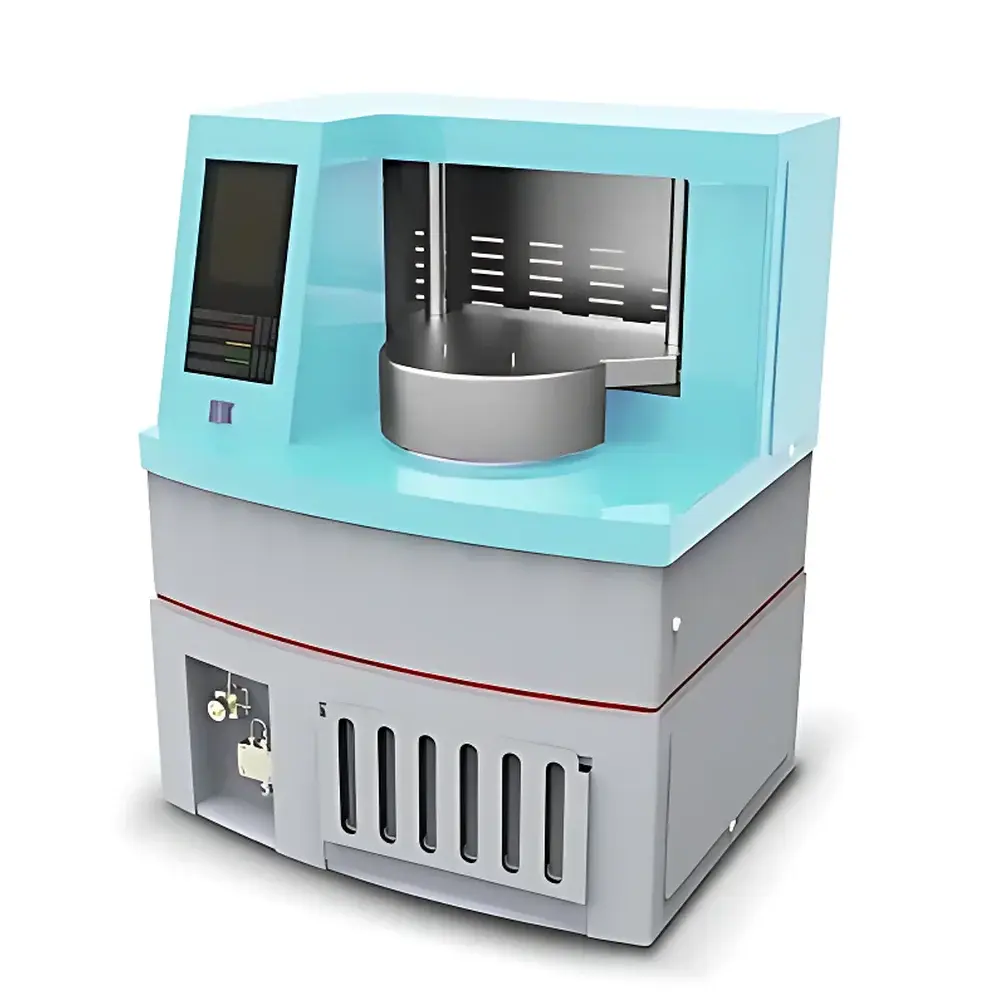
Shanghai Spectrum SP-600QSE Accelerated Solvent Extractor
| Brand | Shanghai Spectrum |
|---|---|
| Origin | Shanghai, China |
| Model | SP-600QSE |
| Extraction Type | Solid-Liquid Extraction |
| Compliance | EPA Method 3545A |
| Channel Configuration | 6 Parallel Independent Channels |
| Extraction Cell Volumes | 11 mL, 22 mL, 34 mL |
| Max Cell Temperature | 200 °C |
| Safety Feature | Over-Temperature Cut-Off |
| Collection Vial Options | 40 mL / 50 mL / 60 mL |
| Flow Direction | Top-to-Bottom Vertical Elution |
| Cell Positioning | Fixed Vertical Alignment |
| Solvent Pressure Monitoring | Real-Time Alarm Function |
| System Architecture | Fully Automated, Channel-Isolated Fluidics |
Overview
The Shanghai Spectrum SP-600QSE Accelerated Solvent Extractor is an automated solid-liquid extraction system engineered for high-throughput, reproducible recovery of analytes from solid and semi-solid matrices—including soils, sediments, sludges, tissues, and polymer composites. It operates on the fundamental principle of accelerated solvent extraction (ASE®), leveraging elevated temperature (up to 200 °C) and controlled pressure (typically 1,500–2,000 psi, per standard ASE methodology) to enhance solute solubility and mass transfer kinetics while maintaining solvent integrity. Unlike conventional Soxhlet or ultrasonic extraction, the SP-600QSE achieves complete extraction cycles in minutes rather than hours, significantly reducing thermal degradation risk and improving analyte stability. Its design adheres strictly to U.S. Environmental Protection Agency Method 3545A, ensuring regulatory acceptability for environmental monitoring, food safety testing, and compliance-driven laboratories operating under ISO/IEC 17025 or EPA-accredited protocols.
Key Features
- Six parallel, fully independent extraction channels—each with dedicated fluidic pathways, pressure sensors, temperature probes, and Peltier-based cooling modules—to eliminate cross-contamination and enable true multi-sample concurrency.
- Modular extraction cell architecture supporting three standardized volumes (11 mL, 22 mL, and 34 mL), all rated for continuous operation up to 200 °C with integrated over-temperature cut-off protection.
- Vertical cell orientation and top-to-bottom solvent flow path ensure consistent packing density, uniform solvent penetration, and minimal channeling—critical for method robustness across heterogeneous samples.
- Real-time solvent pressure monitoring with configurable alarm thresholds prevents system over-pressurization and supports preventive maintenance logging.
- Automated vial positioning and sequential fraction collection into user-selected 40 mL, 50 mL, or 60 mL glass vials—compatible with downstream autosamplers for GC, HPLC, or ICP-MS analysis.
- Embedded control interface with method storage, stepwise parameter programming (pre-rinse, static extraction, flush, purge), and audit-ready event logging.
Sample Compatibility & Compliance
The SP-600QSE accommodates a broad range of solid and semi-solid sample types without requiring homogenization or pre-drying, provided particle size is reduced to ≤ 0.5 mm and moisture content remains below 70% w/w. Compatible matrices include EPA SW-846 compliant environmental solids (e.g., contaminated soils, fly ash, dredged sediments), agricultural products (grains, feedstuffs), biological tissues (liver, muscle), and industrial polymers. All operational parameters—including temperature ramp profiles, static dwell time, and solvent flush volume—can be configured to meet method-specific requirements outlined in EPA 3545A, ASTM D7699, and ISO 14507. The system’s isolated-channel architecture satisfies GLP traceability standards by enabling discrete calibration verification per channel and eliminating shared fluidic components that compromise data integrity.
Software & Data Management
The SP-600QSE runs on embedded firmware with USB and Ethernet connectivity for remote configuration and status monitoring via Windows-compatible desktop software. Each extraction run generates a timestamped log file containing channel-specific temperature/pressure profiles, solvent delivery metrics, and error codes—exportable as CSV or PDF for inclusion in analytical reports. Audit trail functionality records all user actions (login, method edits, run initiation), aligned with FDA 21 CFR Part 11 principles for electronic records. Software supports IQ/OQ documentation templates and allows method cloning with delta validation—facilitating rapid requalification after maintenance or relocation. No cloud dependency; all data resides locally unless explicitly exported.
Applications
- Environmental analysis: PCBs, PAHs, organochlorine pesticides, dioxins/furans, and petroleum hydrocarbons from soil and sediment.
- Food and feed testing: Mycotoxins (aflatoxin B1, ochratoxin A), fat-soluble vitamins (A, D, E), and pesticide residues in cereals and animal feed.
- Pharmaceutical R&D: Active pharmaceutical ingredient (API) recovery from excipient blends and residual solvent quantification in solid dosage forms.
- Materials science: Additive leaching studies from plastics, flame retardants from textiles, and plasticizer extraction from PVC compounds.
- Forensic toxicology: Drug metabolite isolation from hair and tissue specimens prior to LC-MS/MS confirmation.
FAQ
Does the SP-600QSE support gradient temperature programming during a single extraction cycle?
No—each channel executes isothermal static extraction at a user-defined setpoint; however, multiple methods can be queued sequentially with different temperature presets.
Are extraction cells reusable, and what is their expected service life?
Yes—quartz and stainless-steel cells are designed for ≥ 200 extractions when cleaned per manufacturer guidelines; cell gaskets require replacement after every 10–15 runs.
Can the system integrate with third-party LIMS platforms?
Yes—via ASCII-based output files and configurable delimiter settings; direct API integration is not supported out-of-the-box.
What solvent compatibility limitations apply?
All common organic solvents (hexane, acetone, DCM, methanol, acetonitrile) are supported; chlorinated solvents require corrosion-resistant wetted materials (standard on SP-600QSE); aqueous mixtures up to 50% water are permissible with appropriate cell conditioning.
Is method transfer from legacy ASE systems straightforward?
Yes—EPA 3545A-compliant methods translate directly; minor optimization of flush volume and purge time may be required due to differences in internal dead volume and cooling efficiency.



