
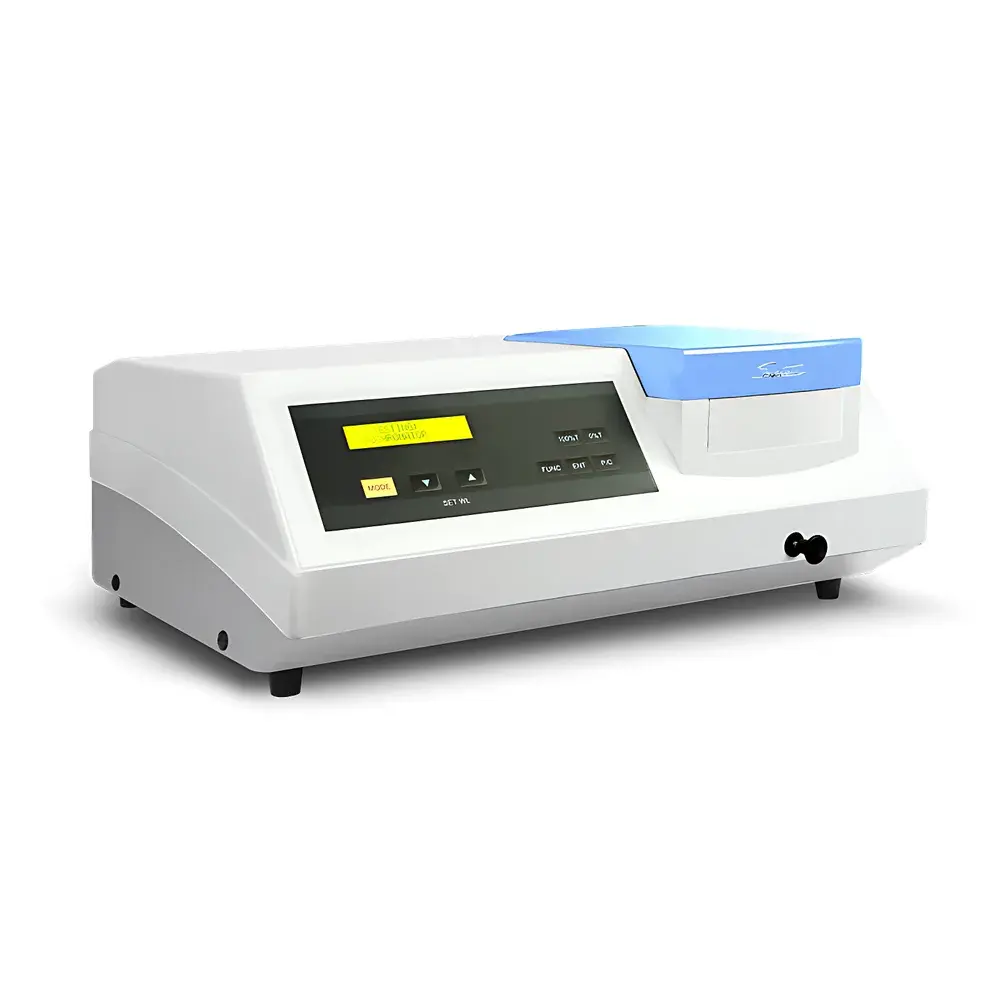
Shanghai Spectrum SP-752 Ultraviolet-Visible Spectrophotometer
| Brand | Shanghai Spectrum |
|---|---|
| Origin | Shanghai, China |
| Manufacturer Type | Authorized Distributor |
| Regional Classification | Domestic (PRC) |
| Model | SP-752 |
| Price Range | USD 1,400–2,800 |
| Optical Design | Single-Beam |
| Detector Type | Photodiode Array (PDA) |
| Wavelength Scanning Mode | Motorized Automatic Wavelength Selection |
| Wavelength Calibration | Self-Referencing Auto-Calibration via Spectral Feature Recognition |
| Displayed Parameters | Transmittance (%T), Absorbance (A), Concentration (c), Wavelength (nm) |
| Software Modules | Spectrum Scan, Kinetic (Time) Scan, Quantitative Analysis, Nucleic Acid (DNA/RNA) Analysis |
| Expandability | Modular Accessory Interface (e.g., cuvette holders, fiber-optic probes, temperature-controlled cells) |
| Compliance Framework | Designed to support GLP documentation workflows and basic ISO/IEC 17025 alignment for routine QC labs |
Overview
The Shanghai Spectrum SP-752 Ultraviolet-Visible Spectrophotometer is a single-beam, microprocessor-controlled analytical instrument engineered for routine absorbance and transmittance measurements across the ultraviolet and visible spectral regions. It operates on the fundamental principle of Beer–Lambert law-based quantitative spectroscopy, where sample-induced attenuation of incident light at discrete or scanned wavelengths is converted into concentration or purity metrics. Unlike double-beam systems, the SP-752 employs a robust single-beam architecture with integrated real-time energy optimization—automatically detecting optimal lamp positioning and dynamically switching between deuterium (UV) and tungsten-halogen (VIS/NIR) sources based on selected wavelength range. Its photodiode array detector enables rapid spectral acquisition without mechanical slit scanning, supporting both fixed-wavelength assays and full-spectrum characterization from 190 nm to 1100 nm (typical operational range; exact limits depend on lamp output and grating efficiency). The instrument performs self-referencing wavelength calibration at startup using intrinsic spectral features (e.g., mercury or holmium oxide reference peaks when optional calibration standards are installed), ensuring traceable wavelength accuracy without external intervention.
Key Features
- Motorized automatic wavelength selection with high-resolution stepper motor positioning and closed-loop feedback control
- Dual-lamp system (deuterium UV source + tungsten-halogen VIS/NIR source) with programmable auto-switching logic and individual on/off control
- Self-calibrating wavelength verification using spectral landmark recognition—no manual adjustment required
- Real-time energy optimization algorithm continuously adjusts lamp position and intensity for maximum signal-to-noise ratio
- Integrated PDA detector providing simultaneous multi-wavelength detection for enhanced measurement reproducibility
- Modular hardware interface supporting standardized accessories: 4-cell rotating cuvette holders, 10-mm pathlength quartz/silica cuvettes, fiber-optic sampling probes, and optional Peltier-controlled temperature cells
- Intuitive LCD interface with context-sensitive soft keys and multilingual menu navigation (English, Chinese, Spanish)
Sample Compatibility & Compliance
The SP-752 accommodates standard 10 mm square cuvettes (quartz for UV, optical glass for VIS), as well as micro-volume adapters and flow cells compatible with HPLC effluent monitoring. Sample types include aqueous and organic solutions, colloidal suspensions (with appropriate filtration), enzymatic reaction mixtures, nucleic acid preparations, and dye-based calibration standards. While not certified to IEC 61000-4 electromagnetic immunity standards out-of-box, the instrument meets Class II safety requirements per GB 4793.1 (equivalent to IEC 61010-1) for laboratory electrical equipment. Its firmware supports audit-trail-enabled operation when paired with optional PC-based software compliant with FDA 21 CFR Part 11 Annex 11 principles—enabling electronic signatures, user access levels, and change history logging for regulated environments.
Software & Data Management
The SP-752 is supplied with SP-SpectraControl v3.x PC software (Windows 10/11 compatible), offering five core application modules: (1) Spectrum Scan for full-range or user-defined spectral acquisition; (2) Kinetic Scan for time-resolved absorbance monitoring up to 60 data points/sec; (3) Quantitative Analysis with single/multi-point calibration curves and error propagation reporting; (4) DNA/RNA module implementing standard extinction coefficients (e.g., 50 µg/mL for dsDNA at 260 nm) and purity ratio calculations (A260/A280, A260/A230); and (5) Method Storage supporting up to 100 user-defined protocols with parameter locking and version timestamping. All data exports in CSV, TXT, and JCAMP-DX formats; spectral overlays and derivative plots are natively supported. Raw absorbance files retain metadata including date/time stamp, operator ID, lamp hours, and calibration status flag.
Applications
This spectrophotometer serves quality control laboratories in pharmaceutical manufacturing (raw material identification, assay validation per USP ), academic teaching labs (Beer’s law experiments, enzyme kinetics), environmental testing facilities (nitrate/nitrite quantification via colorimetric methods), food & beverage R&D (color value analysis, antioxidant capacity assays), and molecular biology core facilities (nucleic acid quantification, protein concentration estimation). Its modular design allows cost-effective configuration scaling—from entry-level teaching units equipped with basic cuvette holders to GLP-compliant systems integrated with barcode readers and LIMS interfaces.
FAQ
What is the typical wavelength range supported by the SP-752?
The instrument operates from 190 nm to 1100 nm, limited by deuterium lamp UV cutoff and tungsten-halogen NIR roll-off; effective range depends on detector quantum efficiency and optical coating transmission.
Does the SP-752 support GLP-compliant data integrity requirements?
Yes—when used with SP-SpectraControl software configured for audit trail mode, it provides electronic record retention, user authentication, and immutable method archiving aligned with ALCOA+ principles.
Can the SP-752 perform kinetic measurements for enzyme activity assays?
Yes—its kinetic scan mode captures absorbance changes at user-defined intervals (100 ms to 60 s resolution) over durations up to 24 hours, with automatic slope calculation and endpoint detection.
Is external wavelength calibration required after installation?
No—the built-in self-calibration routine uses internal reference features; however, periodic verification with NIST-traceable holmium oxide or didymium filters is recommended for ISO/IEC 17025 accreditation.
What accessories are available for specialized sample handling?
Options include thermostatted cell holders (±0.1 °C stability), variable pathlength cuvettes (1–100 mm), integrating spheres for turbid samples, and fiber-optic probes for remote or in-situ measurements.
Related Products





