
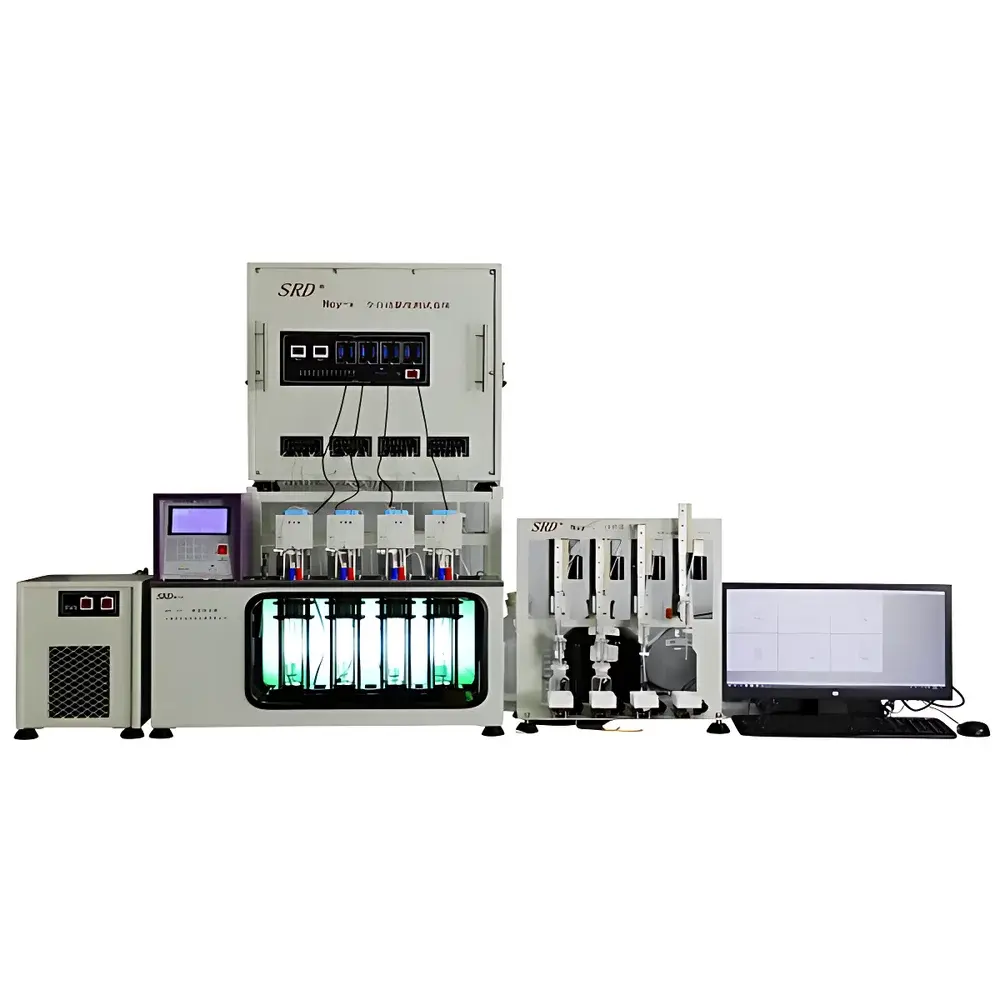
Shanghai SRD NCY-X Automated Capillary Viscometer System
| Brand | SRD |
|---|---|
| Origin | Shanghai, China |
| Manufacturer Type | Authorized Distributor |
| Country of Origin | China |
| Model | SRD NCY-X |
| Instrument Type | Capillary Viscometer |
| Viscosity Range | 0.1–1000 mPa·s |
| Configuration Options | NCY-X/2, NCY-X/4, NCY-X/6 (2/4/6 parallel capillary units) |
| Temperature Stability | ±0.01 °C long-term uniformity (JWC precision thermostatic bath) |
Overview
The Shanghai SRD NCY-X Automated Capillary Viscometer System is an engineered solution for precise, high-throughput intrinsic viscosity, relative viscosity, limiting viscosity number (LVN), and viscosity-average molecular weight determinations of synthetic and natural polymers—including polyethylene terephthalate (PET), polyamide (PA), polycarbonate (PC), cellulose derivatives, and polyacrylonitrile (PAN). Based on the fundamental principle of capillary flow viscometry—governed by the Hagen–Poiseuille equation—the system measures the efflux time of dilute polymer solutions through standardized Ubbelohde or Cannon–Fenske capillaries under gravity-driven laminar flow conditions. Its architecture integrates gravimetric dosing, optical flow detection, real-time video monitoring per capillary unit, and automated statistical validation of efflux times—all synchronized with a proprietary JWC-series precision thermostatic bath. This ensures thermodynamic stability critical for ISO 1628-1, ASTM D4603, ASTM D789, and GB/T 1632 compliance in QC laboratories and polymer R&D centers.
Key Features
- Modular parallel testing architecture: Selectable configurations—NCY-X/2 (2 capillaries), NCY-X/4 (4 capillaries), or NCY-X/6 (6 capillaries)—enable concurrent analysis of multiple samples or concentration series, reducing total assay time by up to 75% versus single-unit systems.
- Optical flow monitoring: High-resolution CCD imaging captures real-time meniscus movement across each capillary; software overlays dynamic flow velocity vectors and flags anomalies (e.g., bubble formation, meniscus instability) before data acceptance.
- Automated outlier rejection: Implements ASTM D445-compliant iterative statistical filtering—discarding efflux times deviating >±0.5% from the median of ≥3 replicate runs per sample—ensuring only metrologically valid data enters final calculations.
- JWC precision thermostatic bath: Engineered for long-term thermal uniformity (±0.01 °C over 24 h, spatial gradient ≤0.02 °C across bath volume); temperature calibration traceable to NIM (National Institute of Metrology, China) standards.
- Gravimetric solvent/solution dispensing: Integrated balance-controlled delivery ensures ±0.1 mg mass accuracy for solution preparation—critical for reliable concentration-dependent viscosity extrapolation (e.g., Huggins, Kraemer plots).
Sample Compatibility & Compliance
The NCY-X system supports standard capillary types (Ubbelohde, Cannon–Fenske, Ostwald) with nominal diameters from 0.5–1.2 mm and is validated for use with common polymer solvents including phenol/1,1,2,2-tetrachloroethane (for PET), sulfuric acid (for cellulose), formic acid (for PA6/66), and chloroform (for PMMA). All hardware and software components comply with ISO/IEC 17025:2017 general requirements for testing laboratories. Data acquisition and processing meet GLP audit-trail requirements: timestamps, operator ID, instrument configuration logs, and raw efflux time arrays are immutably archived in encrypted binary format. Optional 21 CFR Part 11-compliant electronic signature module available upon request.
Software & Data Management
The NCY-X Control Suite (v4.2+) provides full ICH Q5E-aligned reporting for polymer characterization: automatic calculation of intrinsic viscosity [η], reduced viscosity (ηsp/c), inherent viscosity (ln(ηr)/c), and Mark–Houwink–Sakurada-derived Mv using user-defined K and α coefficients. Export formats include CSV (for LIMS integration), PDF analytical reports (with embedded chromatogram-style efflux curves), and XML (for ELN synchronization). Audit trails record all parameter modifications, calibration events, and result approvals—retained for ≥36 months. Software validation documentation (IQ/OQ/PQ protocols) supplied with installation.
Applications
- Quality control of PET chip and fiber-grade resins per ISO 2555 and GB/T 14189
- In-process monitoring of polyamide polymerization kinetics via sequential intrinsic viscosity tracking
- Stability assessment of biopolymer solutions (e.g., hyaluronic acid, chitosan) under accelerated aging conditions
- Regulatory submission support for medical device polymers (ISO 10993-13) and pharmaceutical excipients (USP )
- Academic research on structure–property relationships in branched vs. linear polyolefins
FAQ
What capillary types and sizes are supported?
Ubbelohde (standard and dilution), Cannon–Fenske routine, and Ostwald viscometers with capillary bore diameters from 0.5 mm to 1.2 mm; custom calibrations available for non-standard geometries.
Is temperature calibration traceable to national standards?
Yes—JWC bath sensors are calibrated annually against NIM-certified reference thermometers (certificate included); in-house verification performed daily using PT100 probes with ±0.005 °C uncertainty.
Can the system interface with our existing LIMS?
Yes—CSV and XML export modes support direct ingestion into LabVantage, Thermo Fisher SampleManager, and Waters Empower via configurable field mapping and scheduled FTP/SFTP push.
What maintenance intervals are recommended?
Capillary cleaning after every 20 runs; optical lens inspection monthly; JWC bath fluid replacement every 12 months; full system performance qualification (SPQ) annually per ISO/IEC 17025 Annex A.3.



