
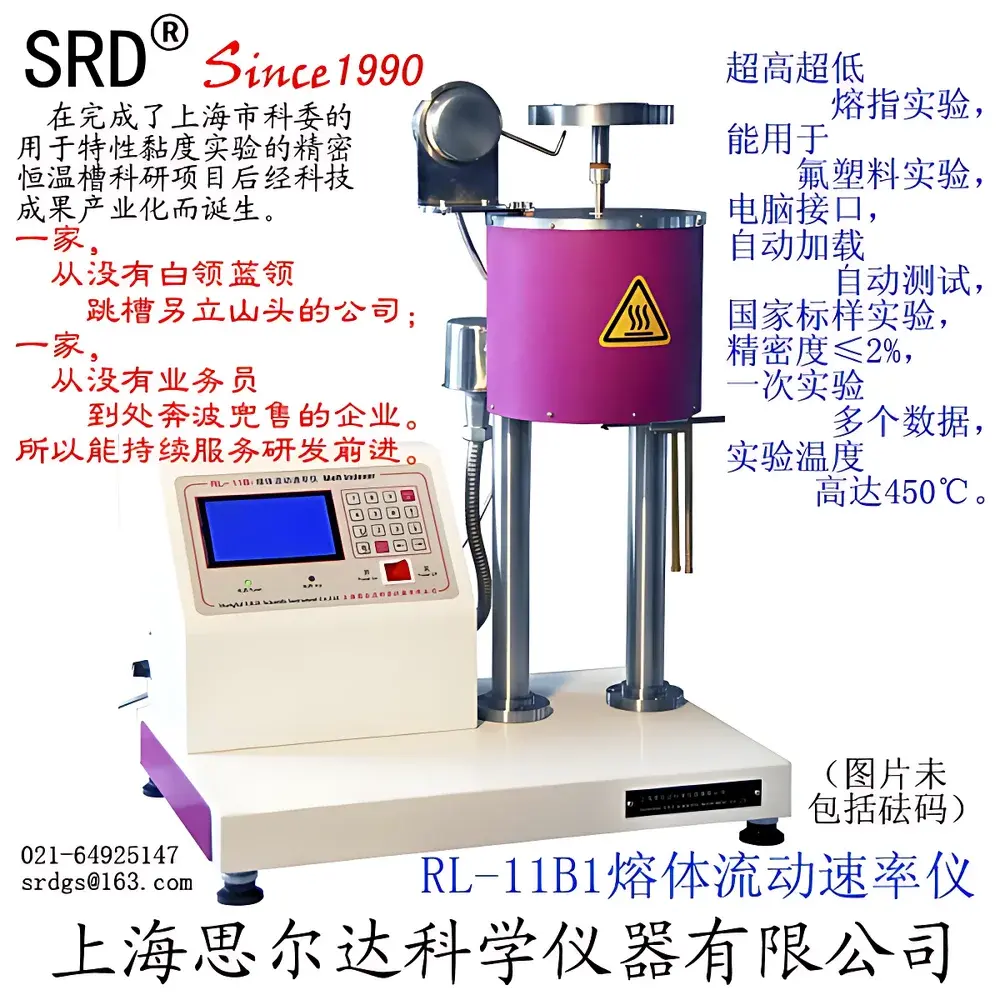
Shanghai SRD RL-11B1 Melt Flow Indexer (MFI) / Melt Mass Flow Rate (MFR) and Melt Volume Flow Rate (MVR) Tester
| Brand | SRD |
|---|---|
| Origin | Shanghai, China |
| Model | RL-11B1 |
| Temperature Control Range | 100–400 °C |
| Temperature Display Accuracy | < 0.2 °C |
| 8-Hour Temperature Stability | < 0.1 °C |
| Temperature Recovery Time | ≤ 4 min |
| Timing Range | 0–999.9 s & 0–9999 s |
| Standard Die Dimensions | Φ2.095 ± 0.005 mm & Φ1.180 ± 0.010 mm |
| Load Options | 325 g, 2160 g, 5000 g (standard configuration) |
| MFR/MVR Measurement Range | 0.01–9999 g/10 min (automated mode) |
| Compliance | GB/T 3682–2000, ISO 1133:1997(E), JIS K7210 |
Overview
The Shanghai SRD RL-11B1 Melt Flow Indexer is a precision-engineered instrument designed for the standardized determination of Melt Mass Flow Rate (MFR) and Melt Volume Flow Rate (MVR) of thermoplastic polymers under controlled temperature and load conditions. Based on the fundamental principle of extrusion rheometry—where molten polymer is forced through a standardized capillary die under defined gravitational or applied loads—the RL-11B1 delivers repeatable, traceable, and metrologically sound flow rate data essential for quality control, material specification verification, and process development in polymer manufacturing. Its operation adheres strictly to internationally recognized test methodologies outlined in ISO 1133, ASTM D1238, GB/T 3682, and JIS K7210, ensuring cross-laboratory comparability and regulatory acceptability in both R&D and production environments.
Key Features
- Microprocessor-based dual-loop temperature control system with real-time PID regulation, achieving ±0.1 °C stability over 8 hours and full thermal recovery within ≤4 minutes after load change.
- High-precision digital timing circuitry supporting dual-range measurement (0–999.9 s and 0–9999 s) with 0.1 s resolution, enabling accurate dwell-time capture for low- and high-flow materials.
- Dual-die configuration included: standard Φ2.095 ± 0.005 mm (for general-purpose testing per ISO 1133 Method A) and Φ1.180 ± 0.010 mm (for high-viscosity or low-MFR materials per Method B).
- Integrated manual cutting mechanism with ergonomic lever actuation—ensures compliance with gravimetric (cut-and-weigh) procedures when automated detection is unsuitable or requires validation.
- Onboard calibration offset adjustment: users may apply real-time temperature correction factors using an external certified reference thermometer, compensating for minor sensor drift without hardware recalibration.
- Robust mechanical architecture with stainless-steel barrel, hardened steel die assembly, and vibration-damped base—designed for long-term dimensional stability and minimal thermal gradient distortion.
Sample Compatibility & Compliance
The RL-11B1 supports routine testing of a broad spectrum of thermoplastic resins including polyethylene (PE), polypropylene (PP), polycarbonate (PC), polyamide (PA6, PA66), polyoxymethylene (POM), acrylonitrile-butadiene-styrene (ABS), poly(methyl methacrylate) (PMMA), cellulose esters, and engineering thermoplastics such as polyphenylene sulfide (PPS) and polyetherimide (PEI). It accommodates both virgin and compounded grades, including filled, reinforced, and flame-retarded formulations—provided they exhibit sufficient thermal stability within the 100–400 °C operating range. All operational parameters—including temperature setpoint accuracy, die geometry tolerances, load application precision, and timing resolution—meet the mandatory requirements of ISO 1133:1997(E), GB/T 3682–2000, and JIS K7210. The instrument is suitable for laboratories operating under GLP frameworks and supports audit-ready documentation when paired with validated SOPs and external calibration records.
Software & Data Management
While the RL-11B1 operates as a standalone benchtop instrument with embedded firmware (no PC dependency required), its measurement logic incorporates built-in arithmetic algorithms compliant with ISO 1133 Annexes A and B for both MFR and MVR calculation. Results are displayed directly on the high-contrast LCD screen, showing intermediate values—including extrudate cut time, mass, volume (if density input is provided), and final flow rate—with automatic unit conversion (g/10 min or cm³/10 min). For laboratories requiring electronic record retention, the device supports manual transcription into LIMS or ELN systems. Optional RS-232 or USB-to-serial interface modules (sold separately) enable ASCII-formatted data export for integration with third-party QA/QC software. All internal calculations adhere to rounding rules specified in ISO/IEC 17025:2017 Clause 7.6.2, and raw timing/mass inputs remain accessible for traceability and uncertainty budgeting.
Applications
This instrument serves critical functions across the polymer value chain: incoming raw material inspection against supplier certificates of analysis; in-process monitoring during extrusion or injection molding; batch-to-batch consistency verification for regulatory submissions (e.g., FDA 510(k) dossiers for medical-grade resins); and formulation screening during R&D of new polymer blends or additives. In quality assurance labs, it supports release testing per ASTM D1238 for PE/PP used in pipe, film, and fiber applications. In academic and contract testing facilities, its dual-die capability and manual/automatic mode flexibility make it suitable for method development studies, interlaboratory round robins, and training on ISO-compliant melt flow methodology. Its documented repeatability—validated using NIST-traceable PE reference materials—ensures confidence in pass/fail decisions aligned with internal specifications or customer contractual limits.
FAQ
Does the RL-11B1 comply with ASTM D1238?
Yes—the instrument’s mechanical design, temperature control performance, die geometry, and load application mechanism fully satisfy the apparatus requirements of ASTM D1238–22, particularly Sections 6.1–6.4 governing extrusion plastometer construction.
Can MVR be calculated without entering melt density?
No—MVR (cm³/10 min) requires user-input of material-specific melt density at test temperature; the instrument does not measure density in situ. However, optional density determination protocols (e.g., using a calibrated pycnometer) can be integrated into lab workflows.
Is the temperature calibration traceable to national standards?
The RL-11B1 itself is not supplied with a certificate of calibration, but its temperature sensor is compatible with external Class A platinum resistance thermometers (PRTs) traceable to NIM (China) or NIST (USA), enabling user-performed verification per ISO/IEC 17025.
What maintenance is required for long-term accuracy?
Routine cleaning of the barrel and die with brass brushes and solvent (e.g., xylene), annual verification of load masses with calibrated weights, and biannual check of thermocouple output against reference PRTs are recommended per manufacturer guidelines.
Does the instrument support GLP-compliant audit trails?
As a standalone device without electronic signature or user-access logging, it does not natively meet 21 CFR Part 11 requirements—but when operated within a documented QA system (with logbooks, calibration records, and SOP-controlled procedures), it supports GLP-aligned data integrity practices.






