
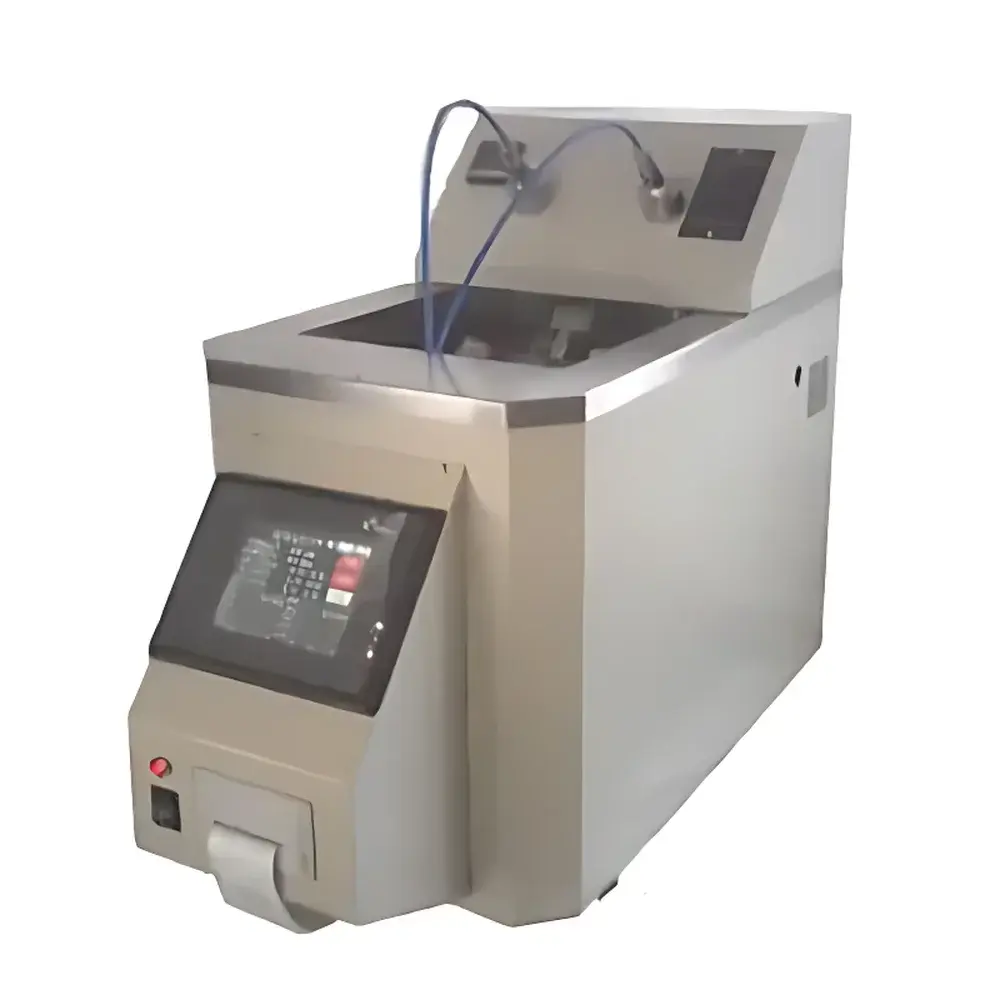
Shanghai Xufeng XF-323 Automated Reid Vapor Pressure (RVP) Tester
| Brand | Shanghai Xufeng |
|---|---|
| Origin | Shanghai, China |
| Model | XF-323 |
| Standards Compliance | GB/T 8017, ASTM D323, ISO 3007, IP 69 |
| Instrument Type | Benchtop, 2- or 4-position miniature bomb configuration |
| Measurement Range | 0–196 kPa (0–2 kgf/cm²) |
| Test Bomb | Full stainless-steel Reid vapor pressure bomb |
| Data Output | Integrated thermal dot-matrix printer |
| Dimensions (W×D×H) | 400 × 600 × 740 mm |
| Weight | 45 kg |
| Power Consumption | 2.0 kW |
| Optional Accessory | Certified mercury manometer (Japan-manufactured, for calibration verification) |
Overview
The Shanghai Xufeng XF-323 Automated Reid Vapor Pressure (RVP) Tester is a benchtop analytical instrument engineered for precise, repeatable determination of the Reid vapor pressure of volatile petroleum products—including gasoline, naphthas, and light distillates—according to internationally recognized standard test methods. It operates on the fundamental principle of the Reid method: measuring the absolute vapor pressure exerted by a liquid sample at 37.8 °C (100 °F) in a sealed, standardized vapor-pressure bomb after thermal equilibration and controlled agitation. Unlike manual RVP systems, the XF-323 integrates a microprocessor-controlled thermal chamber, precision pressure transduction via high-stability piezoresistive sensors, and programmable mechanical vibration to simulate standardized sample agitation—ensuring consistent phase equilibrium between liquid and vapor phases prior to measurement. Its scaled-down bomb geometry maintains strict volumetric proportionality to the ASTM D323 reference bomb (liquid-to-vapor volume ratio of 1:4), enabling faster thermal stabilization and reduced sample volume requirements without compromising metrological traceability.
Key Features
- Automated temperature control system maintaining 37.8 °C ± 0.1 °C throughout the test cycle, compliant with ASTM D323 and GB/T 8017 thermal stability requirements
- Dual- or quad-position configurable test platform supporting parallel analysis of up to four samples per batch—enhancing laboratory throughput while preserving inter-bomb comparability
- Full stainless-steel Reid vapor-pressure bombs fabricated to exact dimensional tolerances specified in ASTM D323 Annex A1 and GB/T 8017 Clause 5.1
- High-resolution digital pressure sensing with real-time acquisition and automatic zero-drift compensation; calibrated traceably to NIST-traceable pressure standards
- Integrated thermal dot-matrix printer providing immediate hard-copy output of test parameters, measured RVP value, test date/time stamp, and operator ID (if configured)
- Intuitive LCD interface with menu-driven navigation and on-screen status indicators for temperature, pressure, agitation phase, and elapsed time
- Robust mechanical architecture designed for continuous operation in QC laboratories adhering to ISO/IEC 17025 environmental and operational specifications
Sample Compatibility & Compliance
The XF-323 is validated for use with Class I and II petroleum liquids as defined in ASTM D4057 and ISO 3170, including motor gasoline, aviation gasoline, reformulated blends, and stabilized natural gasoline. It excludes application to liquefied petroleum gases (LPG), crude oils, or highly viscous residues requiring alternative test protocols (e.g., ASTM D6377 for VPCR). All hardware components—including bomb bodies, valve assemblies, and pressure lines—are constructed from 316 stainless steel to resist corrosion from sulfur-containing fuels and oxygenated additives. The instrument satisfies essential requirements for regulatory compliance under U.S. EPA Method IP-251, California Air Resources Board (CARB) gasoline volatility specifications, and EU Directive 98/70/EC. Routine verification may be performed using the optional Japan-manufactured certified mercury manometer—calibrated to ±0.1 kPa accuracy—for independent pressure reference validation per ISO 17025 clause 6.5.
Software & Data Management
The embedded firmware implements deterministic real-time scheduling for all critical test phases: pre-heating (10 min), thermal equilibration (5–7 min), agitation (2 min), and pressure stabilization (2 min). While the base unit does not include PC connectivity, its internal memory logs up to 500 test records with full metadata—including ambient barometric correction values applied in accordance with ASTM D323 Section 9.2. Data export is supported via RS-232 serial interface (optional USB-to-serial adapter) for integration into LIMS environments. Audit trail functionality meets GLP and GMP documentation expectations, recording operator-initiated actions, system error codes, and timestamped parameter changes. Firmware updates are delivered via secure SD card load—ensuring version control and traceability during FDA 21 CFR Part 11-compliant deployments when paired with appropriate electronic signature modules.
Applications
- Quality control of finished gasoline batches prior to refinery dispatch or terminal blending
- Monitoring seasonal volatility adjustments (summer/winter blends) in accordance with EPA Tier 3 and E10/E15 regulatory limits
- Research and development of low-RVP reformulated fuels targeting evaporative emission reduction
- Contract testing laboratories performing third-party certification per API RP 2540 or ISO/IEC 17025-accredited scopes
- Educational laboratories demonstrating fundamental vapor-liquid equilibrium principles in petroleum engineering curricula
FAQ
What standards does the XF-323 comply with?
ASTM D323, GB/T 8017, ISO 3007, and IP 69—all implemented with strict adherence to apparatus geometry, temperature control, and procedural timing requirements.
Is barometric correction applied automatically?
Yes—the instrument accepts manual input of local atmospheric pressure prior to test initiation and applies correction per ASTM D323 Section 9.2 to report absolute RVP values.
Can the XF-323 be used for ethanol-blended fuels?
Yes, provided the sample is properly stabilized and free of suspended water; ethanol content up to 15% v/v (E15) is within validated operating range.
Does the system support remote monitoring or network integration?
Not natively—but RS-232 output enables connection to SCADA or LIMS platforms via industry-standard Modbus RTU or ASCII protocol translation.
What maintenance intervals are recommended?
Pressure sensor calibration verification every 6 months; bomb O-rings replaced per 200 test cycles or annually; thermal chamber cleaning quarterly per ISO 17025 preventive maintenance schedules.







