
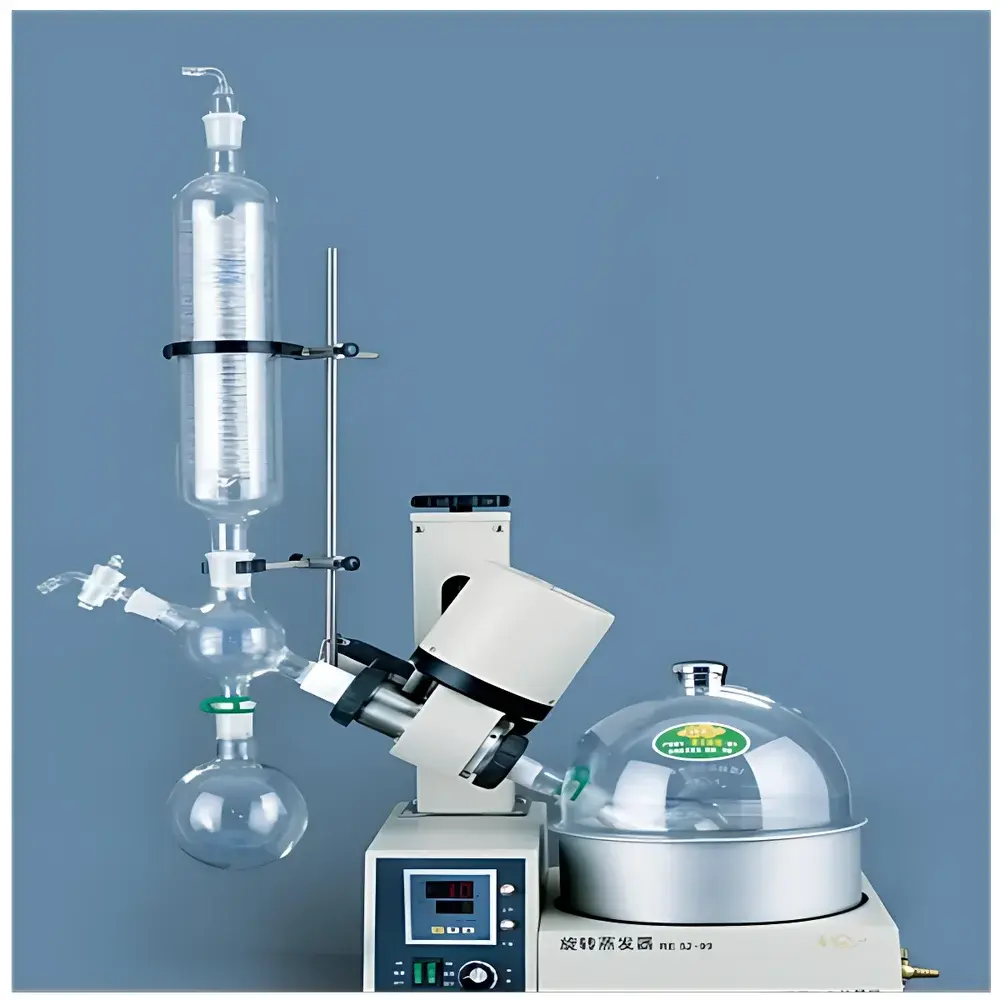
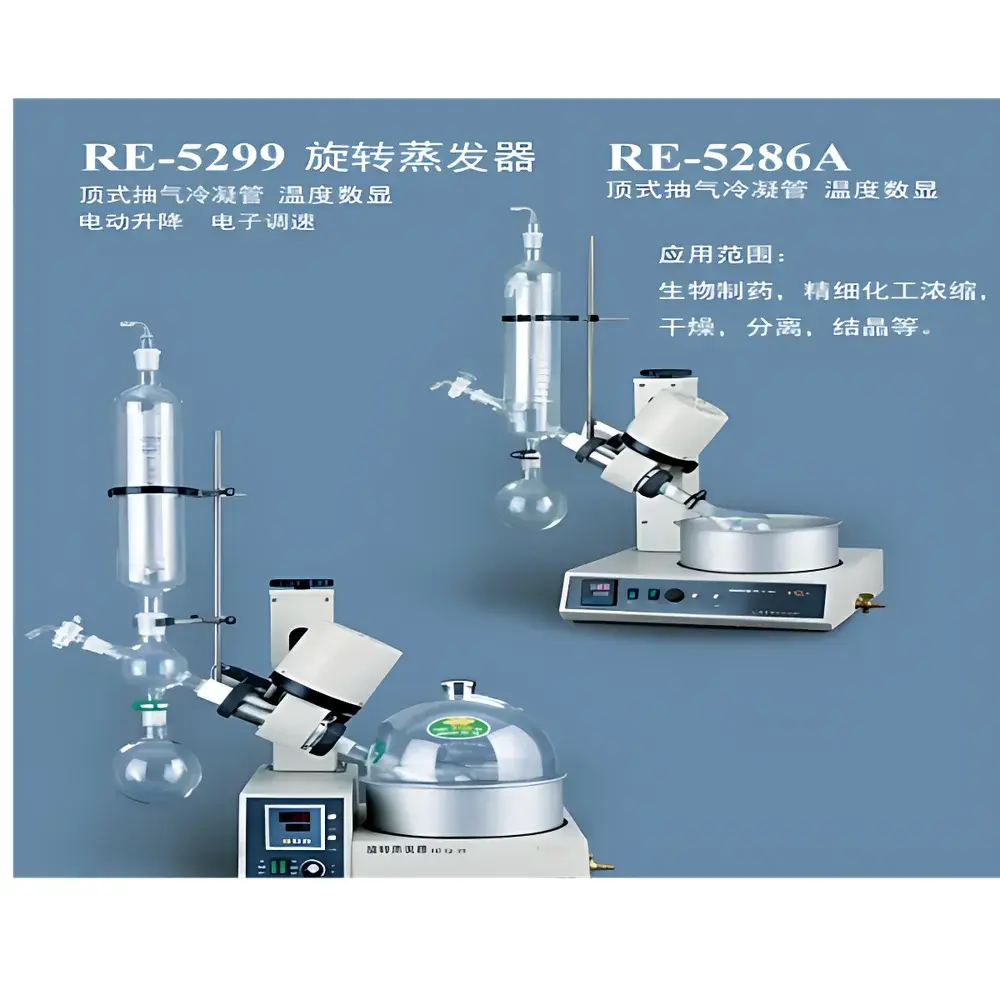
Shanghai Yarong RE-5299 Rotary Evaporator
| Brand | Shanghai Yarong / Yarong |
|---|---|
| Origin | Shanghai, China |
| Manufacturer Type | Authorized Distributor |
| Product Origin | Domestic (China) |
| Model | RE-5299 |
| Pricing | Available Upon Request |
Overview
The Shanghai Yarong RE-5299 Rotary Evaporator is an engineered benchtop system designed for efficient solvent removal, sample concentration, and gentle compound recovery under reduced pressure. It operates on the fundamental principle of rotary evaporation: a rotating evaporation flask increases the liquid’s surface area while simultaneous heating (via a thermostatically controlled water bath) and vacuum application lower the boiling point—enabling rapid, low-temperature evaporation with minimal thermal degradation. This configuration makes the RE-5299 particularly suitable for heat-sensitive organic compounds, pharmaceutical intermediates, natural product extracts, and synthetic reaction mixtures commonly handled in academic research laboratories, quality control environments, and pilot-scale R&D settings.
Key Features
- Digitally controlled variable-speed drive: 0–130 rpm electronic stepless speed regulation ensures precise rotational stability across diverse viscosities and flask sizes (up to 5 L).
- Integrated temperature-controlled heating bath: Stainless steel bath with PTFE-coated interior and embedded Pt100 sensor delivers accurate temperature regulation from ambient to 99 °C ±1 °C, with LED digital display for real-time monitoring.
- Enhanced condensation efficiency: Large-bore vertical condenser tube with high-surface-area design and optimized coolant flow path maximizes condensate recovery; compatible with standard laboratory cooling circulators or tap-water cooling (with optional chiller interface).
- Safety-integrated heating mantle: 1000 W power output housed in a corrosion-resistant stainless-steel/PTFE composite bath, fully enclosed by a transparent polycarbonate safety shield—providing splash protection, thermal insulation, explosion mitigation, and contamination prevention during operation.
- Ergonomic vertical lift mechanism: Motor-assisted automatic升降 (rise/fall) enables safe, repeatable positioning of the evaporation flask relative to the bath and condenser without manual adjustment.
- Chemically resistant fluid handling: PTFE-tipped feed valve and fluoropolymer-reinforced tubing ensure compatibility with common organic solvents including acetone, ethanol, ethyl acetate, dichloromethane, and hexane.
Sample Compatibility & Compliance
The RE-5299 supports standard ground-glass jointed glassware (ISO 29771/KG 29/32, KG 35/40), including 1 L, 2 L, and 5 L round-bottom flasks. Its vacuum-tight construction (rated to ≤10 mbar with appropriate vacuum pump) meets general laboratory requirements for reproducible distillation under reduced pressure. While not certified to specific ISO or ASTM standards as a standalone unit, its operational parameters align with common practices outlined in USP , ASTM E2654 (Standard Guide for Laboratory Evaporation Techniques), and GLP-compliant workflows where instrument qualification (IQ/OQ) is performed per internal SOPs. The transparent safety shield facilitates visual process monitoring without compromising operator safety—consistent with IEC 61010-1:2010 requirements for laboratory electrical equipment.
Software & Data Management
The RE-5299 is a manually operated, analog-digital hybrid instrument with no embedded microprocessor or network connectivity. Temperature setpoint and rotation speed are adjusted via front-panel potentiometers with digital readouts; no data logging, USB export, or remote control capability is included. Users requiring audit-trail functionality (e.g., FDA 21 CFR Part 11 compliance) must integrate external recording devices—such as calibrated temperature data loggers or programmable vacuum controllers—with documented calibration and validation protocols. For routine QC applications, manual entry into ELN systems (e.g., LabArchives, Benchling) is supported via standardized operating procedures.
Applications
- Concentration of dilute organic extracts in natural product isolation (e.g., plant alkaloids, essential oils, polyphenols).
- Removal of volatile solvents post-SPE, column chromatography, or solid-phase synthesis.
- Recovery and recycling of high-purity solvents in synthetic chemistry workflows.
- Pre-concentration of aqueous samples prior to HPLC or GC analysis.
- Drying of thermolabile APIs and excipients under mild conditions (≤40 °C bath + vacuum).
- Teaching laboratory demonstrations of phase equilibria, vapor pressure depression, and mass transfer principles.
FAQ
What is the maximum recommended vacuum level for optimal performance?
The system achieves stable operation at pressures down to 10 mbar when paired with a two-stage diaphragm vacuum pump (e.g., KNF N840.3T) and cold trap.
Is the heating bath compatible with silicone oil or other high-boiling-point media?
No—the bath is designed exclusively for water-based heating; use of oils may damage the PTFE coating and compromise temperature sensor accuracy.
Can the RE-5299 be used for fractional distillation?
It is not configured for true fractional separation; however, sequential evaporation at incrementally increasing bath temperatures can achieve partial fractionation of solvent mixtures with sufficiently divergent boiling points.
What maintenance is required for long-term reliability?
Regular inspection of PTFE seals, periodic cleaning of the condenser interior with isopropanol, and annual verification of temperature sensor calibration against a traceable reference thermometer are recommended.
Does the unit include vacuum gauge and pressure control?
No—vacuum measurement and regulation require external instrumentation; a digital vacuum gauge and proportional vacuum controller must be added for closed-loop pressure management.



