
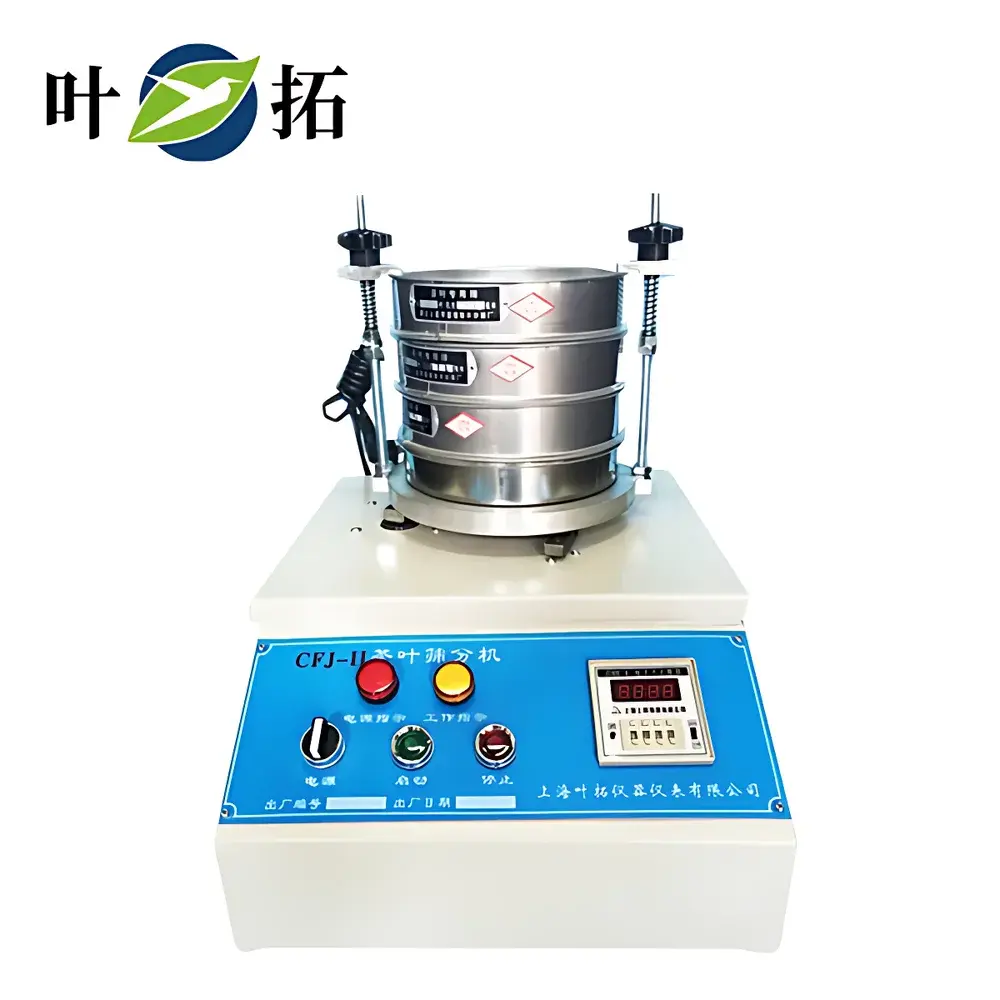
Shanghai Yetuo CFJ-II Tea Sieve Analyzer
| Brand | Yetuo |
|---|---|
| Origin | Shanghai, China |
| Manufacturer Type | Direct Manufacturer |
| Product Category | Domestic |
| Model | CFJ-II |
| Principle | Vibration-based Sieving |
| Sieve Rotation Speed | 200 ± 5 rpm |
| Oscillation Amplitude | 60 mm |
| Counting Accuracy | ±0.5 revolutions (N = preset count) |
| Power Supply | 220 ± 10% V, 50 Hz |
| Power Consumption | 60 W |
| Dimensions (L×W×H) | 446 × 361 × 360 mm |
| Net Weight | 25 kg |
Overview
The Shanghai Yetuo CFJ-II Tea Sieve Analyzer is a dedicated mechanical vibration sieve instrument engineered for standardized particle-size distribution analysis of processed tea leaves. It operates on the principle of controlled horizontal circular oscillation—generating consistent kinetic energy to separate tea particles across calibrated mesh screens according to ISO 565 and GB/T 8311–2002 specifications. Unlike general-purpose laboratory shakers, the CFJ-II integrates a precision-machined rotary drive mechanism with fixed-amplitude eccentric motion (60 mm), ensuring reproducible stratification of whole leaf, broken leaf, fannings, and dust fractions. Its design targets routine QC/QA workflows in tea processing facilities, national inspection laboratories, and certification bodies conducting mandatory QS (now SC) food safety compliance testing under China’s GB 14881 and GB/T 8311–2002 requirements. The instrument delivers traceable, operator-independent results by eliminating manual sieving variability—critical for batch release decisions and regulatory audit readiness.
Key Features
- Sturdy cast-iron base and reinforced stainless-steel housing ensure long-term mechanical stability during continuous operation.
- Precise electromechanical rotation control maintains 200 ± 5 rpm across load variations—optimized for standard 200 mm diameter test sieves per GB/T 8311–2002.
- Fixed 60 mm horizontal oscillation amplitude guarantees uniform particle agitation without over-grinding or screen blinding.
- Digital preset counter with ±0.5 revolution accuracy enables strict adherence to prescribed sieve durations (e.g., 120 s per GB/T 8311–2002).
- Low-noise, brushless AC motor (60 W, 220 V ±10%, 50 Hz) supports uninterrupted daily use in regulated lab environments.
- Compact footprint (446 × 361 × 360 mm) and 25 kg net weight facilitate placement on standard lab benches without anchoring.
Sample Compatibility & Compliance
The CFJ-II accommodates standard 200 mm diameter nested sieve sets—including brass or stainless-steel meshes ranging from 1.0 mm (for broken leaf retention) down to 0.18 mm (for dust quantification). It is validated for dry, free-flowing Camellia sinensis derivatives: green tea, black tea, oolong, white tea, and reprocessed blends. All operational parameters align with GB/T 8311–2002 “Determination of Powder and Broken Content in Tea” and support traceability to ISO/IEC 17025–2017 laboratory accreditation requirements. While not certified to ASTM E11 or ISO 3310–1 as a universal sieve shaker, its performance envelope meets the narrower scope defined for tea-specific particulate analysis in national food safety standards.
Software & Data Management
The CFJ-II operates as a standalone electromechanical instrument with no embedded microprocessor or digital interface. Data recording follows paper-based GLP-compliant protocols: users log sieve sequence, duration, mass retained per fraction, and environmental conditions manually in bound laboratory notebooks. For labs requiring electronic records, integration with LIMS or ELN systems is achieved via external weighing scales (e.g., METTLER TOLEDO XSR series) connected via RS232 or USB; the CFJ-II itself provides no data export capability. This architecture reflects its role as a purpose-built physical tester—not a smart instrument—ensuring minimal validation burden under FDA 21 CFR Part 11 or EU Annex 11 when used within documented SOPs.
Applications
- Quantifying powder content (% w/w ≤ 0.18 mm) and broken tea content (% w/w between 0.18–1.0 mm) per GB/T 8311–2002.
- Batch-to-batch consistency monitoring during tea grading, blending, and packaging operations.
- Supporting SC (formerly QS) food production license audits in Chinese tea manufacturing facilities.
- Reference method validation against automated laser diffraction or image-based particle analyzers.
- Training tool for sensory analysts to correlate physical granulometry with infusion strength and liquor clarity.
FAQ
Does the CFJ-II comply with international standards such as ASTM or ISO?
It conforms specifically to GB/T 8311–2002—the Chinese national standard for tea particle analysis—and is aligned with ISO 565 (test sieves) dimensional tolerances. It is not certified to ASTM E11 or ISO 3310–1 for general-purpose sieving applications.
Can it be used for non-tea materials like spices or herbal powders?
While mechanically capable of sieving other dry botanicals, its calibration, validation, and regulatory acceptance are limited to Camellia sinensis products under GB/T 8311–2002. Use for other matrices requires full method validation per ICH Q2(R2).
Is maintenance required beyond routine cleaning?
Yes—biannual inspection of the eccentric drive coupling, lubrication of the bearing assembly, and verification of rotational speed using a handheld tachometer are recommended to sustain ±5 rpm accuracy over time.
What sieve sizes are supplied with the instrument?
The CFJ-II ships without sieves; users must procure GB/T 8311–2002–compliant 200 mm diameter nested sets (typically 1.0 mm, 0.5 mm, and 0.18 mm apertures) separately from accredited sieve suppliers.
How does it differ from ultrasonic or air-jet sieve analyzers?
Unlike high-energy dispersion methods, the CFJ-II relies solely on mechanical oscillation—preserving particle morphology and avoiding electrostatic aggregation artifacts common in fine tea dust analysis.



