
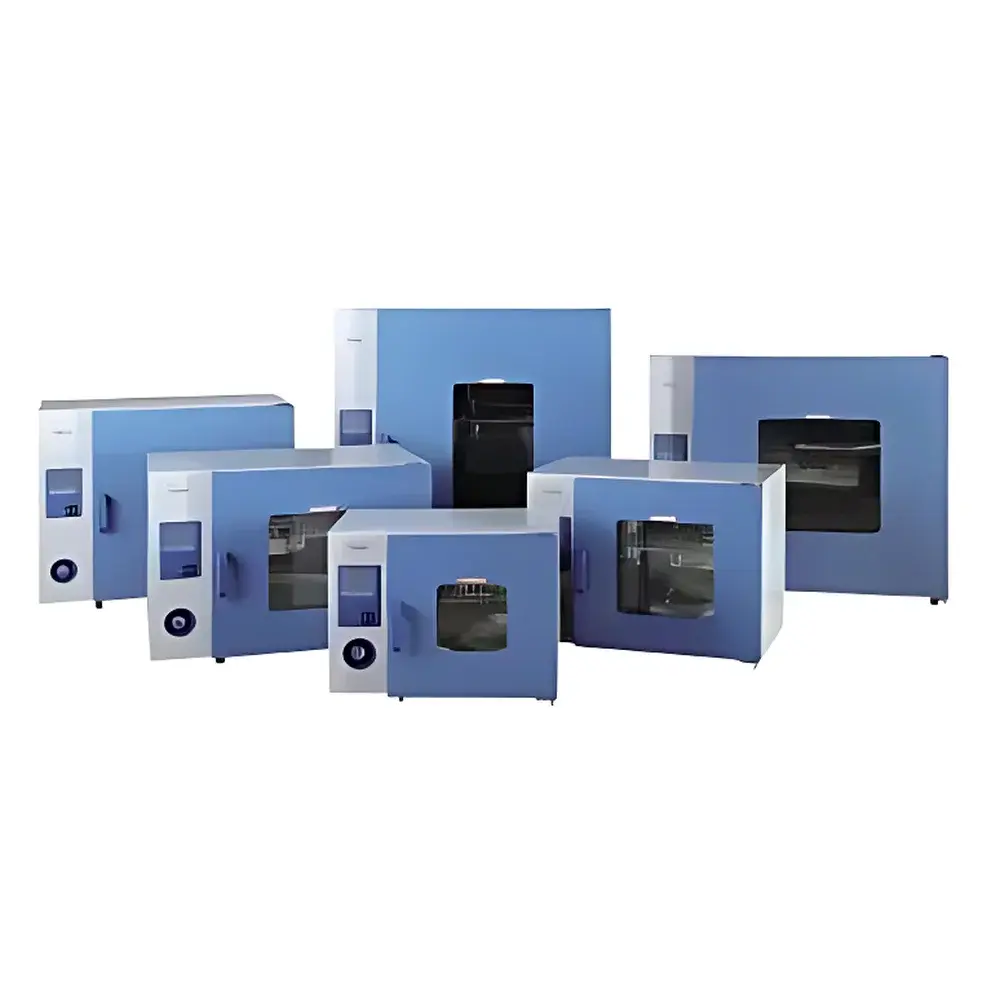
Shanghai Yiheng DHG-9003 Precision Forced-Air Drying Oven
| Brand | Shanghai Yiheng |
|---|---|
| Origin | Shanghai, China |
| Model | DHG-9003 (Drying Oven Series) |
| Temperature Range | RT+10°C to 200°C / RT+10°C to 250°C (customizable) |
| Temperature Uniformity | ±3% at 100°C |
| Temperature Fluctuation | ±1°C |
| Temperature Resolution | 0.1°C |
| Heating Method | Forced-air convection |
| Power Supply | AC 220 V, 50 Hz |
| Timer Range | 0–9999 min |
| Interior Dimensions (W×D×H) | 250 × 260 × 250 mm |
| Exterior Dimensions (W×D×H) | 530 × 370 × 420 mm |
| Shelving | 2 stainless steel shelves |
| Construction | Mirror-finish 304 stainless steel interior |
| Sealing | High-temperature silicone gasket |
| Optional | RS485 interface, thermal printer output, independent over-temperature cutoff |
Overview
The Shanghai Yiheng DHG-9003 Precision Forced-Air Drying Oven is an engineered solution for controlled thermal processing in laboratory and industrial quality assurance environments. Designed around a robust forced-convection architecture, it maintains stable, uniform temperature distribution across the working chamber via a high-temperature-rated centrifugal blower and optimized airflow ducting. Its operational principle relies on continuous recirculation of heated air—ensuring rapid thermal equilibration and minimizing axial and radial gradients. This design meets the functional requirements of ASTM E145–22 (Standard Specification for Gravity-Convection and Forced-Ventilation Ovens) and supports GLP-compliant drying, baking, sterilization, and moisture loss determination protocols. The oven operates within a standard range of ambient +10°C to 200°C, with optional calibration and validation support extending capability to 250°C for specialized applications such as polymer pre-drying or solvent residue removal.
Key Features
- Mirror-polished 304 stainless steel interior chamber—resistant to corrosion, easy to clean, and compliant with ISO 14644-1 Class 8 cleanroom-compatible surface finish standards.
- Microprocessor-based P.I.D. temperature controller with 0.1°C resolution, real-time digital display, and programmable timer (0–9999 minutes) for unattended operation.
- Independent dual-limit safety system: primary control loop plus hardware-based over-temperature cut-off that interrupts power when user-defined threshold is exceeded—meeting IEC 61010-1 Category II safety requirements.
- Adjustable air inlet and exhaust dampers on the front panel allow fine-tuning of chamber atmosphere exchange rate—critical for volatile organic compound (VOC) management or low-oxygen drying.
- High-integrity silicone door gasket rated for continuous operation up to 250°C; replaceable without tools and certified per UL 94 V-0 flammability classification.
- Modular electrical architecture supports optional RS485 Modbus RTU communication for integration into centralized lab monitoring systems (e.g., LabVantage, Thermo Fisher SampleManager), and thermal printer output for audit-ready hardcopy logs.
Sample Compatibility & Compliance
The DHG-9003 accommodates standard-sized petri dishes, weighing boats, crucibles, glassware, and polymer samples up to 250 mm in height. Its chamber geometry and airflow profile ensure compatibility with USP <<1211> dry-heat sterilization cycles (160°C for 120 min) and ASTM D563–21 moisture content testing for pharmaceutical excipients. All materials contacting the sample environment conform to FDA 21 CFR Part 177.2490 (food-contact compliant silicone) and EU Regulation (EC) No 1935/2004. Device firmware supports configurable audit trails and electronic signature capability when paired with validated third-party data acquisition software—enabling compliance with 21 CFR Part 11 for regulated QC laboratories.
Software & Data Management
While the DHG-9003 operates as a standalone instrument, its optional RS485 port enables bidirectional communication using standard Modbus RTU protocol. Integration with SCADA or LIMS platforms permits remote setpoint adjustment, real-time temperature logging, alarm event capture, and automated report generation. When used with certified thermal printers, the unit produces timestamped, traceable records—including date/time, setpoint, actual chamber temperature, and elapsed timer value—satisfying ALCOA+ data integrity principles (Attributable, Legible, Contemporaneous, Original, Accurate, Complete, Consistent, Enduring, Available). Firmware updates are delivered via secure USB loader with SHA-256 checksum verification.
Applications
- Moisture content determination per AOAC 950.46 and ISO 5530-1 in food, feed, and agricultural commodities.
- Drying of filter papers, gravimetric precipitates, and ceramic green bodies prior to sintering.
- Baking of printed circuit board (PCB) solder masks and conformal coatings under IPC-CC-830B environmental profiles.
- Pre-conditioning of hygroscopic reference standards (e.g., potassium hydrogen phthalate) before titrimetric analysis.
- Low-temperature sterilization of reusable glassware and metal instruments where autoclaving is unsuitable.
- Accelerated aging studies per ICH Q1A(R2) guidelines for pharmaceutical packaging stability assessment.
FAQ
What is the maximum validated operating temperature for the DHG-9003?
The standard configuration is validated to 200°C; units configured for 250°C operation undergo extended burn-in and individual chamber mapping per ISO/IEC 17025-accredited procedures.
Does the oven support GMP-compliant data archiving?
Yes—when equipped with RS485 and paired with 21 CFR Part 11–compliant data acquisition software, full electronic record retention—including operator ID, modification history, and system audit logs—is achievable.
Can the DHG-9003 be used for dry-heat depyrogenation?
It meets minimum dwell-time and temperature criteria for depyrogenation (e.g., 250°C for ≥45 min) only in configurations explicitly validated for that purpose and installed with calibrated Class A sensors per EN 61010-1 Annex BB.
Is the interior chamber volume suitable for ISO 17025 proficiency testing?
With two adjustable 304 stainless steel shelves and ±3% temperature uniformity at 100°C, it satisfies ISO/IEC 17025 clause 6.4.3 requirements for equipment suitability when used with NIST-traceable reference thermometers.
How often does the temperature sensor require recalibration?
Annual calibration against a certified reference thermometer (e.g., Fluke 1523 with 0.02°C uncertainty) is recommended; internal P.I.D. tuning parameters remain stable for ≥24 months under normal usage conditions.



