
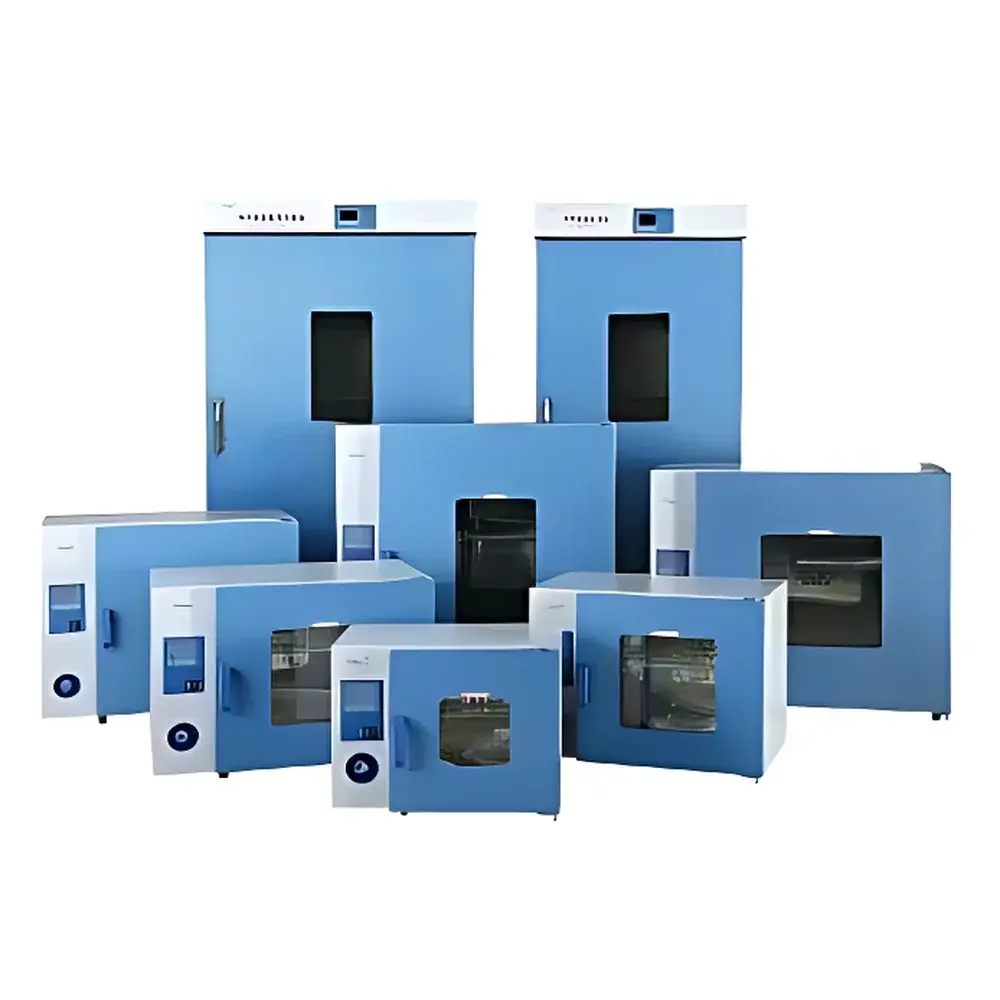
Shanghai Yiheng DHG-9005 Precision Forced-Air Drying Oven
| Brand | Shanghai Yiheng |
|---|---|
| Origin | Chongqing, China |
| Manufacturer Type | Authorized Distributor |
| Product Category | Domestic |
| Model | DHG-9005 (Drying Oven Series) |
| Instrument Type | Precision Drying Oven |
| Temperature Range | RT+10°C to 300°C |
| Temperature Uniformity | ±3% at 100°C |
| Temperature Fluctuation | ±1.0°C |
| Interior Material | Mirror-Finish Stainless Steel (A-Series) |
| Heating Method | Forced-Air Convection |
Overview
The Shanghai Yiheng DHG-9005 is a precision forced-air drying oven engineered for consistent thermal processing in laboratory and industrial quality control environments. Based on convection heat transfer principles, it maintains stable, uniform temperature distribution across the working chamber via a high-reliability axial fan and optimized airflow duct design—ensuring minimal thermal gradients during extended operation. Designed for applications including moisture content determination, pre-weighing sample conditioning, polymer curing, pharmaceutical excipient drying, and microbiological media preparation, the DHG-9005 complies with fundamental thermal stability requirements outlined in ISO 17025-accredited laboratories and aligns with general Good Laboratory Practice (GLP) operational expectations. Its robust architecture supports continuous operation under controlled ambient conditions (5–40°C, ≤80% RH), making it suitable for routine use in QC labs, R&D facilities, and production support settings.
Key Features
- Mirror-finish stainless steel interior (304 grade) fabricated by argon arc welding—resistant to corrosion, easy to clean, and compliant with hygiene-sensitive protocols.
- Digital microprocessor-based P.I.D. temperature controller with 0.1°C resolution, real-time display, and programmable timer (0–9999 minutes).
- Independent over-temperature protection circuit—automatically cuts power if setpoint exceeds user-defined safety limit, preventing thermal runaway.
- Adjustable air inlet and exhaust dampers enable fine-tuning of internal atmosphere exchange rate, supporting volatile solvent removal or low-oxygen drying scenarios.
- High-efficiency silicone rubber door gasket rated for continuous service up to 300°C, minimizing heat loss and extending seal life.
- Forced-air convection system featuring a high-temperature-rated centrifugal blower ensures rapid thermal recovery and ±3% temperature uniformity (measured per ISO 17025 Annex A at 100°C).
Sample Compatibility & Compliance
The DHG-9005 accommodates standard laboratory glassware (e.g., weighing dishes, Petri dishes, crucibles) and metal trays up to 250 × 260 × 250 mm (W×D×H). Its chamber volume (16 L) supports ASTM D2240-compliant polymer hardness sample conditioning, USP dry-heat sterilization validation studies (when operated at ≥160°C for ≥2 hours), and ISO 5725-based repeatability testing of moisture analyzers. While not certified to IEC 61010-1 or UL 61010B as a standalone medical device, its construction meets baseline electrical safety and thermal enclosure standards expected of Class II laboratory ovens. Documentation packages—including factory calibration certificates (traceable to NIM, China) and material compliance declarations—are available upon request for internal audit or regulatory review.
Software & Data Management
The DHG-9005 operates as a standalone instrument but supports optional RS485 serial interface (Modbus RTU protocol) for integration into centralized lab monitoring systems. When paired with third-party data acquisition software (e.g., LabVIEW, WinCC, or custom SCADA), users can log time-stamped temperature readings, generate trend reports, and export CSV files for statistical process control (SPC) analysis. Optional thermal printer connectivity enables hard-copy record generation for GLP/GMP traceability—particularly valuable in regulated environments requiring audit-ready documentation per FDA 21 CFR Part 11 (when used with validated electronic signature workflows). Firmware updates are performed locally via USB port; no cloud dependency or proprietary software installation is required.
Applications
- Moisture loss-on-drying (LOD) assays per USP , Ph. Eur. 2.2.32, and AOAC 950.46.
- Pre-conditioning of reference standards and calibration weights prior to gravimetric analysis.
- Thermal stabilization of ceramic substrates, catalyst carriers, and filter membranes before surface characterization (e.g., BET, SEM).
- Drying of botanical extracts, herbal powders, and food-grade ingredients under controlled airflow to minimize oxidation.
- Baking of printed circuit board (PCB) solder masks and conformal coatings prior to electrical testing.
- Heat treatment of metallographic specimens prior to etching and microstructure evaluation.
FAQ
What is the maximum operating temperature and how is thermal stability verified?
The DHG-9005 is rated for continuous operation from ambient +10°C to 300°C. Temperature stability is confirmed through internal calibration using a Class A PT100 sensor and validated against a NIST-traceable reference thermometer during factory acceptance testing.
Does the oven support validation protocols such as IQ/OQ/PQ?
Yes—the unit provides stable thermal performance suitable for Installation Qualification (IQ) and Operational Qualification (OQ) activities. Users must perform Performance Qualification (PQ) with their specific load configuration and test method per ISO/IEC 17025 Clause 5.10.
Can the DHG-9005 be used for sterilization?
It meets dry-heat sterilization parameters (e.g., 160°C for 120 min) defined in USP , but validation must be conducted per facility SOPs using biological indicators (e.g., Geobacillus stearothermophilus spores).
Is the stainless steel interior electropolished or passivated?
The interior uses mirror-finish 304 stainless steel formed by precision CNC machining and argon arc welding; electropolishing is not standard but can be specified as a custom order.
What maintenance intervals are recommended?
Fan lubrication is not required (sealed bearings); gasket inspection is advised every 6 months in high-use labs, and temperature sensor verification should occur annually or after 500 operating hours.
Related Products



