
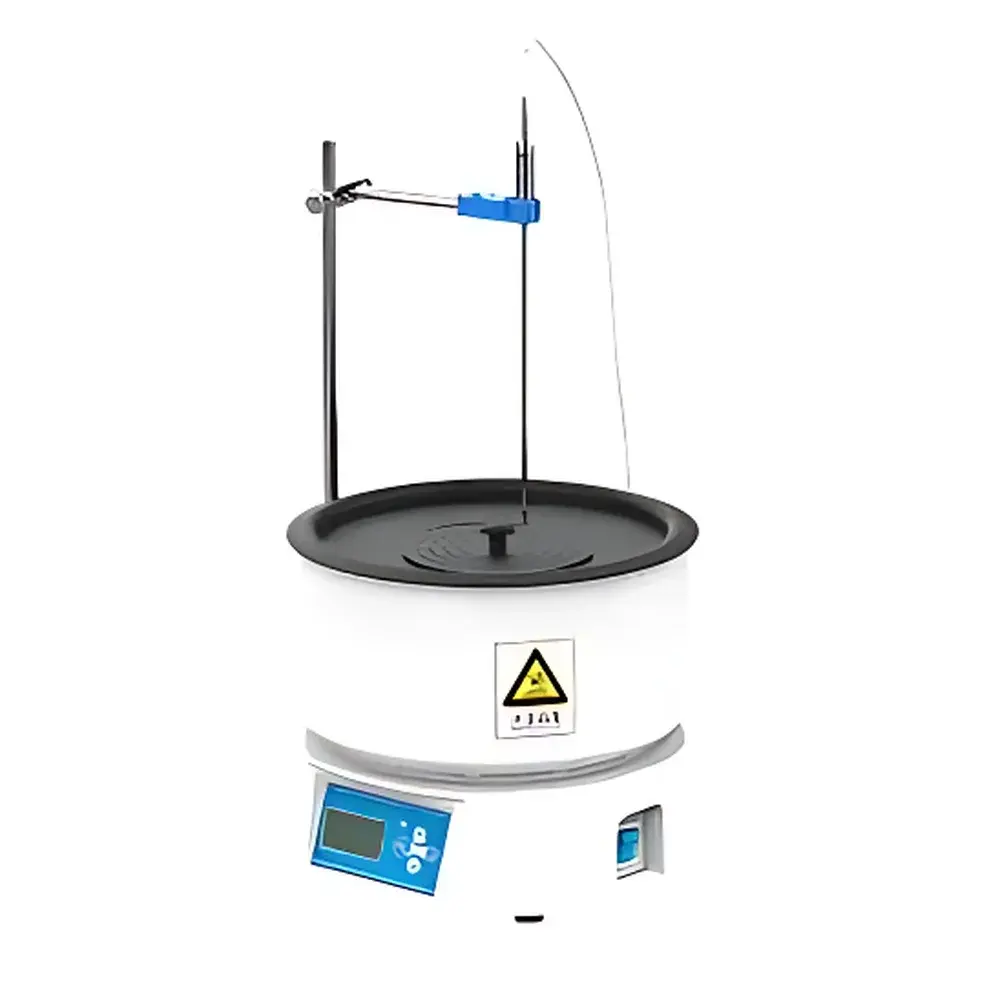
Shanghai Yiheng DU-3GW / DU-3GO Integrated Constant-Temperature Magnetic Stirring Water & Oil Bath Circulator (Heating Bath Series)
| Brand | Shanghai Yiheng |
|---|---|
| Origin | Shanghai, China |
| Manufacturer Type | Authorized Distributor |
| Product Category | Domestic |
| Models | DU-3GW / DU-3GO |
| Instrument Type | Water Bath / Oil Bath |
| Circulation Function | Non-circulating |
| Temperature Control Mode | Heating-Only |
| Bath Volume | 5.5 L |
| Temperature Range | RT+5–99°C (DU-3GW) / RT+5–200°C (DU-3GO) |
| Temperature Stability | ±0.5°C |
| Temperature Fluctuation | ±0.5°C |
| Stirring Speed Range | 0–1800 rpm |
| Internal Bath Dimensions (Ø × H) | Ø230 × 130 mm |
| Heating Power | 1000 W |
| Max Flask Capacity | 3000 mL |
| Power Supply | 220 V, 50 Hz |
| Display | LCD with Rotary Knob Interface |
| Dual-Sensor System | Bath Fluid Temp / External Vessel Temp |
| Safety Features | Independent Over-Temperature Alarm, Flame-Retardant Housing, Fume Hood Compatible Design |
| Motor Type | High-Durability DC Brushless Motor |
| Heating Element Material | ASTM A240 Type 304 Stainless Steel |
| Magnet Type | High-Temperature Rare-Earth Permanent Magnet (Rated >200°C Continuous Duty) |
Overview
The Shanghai Yiheng DU-3GW and DU-3GO are integrated constant-temperature magnetic stirring baths engineered for precision thermal control and homogeneous mixing in routine laboratory workflows. Unlike recirculating chillers or external bath circulators, these units operate as self-contained, non-circulating heating baths—ideal for applications requiring stable thermal environments without fluid transfer lines or external pumps. The core principle relies on direct resistive heating of the bath medium (water or heat-transfer oil) via a fully immersed 304 stainless steel heating element, combined with synchronous magnetic coupling between an internal stirrer motor and a PTFE-coated stir bar placed in the sample vessel or directly within the bath fluid. This dual-function architecture enables simultaneous temperature maintenance and mechanical agitation—critical for reaction kinetics studies, dissolution testing, enzyme assays, and sample equilibration where thermal uniformity and convective homogeneity must be maintained over extended durations.
Key Features
- Integrated magnetic stirring system with adjustable speed (0–1800 rpm), driven by a maintenance-free DC brushless motor ensuring long-term operational stability and low electromagnetic interference.
- Dual-mode operation: compatible with both aqueous (DU-3GW: RT+5–99°C) and high-temperature oil-based media (DU-3GO: RT+5–200°C), validated for continuous duty at maximum setpoints using high-curie-point rare-earth magnets.
- PID-based digital temperature control with ±0.5°C stability across the full operating range; calibrated against traceable NIST-traceable reference sensors.
- LCD display with intuitive rotary encoder interface supports real-time switching between bath fluid temperature and optional external probe input—enabling concurrent monitoring of reaction vessel interior when used with an auxiliary Pt100 sensor.
- Robust construction: 304 stainless steel inner bath (Ø230 × 130 mm, 5.5 L capacity), flame-retardant outer housing, and IP20-rated electrical enclosure suitable for fume hood installation.
- Dedicated safety architecture including independent mechanical over-temperature cutoff (non-resettable at >220°C), ground-fault detection, and thermal fuse redundancy per IEC 61010-1:2010 requirements.
Sample Compatibility & Compliance
The DU-3GW/DU-3GO accommodates standard laboratory glassware up to 3000 mL (e.g., round-bottom flasks, beakers, and jacketed reactors) with unobstructed access to the bath surface. Its open-bath geometry permits direct immersion of temperature probes, pH electrodes, or reflux condensers. All wetted components comply with USP Class VI biocompatibility standards for indirect contact with pharmaceutical intermediates. The unit meets CE marking requirements under the Low Voltage Directive (2014/35/EU) and EMC Directive (2014/30/EU). While not certified for GMP manufacturing environments, its dual-sensor logging capability, repeatable PID performance, and audit-ready alarm events support GLP-compliant documentation in R&D and QC laboratories. It is routinely deployed in accordance with ASTM E2777-21 (Standard Practice for Thermal Stability Testing of Liquids) and ISO 17025-accredited calibration protocols when paired with external reference thermometers.
Software & Data Management
These models operate as standalone instruments without proprietary software dependency. Temperature setpoints, stirring speed, and active sensor selection are managed locally via the front-panel interface. For integration into networked lab environments, analog 0–5 V or 4–20 mA output options (available upon request) enable connection to SCADA systems, PLCs, or data loggers compliant with Modbus RTU or IEEE 1451.2. All alarm events—including over-temperature cutoff activation and motor stall detection—are latched and displayed until manually acknowledged, supporting root-cause analysis during quality investigations. No cloud connectivity or remote firmware updates are implemented, aligning with air-gapped security policies common in regulated analytical labs.
Applications
- Controlled-temperature synthesis of metal-organic frameworks (MOFs) and nanomaterials requiring prolonged oil-bath heating at 150–180°C.
- Dissolution testing of solid oral dosage forms per USP , where bath temperature uniformity directly impacts release profile reproducibility.
- Enzymatic reaction optimization in biochemical assays, where simultaneous thermal control and gentle agitation prevent localized denaturation.
- Calibration of liquid-in-glass thermometers and digital probes using fixed-point baths (e.g., paraffin wax at 48°C or silicone oil at 100°C).
- Pre-heating and conditioning of viscometry sample holders prior to Brookfield or rotational rheometer measurements.
- Stabilization of reagent solutions prior to HPLC injection or GC autosampler loading to minimize thermal shock-induced baseline drift.
FAQ
Can the DU-3GO be used with silicone oil above 150°C without degradation?
Yes—when filled with DIN 51519-compliant high-temperature silicone oil (e.g., Dow Corning 200 Fluid, 50 cSt), the DU-3GO maintains structural integrity and thermal stability up to its rated 200°C limit. Avoid mineral oils with low flash points.
Is the magnetic stirrer compatible with sealed reaction vessels?
The unit supports magnetic stirring through glass walls up to 10 mm thickness; however, effective torque transmission requires direct line-of-sight alignment between the drive magnet and stir bar. Jacketed reactors may require custom stir bar sizing.
Does the dual-sensor function support simultaneous display of two temperatures?
No—the LCD toggles between bath temperature and external probe input; it does not display both values concurrently. Data logging requires external acquisition hardware.
What is the recommended calibration interval for routine QC use?
Per ISO/IEC 17025:2017 Clause 7.8.2, annual verification against a calibrated reference thermometer is advised, with additional checks after any physical impact or sustained operation at >180°C.
Can this unit be operated continuously for 72 hours at 180°C?
Yes—under proper ventilation and with verified oil level ≥3 cm above heating element, the DU-3GO demonstrates <0.2% drift in setpoint accuracy over 72-hour continuous operation per internal endurance testing (YH-TR-2023-089).



