
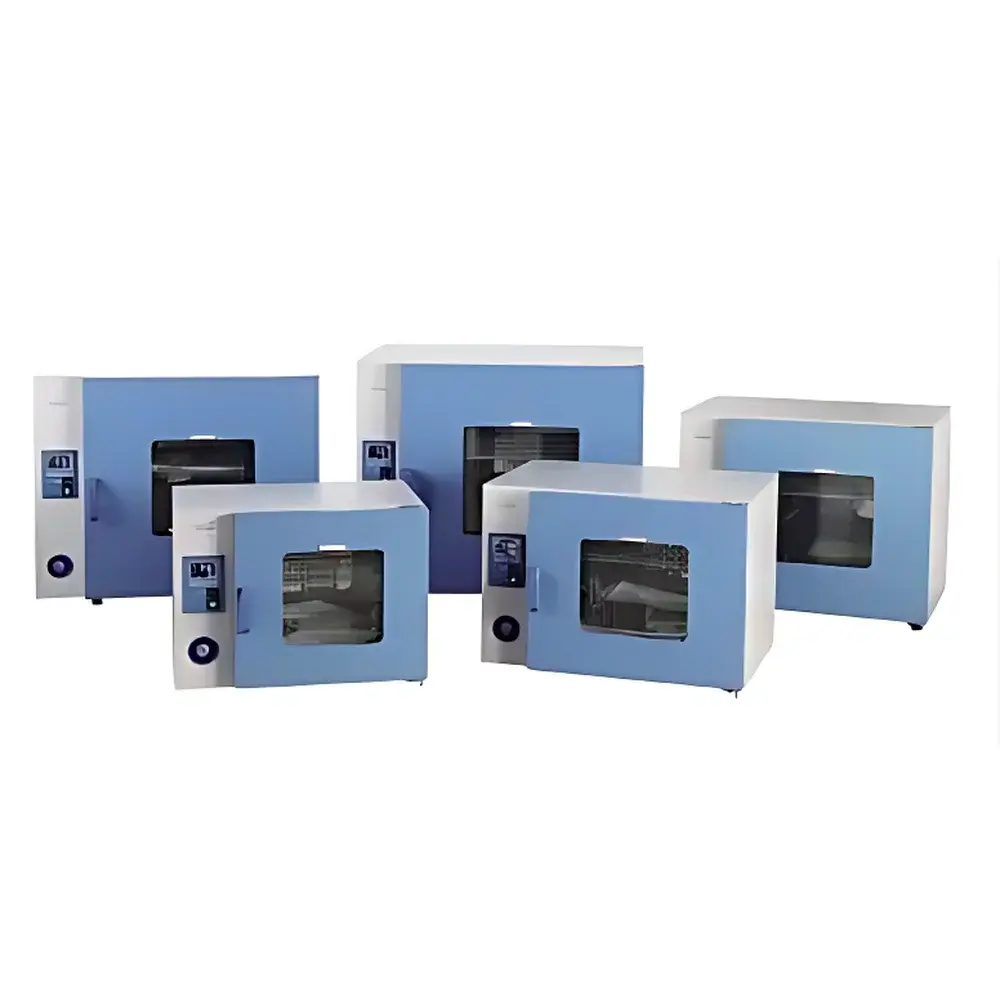
Shanghai Yiheng GRX Series Hot Air Sterilization Oven
| Brand | Shanghai Yiheng |
|---|---|
| Origin | Shanghai, China |
| Manufacturer Type | Authorized Distributor |
| Product Category | Domestic (China-Made) |
| Model Series | GRX Series |
| Instrument Type | High-Temperature Forced-Air Oven |
| Temperature Range | RT+10°C to 200°C / RT+10°C to 250°C |
| Temperature Uniformity | ±1°C |
| Heating Method | Forced Convection with Adjustable Fan Speed |
Overview
The Shanghai Yiheng GRX Series Hot Air Sterilization Oven is a precision-engineered forced-convection drying and dry-heat sterilization system designed for laboratory, pharmaceutical, and quality control environments. It operates on the principle of dry-heat microbial inactivation—leveraging elevated temperatures to induce irreversible oxidative damage to cellular components, denature essential proteins, and disrupt membrane integrity through electrolyte concentration effects. Unlike moist-heat methods (e.g., autoclaving), dry-heat sterilization requires higher temperatures and longer exposure times but is uniquely suitable for heat-stable, moisture-sensitive, or non-porous materials such as glassware, metal instruments, powders, and anhydrous reagents. The GRX series is validated for sterilization cycles compliant with ISO 17665-1 (dry-heat sterilization process validation) and supports routine depyrogenation applications per USP when operated at ≥250°C for ≥45 minutes.
Key Features
- Microprocessor-controlled digital temperature regulation with 0.1°C resolution and ±1°C uniformity across the working chamber—ensuring repeatable thermal profiles critical for GLP/GMP-aligned workflows.
- Three-speed adjustable axial fan system enables precise control over airflow velocity, optimizing heat transfer efficiency for heterogeneous load configurations and minimizing thermal gradients during extended sterilization cycles.
- Dual safety architecture: independent mechanical overtemperature cut-off (non-resettable) plus electronic temperature limiter—fully compliant with IEC 61010-1 safety requirements for laboratory electrical equipment.
- Removable, stainless-steel interior chamber with smooth-welded corners and seamless construction facilitates rapid cleaning and residue-free maintenance—critical for cross-contamination prevention in regulated labs.
- Programmable timer (0–5999 minutes) with audible end-cycle alert and automatic power cutoff ensures unattended operation without risk of thermal degradation or energy waste.
- Modular shelving design: standard two-piece adjustable stainless-steel trays with reinforced support brackets; optional third shelf available for enhanced volumetric utilization.
Sample Compatibility & Compliance
The GRX series accommodates a broad range of sample types including borosilicate glassware, stainless-steel surgical tools, ceramic crucibles, filter membranes, lyophilized powder containers, and calibration standards. Its uniform forced-air distribution meets ASTM E2850–22 criteria for temperature uniformity mapping in convection ovens. Units are CE-marked and conform to EN 61000-6-3 (EMC emission) and EN 61000-6-2 (immunity). For pharmaceutical applications, the oven supports 21 CFR Part 11-compliant data logging when integrated with validated external temperature monitoring systems (e.g., calibrated thermocouple arrays + time-stamped acquisition software).
Software & Data Management
While the GRX series features a standalone microcontroller interface (no embedded PC or proprietary software), it is fully compatible with third-party validation and data acquisition platforms. Users may connect calibrated Class A PT100 probes to external dataloggers (e.g., Omega OM-DAQPRO, Testo 176 T4) for IQ/OQ/PQ documentation. All temperature setpoints, dwell times, and fan speed selections are retained in non-volatile memory following power loss. Audit trails—including operator ID (via manual logbook integration), cycle start/stop timestamps, and deviation alerts—are required for FDA audit readiness and may be maintained using LIMS-integrated electronic lab notebooks (ELN).
Applications
- Routine sterilization of reusable labware prior to aseptic processing in microbiology and cell culture facilities.
- Depyrogenation of glass vials and ampoules in parenteral manufacturing environments (validated at 250°C for ≥45 min).
- Moisture removal from hygroscopic chemicals, polymers, and ceramic precursors prior to gravimetric analysis or thermal characterization.
- Accelerated aging studies per ISO 11607-1 for packaging material stability assessment under controlled thermal stress.
- Drying of filter papers, TLC plates, and HPLC sample vials without solvent residue carryover.
- Pre-heating of metal fixtures and calibration standards to minimize thermal drift during metrology procedures.
FAQ
What is the maximum validated sterilization temperature for GRX-series ovens?
The GRX-A variants support continuous operation up to 250°C, meeting USP depyrogenation thresholds when validated with thermally resistant biological indicators (e.g., Geobacillus stearothermophilus spores on stainless-steel carriers).
Can the GRX oven be used for moisture content determination per AOAC or ISO 5555?
Yes—when paired with a certified analytical balance and operated at 105°C ±2°C for specified durations, it satisfies gravimetric moisture loss protocols for food, feed, and soil samples.
Is fan speed adjustment required for all applications?
Fan speed selection depends on load density and thermal mass: low speed for delicate glassware, medium for standard labware, high for rapid equilibration of dense metal loads.
Does the GRX series support remote monitoring or Ethernet connectivity?
No native network interface is provided; however, analog voltage outputs (0–5 V) for temperature feedback are available on select distributor-configured units for integration into building management systems (BMS).
How often should temperature uniformity mapping be performed?
Per ISO/IEC 17025 and EU GMP Annex 15, initial qualification requires 3-point mapping; requalification is recommended semiannually or after major maintenance, relocation, or process change.



