
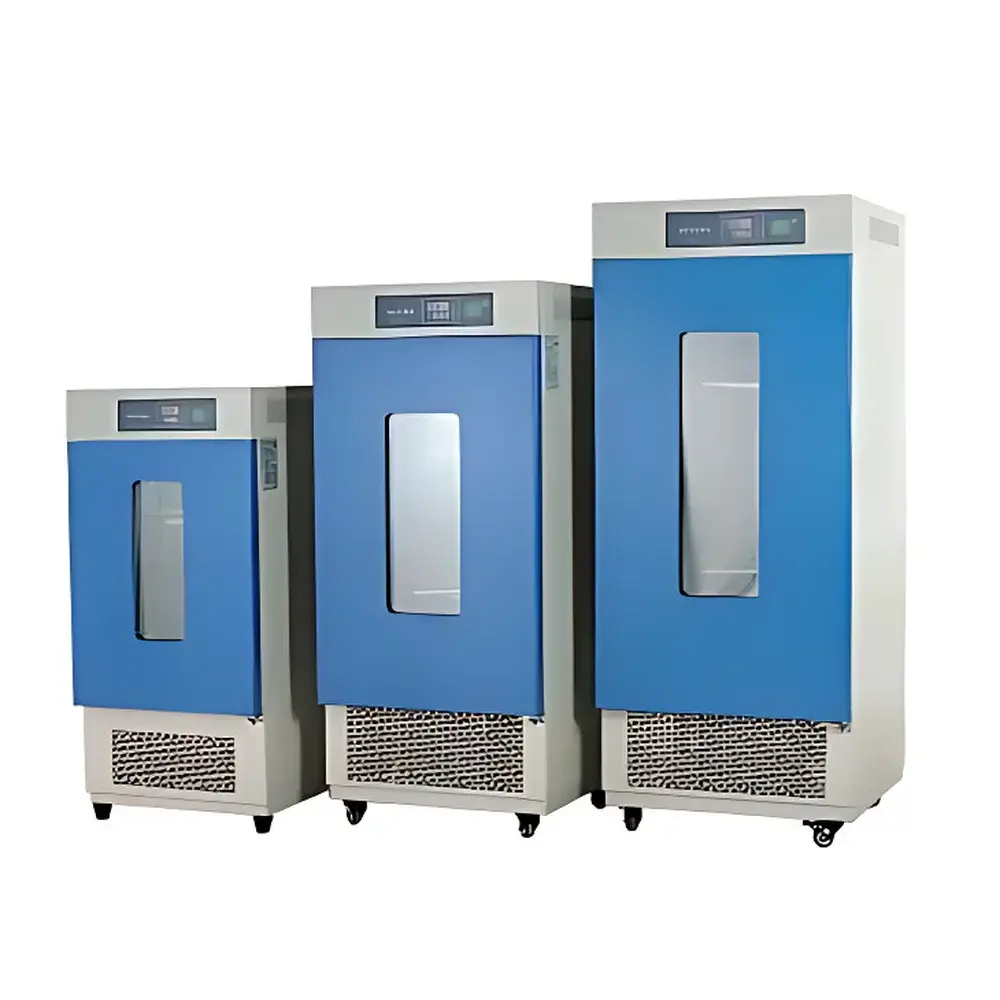
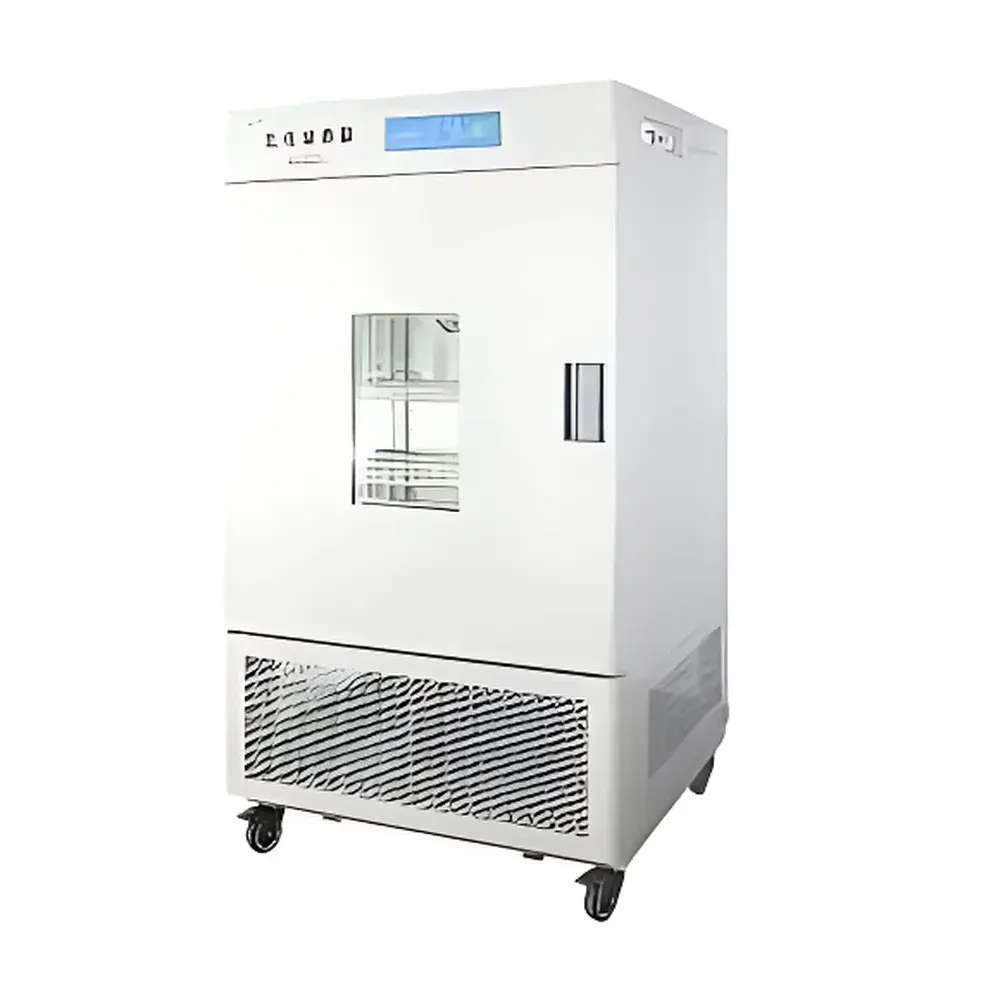
Shanghai Yiheng LRH-Series Biochemical Incubators (LRH-70F / LRH-150F / LRH-250F / LRH-500F)
| Brand | Shanghai Yiheng |
|---|---|
| Origin | Shanghai, China |
| Model Variants | LRH-70F / LRH-150F / LRH-250F / LRH-500F |
| Temperature Range | 0–60 °C |
| Temperature Resolution | 0.1 °C |
| Temperature Uniformity | ±1.5 °C (at 25 °C, for models ≤250 L) / ±2.5 °C (at 25 °C, for LRH-500F) |
| Temperature Fluctuation | ±0.5 °C (high-temp setpoints) / ±1.0 °C (low-temp setpoints) |
| Refrigerant | R134a |
| Power Input | 450–2100 W |
| Internal Dimensions (W×D×H, mm) | 400×350×500 to 670×720×1020 |
| External Dimensions (W×D×H, mm) | 530×560×1080 to 850×1100×1930 |
| Standard Shelving | 2–3 adjustable stainless-steel shelves |
| Timer Range | 0–9999 min |
| Display | LCD (F-series) or LED digital (non-F) |
| Optional | RS485 interface, thermal printer output, independent over-temperature alarm |
Overview
The Shanghai Yiheng LRH-Series Biochemical Incubators are precision-engineered environmental control systems designed for stable, reproducible temperature regulation in life science laboratories. These units operate on a forced-air convection principle with microprocessor-controlled refrigeration and heating circuits, enabling accurate thermal management across a broad operational range of 0–60 °C. The system integrates an eco-friendly R134a refrigerant and a high-efficiency international-brand compressor—engineered to reduce energy consumption by up to 30% relative to legacy designs while extending service life and lowering acoustic emissions (<55 dB[A] at 1 m). Unlike passive or natural-convection incubators, the LRH series employs a three-speed adjustable axial fan to ensure uniform air distribution without inducing excessive sample desiccation—a critical requirement for long-term microbial culture, BOD assays, and plant tissue maintenance.
Key Features
- Mirror-polished stainless-steel interior chamber with radius-rounded corners (≥R15) for seamless cleaning and contamination control per ISO 14644-1 Class 7 cleanroom-compatible protocols.
- Microcomputer-based PID temperature controller with 0.1 °C resolution, real-time deviation compensation, and programmable timer (0–9999 minutes), supporting unattended overnight or multi-day operation.
- Triple-stage fan speed adjustment allows users to optimize airflow velocity based on sample sensitivity—critical for volatile media, low-volume cultures, or agar-based plates.
- Independent mechanical over-temperature cutoff circuit (optional) provides hardware-level fail-safe protection, interrupting power to heating elements if the primary controller exceeds user-defined limits—compliant with IEC 61010-1 safety requirements.
- F-series models feature backlit LCD touch-interface with intuitive menu navigation, real-time parameter logging, and dual-language support (English/Chinese); non-F variants use robust LED numeric displays.
- Standard RS485 serial interface (Modbus RTU protocol) enables integration into centralized lab monitoring networks; optional thermal printer module supports GLP-compliant hard-copy record generation for audit trails.
Sample Compatibility & Compliance
The LRH incubators accommodate standard microbiological and botanical workflows—including bacterial/fungal cultivation (e.g., E. coli, Saccharomyces cerevisiae, Aspergillus niger), BOD5 testing per ASTM D5210 and ISO 5815-1, algal growth studies, seed germination trials, and short-term cell line storage. Chamber dimensions support common vessel formats: 100–250 mL Erlenmeyer flasks, Petri dishes (90–150 mm), multi-well plates, and glass culture tubes. All models meet GB/T 17288–2021 (Chinese national standard for biochemical incubators) and conform to electromagnetic compatibility (EMC) requirements per EN 61326-1. While humidity control is not integrated, the sealed chamber design minimizes ambient moisture exchange—making these units suitable for low-humidity stability testing when paired with external hygrometric monitoring.
Software & Data Management
Equipped with embedded firmware supporting Modbus RTU over RS485, the LRH-F series allows bidirectional communication with third-party SCADA or LIMS platforms (e.g., LabWare, Thermo Fisher SampleManager). Logged data includes timestamped temperature readings, setpoint history, fan speed status, and alarm events—with internal memory retaining ≥30 days of 1-minute interval records. Optional thermal printers produce time-stamped, tamper-evident logs compliant with FDA 21 CFR Part 11 Annex 11 principles when configured with user authentication and electronic signature capability. Audit trail functionality meets GLP/GMP documentation expectations for QC/QA departments in pharmaceutical, food safety, and clinical research settings.
Applications
- Environmental monitoring labs performing wastewater BOD5 analysis and aquatic toxicity screening.
- Pharmaceutical quality control units conducting microbial limit tests (USP ) and sterility method validation.
- Agricultural research institutes maintaining fungal cultures for biocontrol agent development.
- University teaching labs supporting undergraduate microbiology, molecular biology, and plant physiology curricula.
- Public health agencies executing pathogen isolation protocols (e.g., Salmonella, Legionella) under CLIA- or ISO/IEC 17025-accredited conditions.
- Biotech startups requiring cost-effective, CE-marked incubation infrastructure prior to ISO 13485 certification.
FAQ
Does the LRH series support humidity control?
No—these are dry-air biochemical incubators. Humidity regulation is not implemented; however, relative humidity inside the chamber typically stabilizes between 30–60% RH depending on ambient conditions and door-opening frequency.
What is the recommended calibration interval for temperature accuracy verification?
Per ISO/IEC 17025 and manufacturer recommendations, annual calibration using NIST-traceable thermistors or PT100 probes is advised. Internal sensor drift remains within ±0.3 °C over 12 months under continuous operation.
Can the LRH-500F be installed in a standard laboratory fume hood or enclosed cabinet?
No—adequate rear and side ventilation clearance (≥100 mm) is mandatory due to condenser heat dissipation requirements. Installation in confined spaces may trigger thermal overload protection and reduce compressor lifespan.
Is the RS485 interface compatible with LabVIEW or Python-based data acquisition scripts?
Yes—Modbus RTU implementation follows standard function codes (03h/04h for read holding/input registers), enabling native integration via NI-VISA, pymodbus, or similar open-source libraries.
Are spare parts such as fan assemblies and PID controllers available globally?
Shanghai Yiheng maintains authorized distributor networks in North America, EU, and APAC regions; OEM-grade compressors, display modules, and control boards are stocked with typical lead times of 4–6 weeks.
Related Products



