
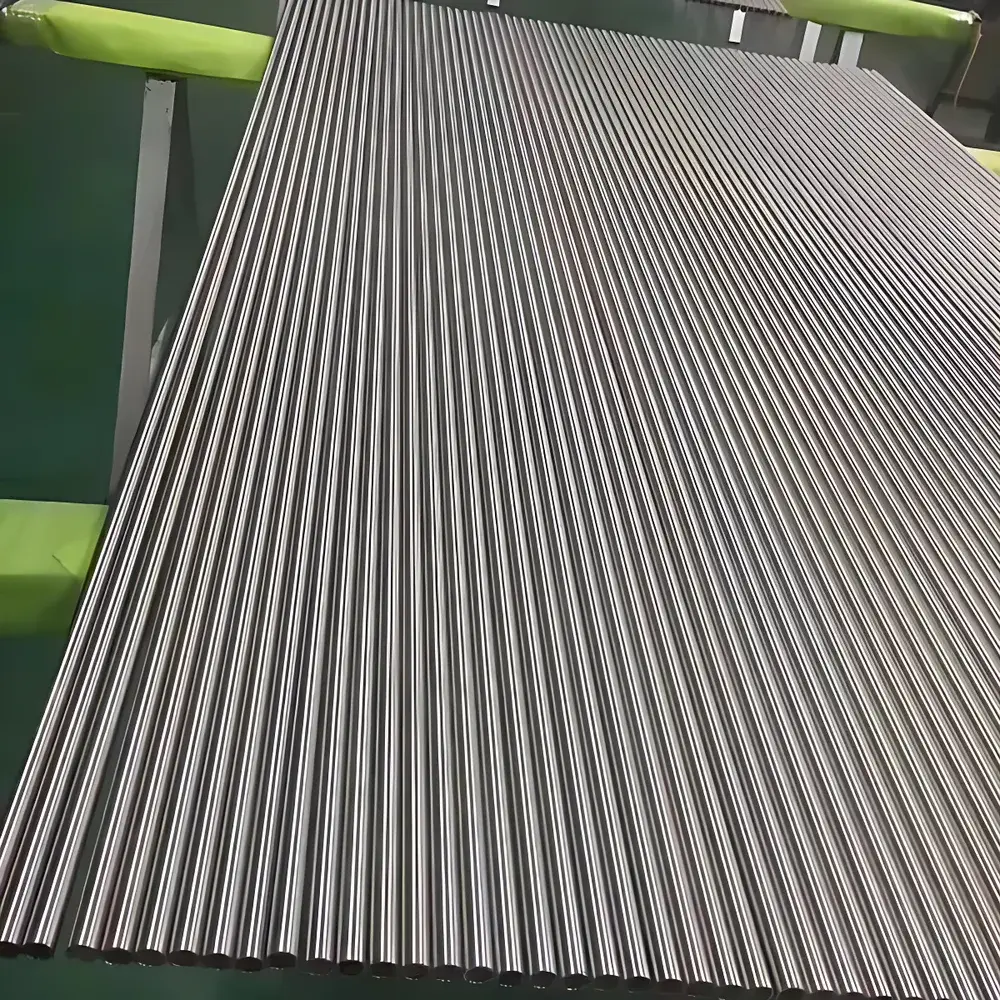
ShangHaiYousufu 316L Stainless Steel BA Tubing for Gas Chromatography Systems
| Brand | ShangHaiYousufu |
|---|---|
| Origin | Shanghai, China |
| Manufacturer Type | Authorized Distributor |
| Country of Origin | China |
| Model | 12.7 mm OD × 0.89 mm Wall Thickness |
| Tube Material | ASTM A269/A270 Grade 316L Stainless Steel |
| Surface Finish | Bright Annealed (BA) |
| Outer Diameter Tolerance | ±0.02 mm |
| Outer Surface Roughness | Ra ≤ 0.4 µm |
| Compliance Standards | GB/T 12771, ASTM A269, ASTM A270, JIS G3446, DIN 17456 |
| Packaging | Non-woven Fabric Wrapped, Sealed in Plastic Caps |
Overview
ShangHaiYousufu 316L stainless steel BA tubing is engineered specifically for high-integrity fluidic pathways in analytical instrumentation—particularly gas chromatography (GC) systems requiring ultra-high purity and inert transport of carrier and sample gases. Constructed from low-carbon, molybdenum-enhanced 316L stainless steel, this tubing exhibits superior resistance to chloride-induced pitting and stress corrosion cracking compared to standard 304 or 316 grades. The bright annealed (BA) surface finish is achieved through controlled atmosphere heat treatment followed by precision polishing, eliminating scale, oxides, and embedded contaminants while preserving dimensional stability and surface passivity. Unlike electropolished tubing—which may introduce micro-roughness or residual electrolyte residues—BA tubing delivers consistent, reproducible surface chemistry ideal for trace-level analysis of high-purity gases (e.g., electronic-grade N₂, Ar, He, H₂, and specialty gas mixtures). Its use aligns with ISO 8573-1 Class 1 particulate and hydrocarbon specifications for GC carrier gas lines and is routinely specified in applications governed by USP <661>, ASTM E2652, and ICH Q5C for pharmaceutical process gas distribution.
Key Features
- Material compliance: Fully traceable 316L per ASTM A269/A270 with certified mill test reports (MTRs) including chemical composition, mechanical properties, and intergranular corrosion test results (ASTM A262 Practice E)
- Precision dimensional control: Outer diameter tolerance maintained within ±0.02 mm; wall thickness uniformity validated via ultrasonic wall measurement
- Surface integrity: Bright-annealed finish with Ra ≤ 0.4 µm, verified by profilometry; no post-annealing mechanical polishing or acid pickling that could compromise passive layer continuity
- Leak-tight compatibility: Optimized for VCR® and Swagelok® compression fittings; validated helium leak rate <1×10⁻⁹ mbar·L/s per joint under 1000 psi pressure
- Thermal stability: Maintains structural integrity and surface passivation across GC oven temperature ranges (−40 °C to +150 °C), supporting rapid thermal cycling without microcrack formation
- Regulatory readiness: Suitable for installation in GMP-compliant laboratories; supports audit requirements for material traceability, surface cleanliness validation (water-break test per ASTM F312), and documented heat lot control
Sample Compatibility & Compliance
This tubing is validated for continuous service with inert and reactive carrier gases (He, H₂, N₂, Ar, CO₂, synthetic air) and sample streams containing volatile organic compounds (VOCs), sulfur compounds (e.g., H₂S, SO₂), halogenated species, and moisture-saturated matrices. It meets the material compatibility criteria defined in ASTM D7590 for GC column inlet lines and complies with ISO/IEC 17025 clause 5.5.2 for certified reference material transport. All production lots undergo mandatory helium leak testing, visual inspection under 10× magnification, and non-destructive eddy current testing per ASTM E309 to detect subsurface discontinuities. Documentation includes full traceability to heat number, annealing batch, and surface finish verification report.
Software & Data Management
While the tubing itself is a passive component, its integration into chromatographic workflows requires rigorous documentation within laboratory information management systems (LIMS) and electronic lab notebooks (ELN). ShangHaiYousufu provides serialized material certificates enabling direct linkage to instrument calibration records and preventive maintenance logs. For facilities operating under FDA 21 CFR Part 11, the supplied MTRs are digitally signed and archived with timestamped audit trails. Tube installation records—including joint torque values, leak test data, and pre-use purging protocols—are structured to support GLP/GMP deviation investigations and regulatory inspections.
Applications
- Carrier gas delivery lines in online GC systems for semiconductor process gas monitoring (SEMI F57 compliant)
- Sample transfer tubing between gas sampling valves and GC injectors in environmental air quality analyzers (EPA Method TO-15, TO-17)
- Inert conduit for calibration gas standards in metrology labs accredited to ISO/IEC 17025
- High-purity gas manifolds in pharmaceutical cleanroom HVAC and nitrogen purge systems
- Reference gas distribution in hydrogen fuel cell R&D test benches requiring zero metal ion leaching
- Interconnection tubing for GC–MS and GC–FTIR hyphenated systems where background artifact suppression is critical
FAQ
Is this tubing suitable for ultra-high-purity (UHP) gas applications requiring sub-ppb contaminant limits?
Yes—its BA surface and low-carbon 316L composition minimize metallic outgassing and adsorption/desorption hysteresis, making it compatible with UHP specifications per CGA G-4.1 and SEMI F20.
Can it be used with hydrogen carrier gas at elevated temperatures and pressures?
Yes—validated for continuous operation up to 150 °C and 1000 psi; hydrogen embrittlement risk is mitigated by the stabilized 316L microstructure and absence of cold-work-induced dislocations.
Do you provide cleaning validation data (e.g., TOC, metal residue testing)?
Upon request, certified cleaning validation reports are available per ASTM D7590 Annex A1, including ICP-MS trace metal analysis and GC–MS extractables profiling.
What is the maximum recommended bending radius for field installation?
Minimum bending radius is 15× OD (i.e., ≥190 mm for 12.7 mm OD tubing); mandrel bending is recommended to prevent ovality or wall thinning.
Are custom lengths and end preparations (e.g., VCR-ready ends) available?
Yes—cut-to-length service with cleanroom-certified cutting, deburring, and VCR® ferrule assembly is offered with full particulate and moisture testing per ISO 14644-1 Class 5.
Related Products





