
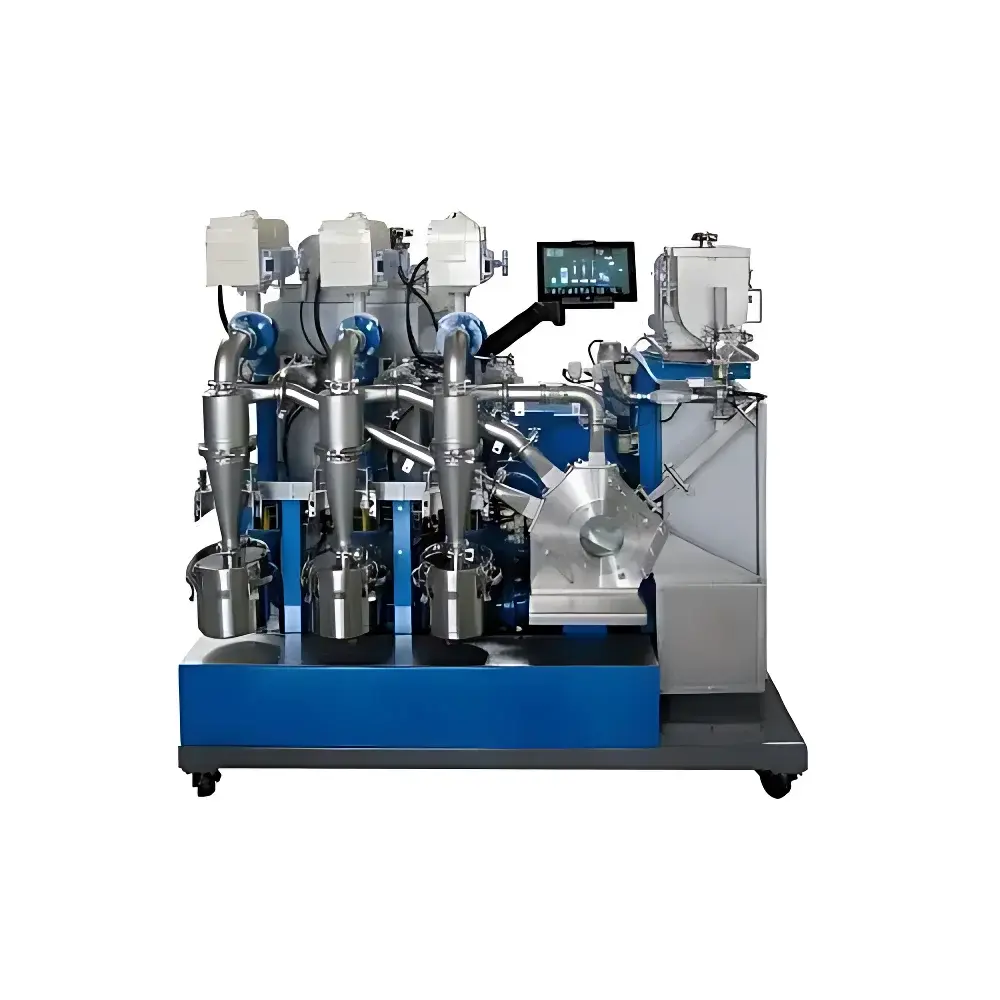
Shashin Kagaku HIPREC Air Classification System
| Brand | Shashin Kagaku |
|---|---|
| Origin | Japan |
| Manufacturer Type | Authorized Distributor |
| Product Origin | Imported |
| Model | HIPREC |
| Pricing | Available Upon Request |
| Classification Principle | Coanda-effect-based pneumatic classification |
| Number of Output Fractions | 3 |
| Particle Size Range | 3–200 µm |
| Throughput Capacity | 1–3000 kg/hr (model-dependent) |
| Airflow Rate | 2–120 m³/min (model-dependent) |
| Construction | Drive-free mechanical design |
| Material Handling Suitability | Abrasive, pyrophoric, and explosible powders |
| Standard Configuration | Wear-resistant components |
| Operation Mode | Inert-gas-compatible closed-loop system |
Overview
The Shashin Kagaku HIPREC Air Classification System is an industrial-grade, drive-free pneumatic classifier engineered for high-precision particle size separation in demanding powder processing environments. Unlike conventional rotor-based classifiers that rely on mechanically driven cutters or rotating vanes, the HIPREC leverages the Coanda effect—a fundamental fluid dynamic phenomenon wherein a jet of air adheres to and follows a curved surface—to achieve sharp, reproducible cut points across three distinct product fractions in a single pass. This principle eliminates moving parts within the classification zone, thereby removing sources of mechanical wear, vibration-induced calibration drift, and potential ignition hazards. The system is particularly suited for materials exhibiting high abrasivity (e.g., silicon carbide, alumina, metal powders), thermal sensitivity, or explosion risk (e.g., organic pigments, pharmaceutical actives, battery cathode precursors), where inert-gas purging and non-sparking architecture are essential for operational safety and regulatory compliance.
Key Features
- Drive-free classification chamber: No motors, bearings, or rotating elements inside the air stream—ensuring zero mechanical wear in the critical separation zone and eliminating maintenance downtime associated with rotor refurbishment.
- High-dispersion feed nozzle: Engineered to fully de-agglomerate incoming powder using controlled supersonic air injection, ensuring uniform particle presentation to the Coanda surface and minimizing bypass or coarse misclassification.
- Triple-fraction output configuration: Simultaneously separates feed material into fine, medium, and coarse cuts via geometrically tuned airflow bifurcation and boundary-layer control—enabling direct integration into multi-stage milling or blending workflows.
- Modular scalability: Twelve standard models (HPC-ZERO through HPC-20) cover throughput ranges from 1 to 3000 kg/hr, with corresponding airflow capacities from 2 to 120 m³/min—each validated for consistent cut-point accuracy under steady-state operation.
- Wear-resistant standard build: Critical contact surfaces—including the Coanda profile, feed nozzle throat, and fraction discharge liners—are fabricated from sintered alumina, tungsten carbide, or hardened stainless steel per ISO 14644-1 Class 7 cleanroom-compatible specifications.
- Closed-loop inert gas compatibility: Integrated purge ports, pressure-balanced isolation valves, and O₂ monitoring interfaces support seamless transition to nitrogen or argon atmospheres—fully compliant with ATEX Directive 2014/34/EU Category 2G and NFPA 652 dust hazard analysis requirements.
Sample Compatibility & Compliance
The HIPREC system is routinely deployed in GMP-regulated pharmaceutical manufacturing (e.g., micronized API grading prior to dry powder inhaler formulation), advanced battery material production (e.g., graphite anode sizing and NMC cathode fractionation), and specialty ceramics processing. Its absence of internal drives satisfies FDA 21 CFR Part 11 data integrity prerequisites when paired with validated PLC control systems. All standard configurations meet ISO 8573-1:2010 Class 2 compressed air quality requirements for particulate and oil content, and structural welds conform to ASME BPVC Section VIII Div. 1 for pressure boundary integrity. Documentation packages include Factory Acceptance Test (FAT) reports, material traceability certificates (EN 10204 3.1), and EU Declaration of Conformity for Machinery Directive 2006/42/EC.
Software & Data Management
While the base HIPREC operates via analog pneumatic control (pressure regulators, flow orifices, and manual cut-point adjustment), optional digital integration includes a Siemens S7-1500 PLC with integrated web server, enabling remote parameter monitoring (differential pressure across classification zones, inlet air temperature/humidity, O₂ concentration) and audit-trail logging compliant with 21 CFR Part 11 Annex 11. All process variables are timestamped, user-ID tagged, and stored in encrypted CSV format with SHA-256 hash verification. Optional HMI panels provide real-time visualization of cut-point stability indices derived from continuous laser diffraction sampling at each outlet (via integrated Sympatec HELOS/OASIS modules).
Applications
- Grading of lithium iron phosphate (LFP) cathode powder to isolate electrochemically active 45 µm) that induce cell shorting.
- De-dusting of spray-dried silica aerogel granules without thermal degradation—leveraging low-shear Coanda separation versus centrifugal alternatives.
- Explosive-sensitive pigment classification (e.g., copper phthalocyanine blue) under continuous nitrogen blanket, meeting OSHA 1910.109 and EN 1127-1 explosion protection standards.
- Recycling stream purification: Separation of aluminum flake from polymer matrix residues in automotive shredder residue (ASR) processing, where abrasive wear resistance extends service life beyond 12,000 operating hours.
- Pharmaceutical excipient conditioning: Narrow-band fractionation of microcrystalline cellulose (MCC) to tighten Dv50 distribution from ±12% to ±3.5%, improving tablet tensile strength reproducibility.
FAQ
Does the HIPREC require electrical power in the classification zone?
No—only the feed screw conveyor, baghouse pulse-jet cleaning system, and optional PLC/HMI require external power. The core classification mechanism is entirely pneumatic and passive.
Can HIPREC be validated for pharmaceutical use under ICH Q5A and Q5C?
Yes—Shashin Kagaku provides IQ/OQ documentation templates aligned with ASTM E2500-13 and ISPE Baseline Guide Vol. 5; PQ protocols must be executed on-site per user-defined product matrices.
What is the typical recalibration interval for cut-point accuracy?
Under stable operating conditions (constant feed rate, moisture <0.5% w/w, inlet air dew point ≤−40°C), cut-point drift remains within ±0.8 µm over 6-month intervals—verified via periodic ISO 13320-compliant laser diffraction checks.
Is third-party ATEX certification available for hazardous area installation?
Yes—ATEX-certified variants (II 2G Ex db IIB T4 Gb) are available with flameproof enclosures for Zone 1 installations; certification bodies include DEKRA, SGS, and UL Solutions.
How does HIPREC compare to cyclone-based classifiers in terms of energy efficiency?
HIPREC consumes 35–42% less specific energy (kWh/ton) than equivalent-capacity multi-stage cyclone trains due to elimination of secondary air recirculation and reduced pressure drop across the classification stage (typical ΔP = 4.2–5.8 kPa vs. 8.5–12.3 kPa).





